
You don’t need to write about your feelings every night. You need one ordinary notebook, five minutes a day, and a system boring enough to survive your busiest week.
Somewhere in your house, probably in a drawer you never open, there’s a half-used journal with a beautiful cover, cream pages, and a ribbon bookmark that still creases where you gave up in February. I’ve owned at least four of those, and I say this with affection: the problem was never you. The problem was that the notebook was asking for something most of us don’t naturally have, which is a nightly willingness to sit down after a long day and compose our inner lives in complete sentences, usually at the exact hour when we’re least able to manage it.
There’s a lower-pressure idea that keeps the notebook and simply changes the job description. Rather than asking it to be a diary, let it be the place where things land: the task you remembered in the shower, the gift idea you overheard at work, the appointment you keep almost forgetting every single time it’s due. One book, one running stream, a handful of marks, and a fifteen-minute review once a month make up the entire system, and it tends to hold up for people who’ve bounced off every journaling method they’ve tried, because it never once requires you to have anything worth saying about your day.
In this article
Why Journals Die by Week Three
Most journaling advice fails for a boring mechanical reason, at least in my experience: it sets the entry bar too high. “Reflect on your day” sounds like a five-minute job until it’s 10:40 PM, you’re tired, and the blank page is staring back. Faced with composing even three thoughtful sentences, most of us close the book and promise to make up for it tomorrow. Tomorrow becomes next month, and the notebook goes back in the drawer.
There’s also a sneakier failure mode, which I’ve come to call the fresh-start trap: the moment you miss a few days, the journal stops being a tool and becomes evidence of your inconsistency. I’ve abandoned notebooks over a four-day gap in March, because the gap felt like a debt, and the only two ways people seem to know how to clear a debt with a journal are to write a long catch-up entry, which almost never happens, or to buy a new notebook and swear this one will be different, which happens constantly. And either way, the old book loses.
The fix for both problems is the same move, and it’s almost disappointingly simple: lower the entry cost to one line, and never start over. If the only requirement is that today’s date appears somewhere on the page, you can meet that requirement while the coffee brews, maybe thirty seconds of work, and if yesterday is blank, nothing happens and no alarm goes off. The gap just sits there, and you’re not behind, because there’s nothing to be behind on.
A notebook you’ll actually use is one that forgives you on the days you have nothing to give it.
The Notebook Itself (Boring Is a Feature)
Spend less than you’d think, and skip anything that feels precious.
This system has exactly one hardware rule, and the rule is that the notebook must not be special. Not the leather-bound one you saved for, and not the $40 journal that makes you want to write beautifully in it. You want the paper equivalent of a utility knife, something you’d never hesitate to scuff, because hesitation is where systems go to die. For most people, a plain dot-grid or lined notebook in the $10–15 range is the sweet spot, and brands like Leuchtturm1917, the German maker whose name is literally its founding year, built their reputation on exactly this kind of unglamorous workhorse, with paper that takes ink well, pages that lie flat, and a back pocket for the receipts of life.
| Notebook style | Best if you… | Watch out for |
|---|---|---|
| Dot-grid, ~A5 (5.8×8.3 in) | Want structure without lines telling you how big to write; the default pick for this system | Tiny dots can be faint on cheaper paper. Check in person if you can |
| Lined, ~A5 | Just want to write fast and straight without thinking about layout | Lines fight with sketches and quick diagrams, which this system uses a lot |
| Softcover pocket size | Want it to live in a jacket or bag and be truly always on you | Fills up two or three times faster. The monthly index gets cramped |
| Hardcover A5 | Write at a desk and like a firm surface under the page | Bulkier to carry, which quietly lowers the odds it’s nearby when you need it |
| Anything “special” | — | Precious notebooks get precious treatment. Skip them for daily work. |
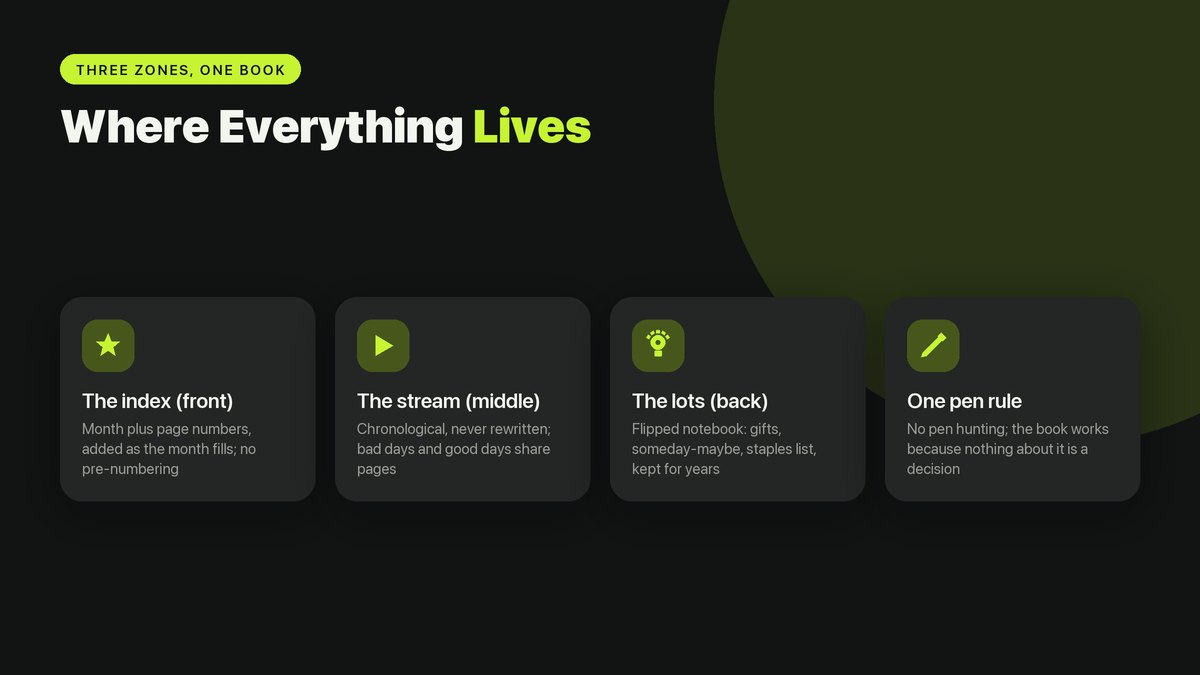
There’s one more rule, and I mean this literally: one pen. Pick a pen you like, keep it clipped to the notebook or tucked into the elastic band, and never negotiate with yourself about writing implements at the moment of capture. Pen-hunting sounds trivial, but it’s a decision, and every decision between you and the page is a place the habit can leak out. Mine is a cheap retractable gel pen with a satisfying click, the kind you can replace for a couple of dollars when it runs dry. Yours can be a pencil, because the brand and the price don’t matter, at least not for the system’s purposes.
The Daily Page, or Date It, Dump It, Done
Every day gets one page, and every page starts the same way, with today’s date at the top, written before anything else. That date line is the entire ceremony. After the date, you dump whatever is currently loaded in your head, not in sentences and not in any particular order. A Tuesday-morning dump might look something like the mess below.
- Call dentist — the six-month reminder email finally arrived
- Thu 7 PM — dinner with Priya, don’t forget the casserole dish
- idea — ask landlord about the hallway light before it gets worse
- olive oil, rice, more of those decent tortillas
- weird dream, something about a ferry, probably nothing
Two of those lines matter; the rest is brain lint, and brain lint is allowed. The dump’s real job is to get the open loops out of your head and onto paper, where they stop charging you rent, at least until the monthly review. David Allen built an entire productivity method around this observation back in 2001 with his book Getting Things Done, and if that name rings a bell, yes, this is the same capture instinct wearing a much smaller outfit.
Once the dump exists, you add two marks. A small dot goes in front of anything that’s an open task, and a circle goes in front of anything that’s an event with a time attached, while everything else stays as plain ink. Those two marks are the system’s entire grammar, and they do more work than they look like: the dot means “this needs a decision from me later,” and the circle means “this will happen whether I decide anything or not.” When you finish a dotted task, you cross it out with one horizontal line, so you can still read what it said later, and there’s a small satisfaction in a crossed-out row that a deleted notification has never once reproduced.
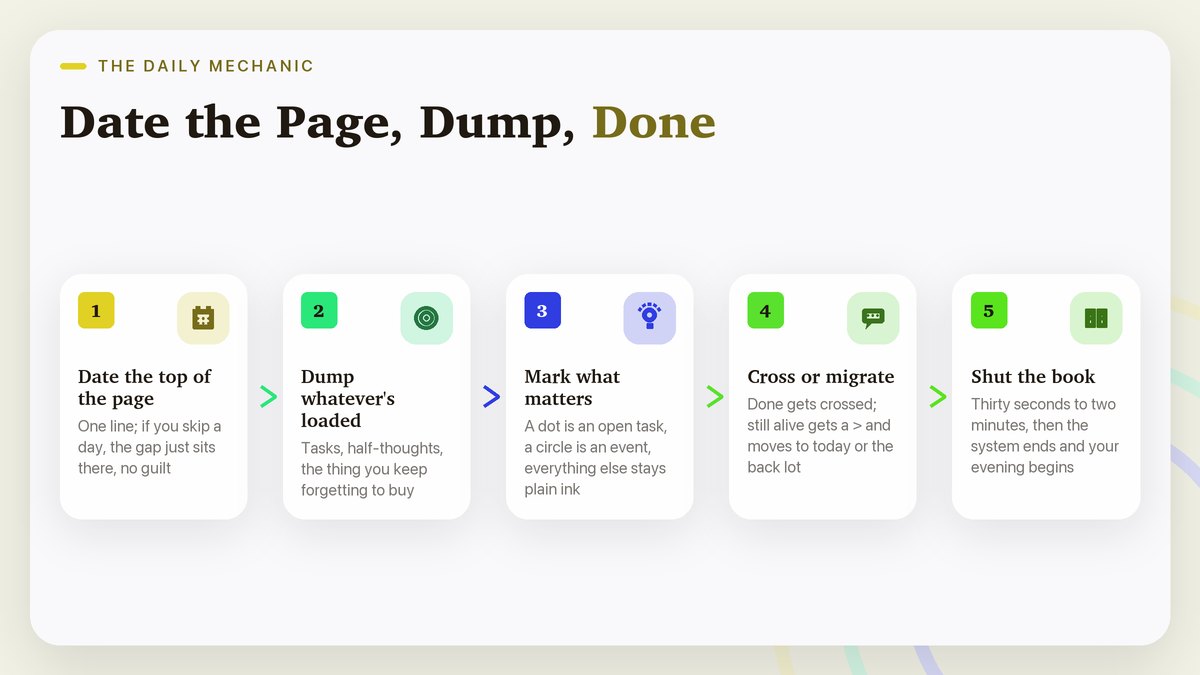
The last move of the day is migration. Anything with a dot that you didn’t finish gets a small > sign, and you rewrite it on today’s new page if it’s still alive, or on one of the back lists if it’s a someday thing. This is borrowed almost directly from the Bullet Journal method that designer Ryder Carroll began sharing online around 2013, whose rapid-logging and signifier ideas this system steals shamelessly and then shrinks to fit people who will never maintain an index of collections. The migration step matters more than it looks, because rewriting a task by hand is a tiny cost, and that cost works as a filter. If you catch yourself migrating “organize garage” for the sixth consecutive month, the annoyance of writing it again tends to become the push you needed to either schedule it or admit you’re never doing it and let it go.
Three Zones, One Book
Flip your notebook open and it has three zones, divided the way books naturally divide, with no setup page and no legend on the inside cover for you to forget the meaning of by Tuesday. The zones are less a design decision than a set of habits about where you write, which means there’s nothing to set up and nothing to rebuild if you fall off for a week.
The front is the index, and it stays nearly empty for a while, because you’ll build it in the monthly reset, one month per line with the page numbers that month covered. The middle, which is most of the book, holds the stream: the dated daily pages in the order they happened, never rearranged and never rewritten, a messy Tuesday and a triumphant Wednesday getting exactly the same treatment, which is to say both just get to exist. The back of the book, approached from the last page and working inward, holds the parking lots, meaning the lists with no expiration date: gift ideas, the books people keep recommending, the grocery staples you rebuy, the things you’d fix in the house if you ever had a free weekend. When a back list fills its page, the next one starts on the page before it, and the old one stays forever.
Why one book instead of a task app, a notes app, and a diary? Partly it’s the physics, since one object has one location and “where did I write that” stops being a question with three possible answers. Mostly, though, it’s that the stream ends up being worth more than the sum of its lists. Six months in, you can flip back through March in ninety seconds and see what you were actually doing, which projects were eating your evenings, and how many times “call dentist” appears before it finally got crossed out. That backward-looking view is the thing journaling promises and almost never delivers, and here it shows up as a side effect of a system you were running anyway.
The Monthly Reset Takes Fifteen Minutes
Set a phone reminder for the 1st, recurring, forever. That single alarm does half the maintenance.
Once a month, roughly, you sit down with the notebook for fifteen minutes. I say “on the first” because a fixed date beats a flexible intention every time, though the realistic version of this system says to reset whenever you notice a new month has started, which is exactly why the recurring reminder matters. Set it once in whatever calendar app you already use, and noticing stops being required.
The reset has four moves. First, you flip back through the month that just ended, skimming for open dots and circled events. Then you add one line to the front index, the month plus the page numbers it spanned. After that, you take every open task that survived the month and give it a verdict: migrate it forward, or kill it, and killing is more underrated than it sounds. A task that’s survived three migrations without action is information about your actual priorities, and the right response to that information is usually a line through it and a small sense of relief. Finally, you write the new month’s first date line, and you’re done until next month.

That index line deserves more credit than it gets, because it’s the difference between an archive and a pile, between being able to put your finger on any afternoon from the last two years and having to reread whole months to find one forgotten line. Two years of daily pages with no index is a haystack; two years with twelve lines at the front is a filing system you can search with your thumb. This is the one piece of the Bullet Journal tradition worth keeping even if you ignore everything else, and it takes maybe five minutes of the fifteen.
What to Write When There’s Nothing to Write
The daily dump works best on busy days, when there’s plenty to unload. On quiet ones, the page can feel awkwardly empty, and this is the moment most journal systems lean on prompts like “what are you grateful for?” If that works for you, keep it, no judgment here. But for the prompt-averse, there are lower-pressure entries that still pay off later, usually when you’re flipping back months from now.
- The carryover check. Glance at yesterday’s open dots. Anything still alive gets rewritten today. Thirty seconds, and the page has already earned its keep.
- One concrete thing. Not “good day.” More like “the plumber came, it’s fixed, $140.” Future-you will be astonished how useful these flat little facts are.
- The nagging thing. Whatever has been circling your head for a week, write it down in plain words. Half the time the act of writing it resolves it; you can see, in ink, that it’s either trivial or actionable.
- Notes from something you consumed. A line from a podcast, a recipe tweak, a quote from the novel on your nightstand. It doesn’t need commentary.
If you want structure for the note-taking side of all this, Cornell’s Learning Strategies Center publishes some of the most sensible, hype-free note-taking guidance anywhere; their overview of study strategies is a good place to start, and the core habit they teach, paraphrasing ideas in your own words rather than transcribing, transfers directly to these pages. A page of your own rough shorthand beats a perfect transcription you never look at again, at least if the research on note-taking is anything to go by.
Why Pen and Paper Still Win at This
It would be reasonable to ask why any of this needs to be analog, since your phone already has a notes app, a reminders app, and a calendar, and all three sync everywhere. The fair question deserves a fair answer: those tools are excellent at holding information and oddly bad at getting you to put it in.
There’s also a cognitive argument, and it’s stronger than the usual romantic hand-waving about stationery. In a widely cited 2014 study published in Psychological Science, Pam Mueller, then a Princeton graduate student, and Daniel Oppenheimer of UCLA found that students who took notes by laptop tended to transcribe lectures nearly verbatim, while students writing by hand were forced to condense and rephrase, and the hand-writers consistently outperformed the typists on conceptual questions afterward. NPR’s write-up of the research lays out the setup and the results in plain terms. The notebook system’s daily dump works the same way, because ink is slow, and the slowness itself is the filter.
The other advantage is the absence of everything else, because a paper page has no notifications on it, no badge counts, and no adjacent app your thumb already knows how to open. When you pick up the notebook to write “buy rice,” rice is what gets written, since rice is all that’s there. That sounds like a small thing until you count how many times a day your phone errands end somewhere other than where they started, which for most of us is more often than we’d like to admit.
Your notebook never interrupts you. That’s not nostalgia. That’s the whole feature.
Making It Stick Past the Honeymoon
When this system collapses, it tends to do so in predictable ways. The most common failure is the decorative upgrade: two weeks in, you watch a video of someone’s elaborate journal spreads and decide your plain pages need washi tape. My advice is to resist this, because decoration is a hobby, which is a fine hobby, but it’s a different hobby, and mixing it into a capture system raises the entry cost back to exactly the height where journals go to die. Your pages are allowed to be ugly; mine are, routinely, and the system doesn’t care either way.
Failure number two is buying a second notebook for a second context, one for work and one for home. This reads as organization and functions as a leak, because the whole point is that everything has one home. When work stuff is written in the same stream as grocery lists, neither pollutes the other, and you carry one object instead of two.
Then there’s the third failure, treating a missed week as a system failure. You will miss a week, possibly several, and the notebook doesn’t care, and neither should you. Just open it, date today’s page, and the system resumes mid-stride with no catch-up entries required. This is the single biggest structural advantage it has over every diary format, because there is no such thing as behind.
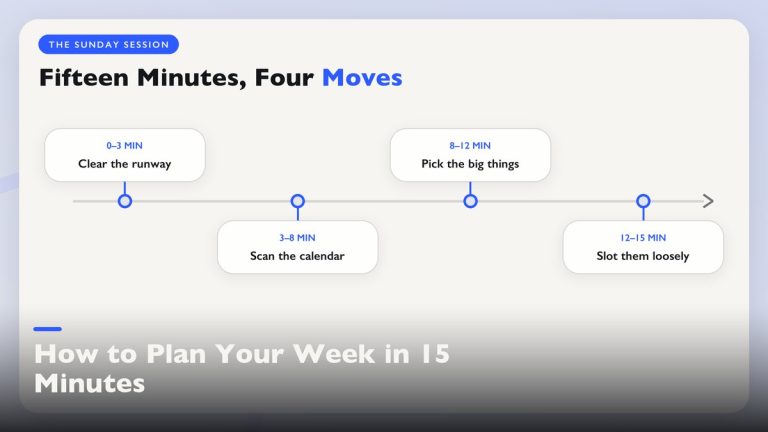
Finally, anchor the dump to something that already happens: the morning coffee, the lunch you eat alone, or the first five minutes after the kids’ bedtime. If you’ve already got a weekly planning habit, this notebook slots in as its paper counterpart, the place where the week’s loose ends actually live day to day. And if you don’t have that habit yet, this is the lower-effort place to start, since a week planned on paper tends to want a week planned, and the fifteen-minute Sunday session described in our guide to planning your week in 15 minutes is the natural next layer once the daily dump feels automatic.
Buy the boring notebook this week, date the first page the day it arrives, and tomorrow morning, before the coffee’s even done, write the date and dump whatever’s loaded. That’s day one of a system you might still be running in five years, mostly because it never once asked you to be the kind of person who journals.
Related reads on this site: How to Plan Your Week in 15 Minutes · The 2-Minute Rule and Other Simple Productivity Tricks That Work · Digital Declutter: Organizing Your Phone in Under an Hour. External references: Bullet Journal · Getting Things Done · Cornell Learning Strategies Center · NPR on the Mueller & Oppenheimer note-taking study · Leuchtturm1917.