A small kitchen doesn’t need more square footage. It needs fewer decisions, smarter zones, and a habit or two that keep the counters clear when life gets busy.
My first city apartment came with eight feet of counter, one drawer that stuck, and a fridge you could hear humming from the couch, and I fought it for a full year with the usual weapons, stackable bins, a rolling cart I kept bruising my hip on, and one of those over-the-sink cutting boards. The kitchen got more crowded rather than more useful, because every fix I bought assumed the problem was volume when it was really placement. What actually fixed it was boring in the best way. I stopped asking where things should go in an ideal kitchen and started watching where my hands went in mine. The answers were consistent within a week. The kettle always ended up by the window, the cutting board lived on top of the microwave, and the spatula I reached for daily sat buried in a drawer with nine other spatulas. Small kitchens don’t punish you for lack of space; they punish you for organizing in your head instead of on the ground. The punishment shows up as a thousand small annoyances every week that you only notice once they finally stop.
That observation is the premise of this whole guide. Nothing here needs a renovation, a landlord’s permission, or a single trip to a specialty store. Some of it does ask you to get rid of things, which is the part everyone resists, and I’ll get to it gently. By the end you’ll have a working map of your own kitchen: five zones, one vertical ladder, a gadget drawer on a diet, and a ten-minute reset that keeps the whole machine from gumming up. Call it an afternoon’s work, less if you don’t stop to wipe every shelf twice, and you can split it across two evenings without losing anything.
In this article
Start With Zones, Not Storage
Most small-kitchen advice begins with containers, bins, racks, the lazy Susan, when containers are actually the last step. The first step is deciding what really happens in your kitchen. A kitchen that works is one where everything a task needs sits within a single step of where the task happens, and no bin on earth can fix one whose tools live on the wrong side of the room.
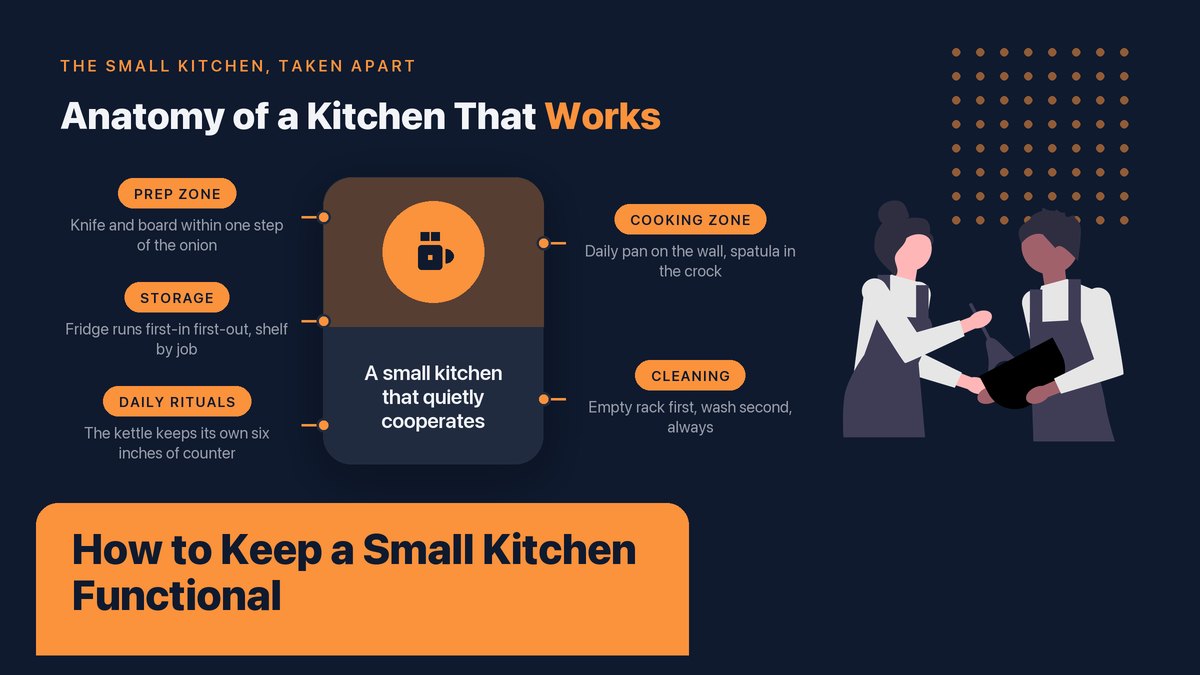
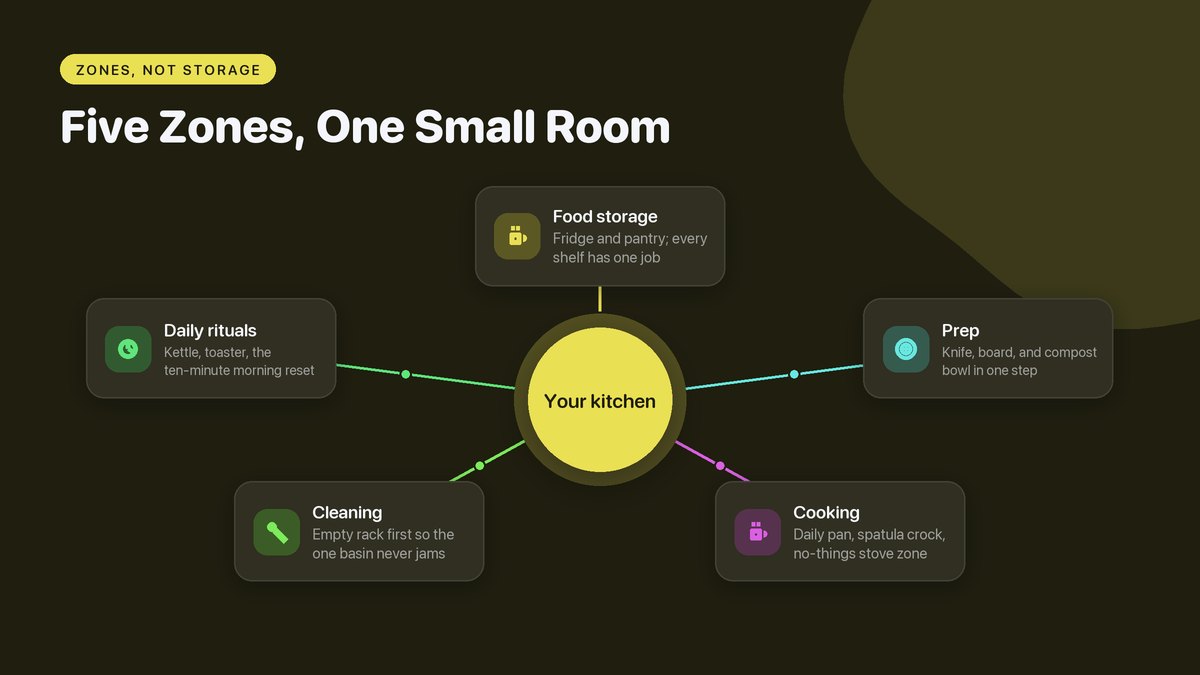
Walk through a normal week of cooking and the same five activities keep showing up. There’s storing food, prepping it, cooking it, cleaning up afterward, and the small daily rituals around the edges, coffee and toast chief among them. Those five activities are your zones, whatever the size of the kitchen. Big kitchens give each zone its own counter, while small ones make zones share, which usually works fine as long as each zone’s tools live at its station rather than scattered wherever they happened to fit. Try the onion test tonight. Stand where you’d chop an onion and notice everything your hand reaches for over the next two minutes, the knife, the board, the compost bowl. All of it should be within one step, and if any single piece lives farther away than that, moving it is tomorrow’s first fix.
Zone thinking also kills the junk-drawer problem at its root. A tool that belongs to no particular zone drifts toward whichever drawer had space that day, and a tool without a zone ends up being clutter with a handle attached.
A Quick Zone Audit You Can Do Tonight
Don’t reorganize anything yet; just cook one ordinary meal and pay attention. Count the times you crossed the kitchen for something, the drawer you opened twice hunting the same tool, the counter corner where dirty dishes pile up because the sink feels two steps too far away. Those observations tell you more about your kitchen’s real layout than any floor plan ever will, and each one is a one-item fix. The compost bowl moves to the prep counter, the daily spatula gets promoted to the crock by the stove. Tiny adjustments, maybe ninety seconds each, though they compound fast over a month of weeknight dinners.
The Vertical Ladder
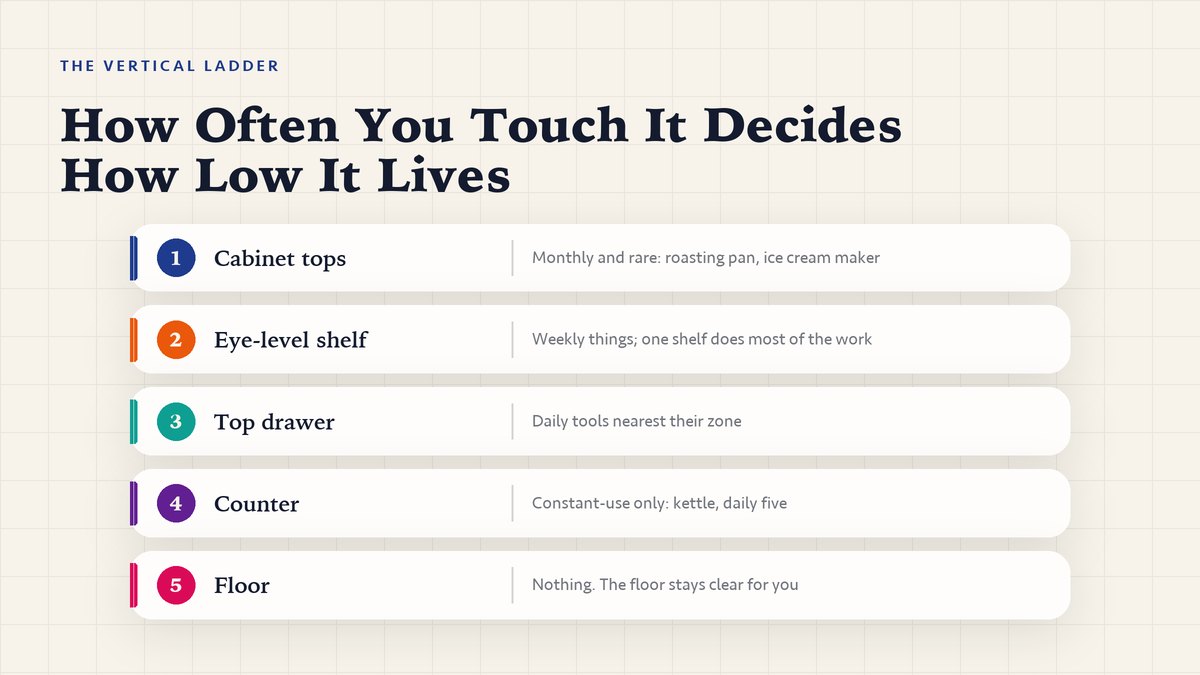
Floor space is the scarcest thing in a small kitchen, and almost nobody uses the other dimension properly. Between the tops of your cabinets and the ceiling there’s usually five to seven feet of empty air. Then there are the door backs, the side of the fridge, and the wall above the counter, and all of it just sits there while the counters drown. Treat that space as a ladder, with each thing placed on the rung that matches how often you touch it.
Daily items get the counter or the top drawer nearest their zone. Weekly items go in the cabinet at eye level (in most small kitchens one shelf ends up doing most of the actual work), and monthly or occasional things climb higher. The roasting pan, the ice cream maker, the twelve stemless wine glasses from a phase, all of it belongs on the top shelves and cabinet crowns where a step stool reaches it but your Tuesday self never has to. The floor itself stays clear, because a rolling cart parked in a narrow galley is a hip-height obstacle you’ll curse on day one and stub your toe on by Friday, unless the kitchen is big enough to park it outside the main lane, and most small kitchens aren’t.
The insides of cabinet doors deserve their own mention, since they’re the most underused square footage in the whole room. A cheap adhesive hook inside the door under the sink holds the dish brush and the towel that would otherwise camp on the counter, and a slim rack on the pantry door takes the foil, the wrap, and the parchment out of the drawer they keep jamming. One caution, learned when a hook dropped into the sink at 7 am. Nothing heavy on a door you open a dozen times a day, and nothing mounted on a cabinet above the stove, where heat makes adhesive give up in about a month.
One warning about the vertical push: leave one stretch of wall and one stretch of counter completely bare. A kitchen where every surface holds something starts to feel like a pantry with a stove in it. Wiping a crowded counter takes about three times as long because you’re relocating twelve objects before you can even see the surface underneath. That empty run of counter near the sink will slowly become the most useful tool you own, especially on nights when two people are trying to cook at once.
This is where ten minutes of scrolling a kitchen showroom actually pays off. The IKEA kitchen gallery is worth your time for one reason: manufacturers spend fortunes solving exactly your problem, and the ideas are free to steal. Rails on the wall instead of knife blocks, hooks under shelves, shelf risers that double the usable height of a cabinet. I’ve borrowed the rail-and-hook trick from three different showrooms now, and it has never once fallen off the wall, which is more than I can say for my early adhesive organizers.
Put the Gadget Drawer on a Diet
Every small kitchen has one. It’s the drawer, or cabinet, or tote on top of the fridge where single-purpose gadgets go to wait, the avocado slicer, the egg separator, the spiralizer from January, three can openers because each was slightly less bad than the last. The drawer isn’t evil; it just never gets audited, year after year, because everything inside it is small enough to ignore and nobody ever empties the thing out just to look.
Empty the whole thing onto the counter, every last piece, and sort it into three piles, being honest, because this drawer is where honest sorting pays most. Pile one holds what you used in the last month, pile two holds what you used in the last year with a specific memory attached, and pile three is everything else. In my kitchen pile three usually turned out to be more than half. Pile three gets boxed, and the box goes to the trunk of your car or the front hall rather than back into storage; if ninety days pass without you opening it, donation takes it unopened. That sounds harsh, though in practice it’s gentle, since you can pull anything back during the trial, and almost nothing ever gets pulled.
What stays deserves better housing, and in a small kitchen the best drawer organizer is often a set of cheap cutlery trays turned sideways, or a few small boxes that keep the baking tools and the measuring tools from melting into one big pile. On the pantry side of the same exercise, the National Center for Home Food Preservation at the University of Georgia keeps plain-language guides to food storage, canning, freezing, and drying, and those double as a useful audit, because roughly half of what crowds small kitchens is food kept in its original half-empty packaging.
A Home for the Daily Five
Zones and the ladder are the architecture, and now for the five objects that decide whether your morning runs smooth. In almost every household, five tools do most of the daily work: the chef’s knife, the cutting board, the one pan, the spatula, and the kettle. Give these five dedicated, permanent homes at their stations and you’ll feel the difference within a week, mostly in the first ten minutes of a workday morning.
The knife lives on a magnetic strip or in a slot insert at the prep zone, never loose in a drawer where the edge bangs against everything else. And if you’re choosing between a strip and a block, the strip wins on counter space every time. The cutting board stands vertically in a cabinet slot or hangs on a hook, because a flat board buried under other flat things gets skipped more often than not. The daily pan hangs on the wall or lives in the oven, a trick half of Europe runs on, instead of sitting nested under four pans it never consented to share with. Spatula and spoon go in a crock by the stove where you can grab one without looking. The kettle gets its own outlet, its own six inches of counter, and permission to never move, which sounds silly right up until you count the mornings that begin with hunting for the kettle.
A functional kitchen is one where you can cook breakfast half-asleep without opening a single drawer twice.
Everything else in the kitchen is secondary to these five, and when space forces a choice, the daily five win, because that ranking beats the usual drift, where the ice cream maker gets prime cabinet space because it was a gift and the knife block gets squeezed out entirely.
Run the Fridge Like a Small Business
The refrigerator in a small kitchen works harder than any other appliance in the room, and it fails in predictable ways: leftovers migrate to the back and fossilize, condiments colonize the door, and produce dies in the bottom drawer because nobody could see it. Restaurants solved this ages ago with a simple discipline, first in, first out, and a home fridge can steal it wholesale.
New groceries go behind the older version of the same thing, so the open jar of salsa gets finished before its replacement is ever cracked, and then each shelf gets a job. The top shelf holds drinks and ready-to-eat food, and the middle holds dairy and leftovers. The bottom (the coldest shelf) holds raw meat resting on a tray so nothing drips, and the crisper holds vegetables with the humidity slider actually used. The door is the warmest zone and belongs to condiments alone, which tolerate temperature swings fine, so milk and eggs live on a proper shelf where the temperature actually stays steady. When you’re unsure how long anything keeps, the cold food storage charts at FoodSafety.gov are the reference I check. They get pleasingly specific. Eggs in the shell keep for three to five weeks, cooked leftovers last three to four days, and ground meat is good for a day or two at most.
One structural habit pays for everything. About ten minutes before grocery day, wipe the fridge down, toss the two fuzzy containers, and write the week’s actual gaps on the list. It also keeps a small fridge from hiding food until it’s past saving, which is the slow way small-kitchen households waste money. A head of lettuce you forgot you owned costs exactly the same as one you threw out on purpose. Small fridges overflow fast, and an overstuffed one runs less efficiently too, because cold air needs room to move. ENERGY STAR’s refrigerator guidance covers the settings side of all this: thirty-seven degrees for the fridge, zero for the freezer, coils dusted once a year, and the door gasket checked with a dollar bill. If the bill slides out easily with the door closed, the seal is leaking cold air and the motor is working overtime to compensate. And since a certified model runs about 9 percent more efficiently than the federal minimum, an old failing fridge is worth replacing on the energy math alone when it finally dies.
Counter Space Is Made, Not Found
You will not find more counter in a small kitchen; you’ll make it, in thirty-second increments, by treating a clear counter as a state that decays instead of one that simply exists. The physics of clutter are merciless, since every flat surface collects stuff at a rate proportional to how empty it is, and once you accept that you can stop blaming yourself for the pile by the toaster.
The fix is a landing-spot policy, which sounds fancy but is really three rules with a name. The first rule is that everything living on the counter must earn its place by being used daily. The second says anything that lands there without a home gets one within twenty-four hours or it leaves. The third keeps the counter beside the stove clear during cooking, because that’s your working surface, the only one that matters at 6:40 pm on a Tuesday. Mail, your wallet, the charging phone, everything pocket-sized lands in one small tray at the kitchen’s edge. That contains the drift and gives you a single place to check when something goes missing.
| Habit | Time cost | What it buys you |
|---|---|---|
| Fridge wipe-down before grocery day | 10 min, weekly | No science experiments, smaller shop, fridge runs cooler |
| Clear counters while dinner simmers | 5 min, nightly | A working surface every evening and a calmer morning |
| Dishwasher or rack emptied every morning | 4 min, daily | Dirty dishes never stack in the sink and block the one big basin |
That third row earns a paragraph, because the single most common small-kitchen failure mode is the occupied sink. One basin, full of last night’s dishes, and the entire cleanup chain jams behind it. So empty the rack first and wash second, always, even when you’re tired, and I know it feels pedantic. It saves maybe twenty minutes a day, which adds up to something like a hundred hours a year you’d otherwise spend shuffling dishes around like a very dull puzzle.
Two Safety Margins Small Kitchens Must Keep
Tight kitchens squeeze out the safety gaps that bigger ones absorb without anyone noticing, and two of them matter enough to say plainly.
Stove clearance comes first, and the numbers earn it. Cooking is by far the leading cause of home fires in the United States, with fire departments responding to roughly 170,000 home cooking fires in 2021 alone. Potholders, paper towels, packaging, dishcloths, all of it drifts toward the burners because that’s where the action is. Fabric or grease near an open flame is how most home cooking fires start. Keep a no-things zone about the width of the stovetop on both sides, keep a lid or a box of baking soda within reach of the stove, since smothering a small grease fire beats throwing water on it (water just spreads the burning oil). Turn pot handles toward the back of the stove too, where nobody can bump them or pull them over. The U.S. Fire Administration’s guidance on preventing cooking fires is short and worth reading once. Its core messages are to stand by your pan, turn the burner off if you leave the kitchen even briefly, and turn the heat down the moment you see smoke or grease start to boil.
Electrical is the second margin, and small kitchens overload circuits in a very particular way. The toaster, the kettle, and the microwave all want the same outlet at 7 am. Countertop appliances draw real current, and a power strip daisy-chained into an extension cord behind a cabinet is a slow problem you won’t notice until it isn’t. Spread the heavy hitters across two outlets, keep cords clear of the sink and the stove, and unplug the rare-use appliances instead of letting five wall warts squat there permanently. Three heating appliances at once on one circuit is exactly how you learn which breaker the kitchen is on.
Light is the third margin, smaller than the other two but real. Small kitchens often run on a single overhead fixture that leaves the counter where you actually chop in your own shadow. A battery LED strip under the wall cabinet costs about fifteen dollars, sticks on in five minutes, and peels off again without leaving a mark, which makes it just about the only upgrade a rental agreement actually allows. Knife work under decent light is safer and faster, and it softens the end of a long workday.
The Ten-Minute Reset
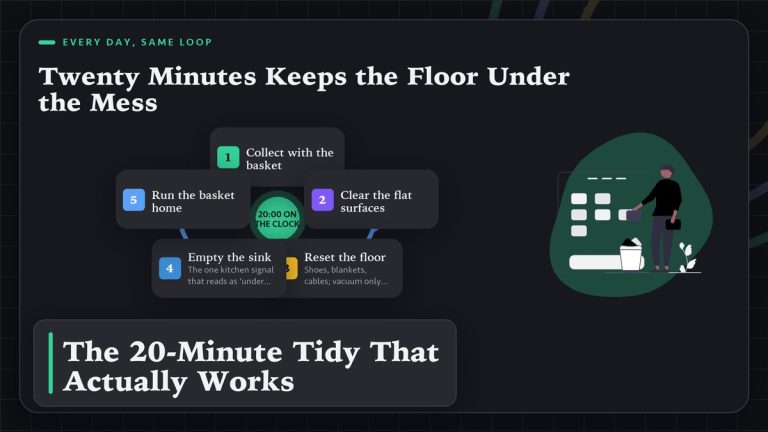
Everything above is setup, and this section is maintenance, which is what separates kitchens that stay functional from ones that slide back within a month of the big tidy. The deal is once a day, ten minutes, at roughly the same time, and it’s not a deep clean; it’s a reset with the same five steps in the same order.
Run it as a fixed loop so it doesn’t require thought at the end of a long day. Clear the counters back to the landing tray, empty the dish rack or dishwasher, and wipe the one counter that matters. Sweep the floor if it needs it, which in a small kitchen takes about ninety seconds. Then set the kitchen back to ready-for-tomorrow and stop, even mid-task, because the ten-minute timer on your phone only works if you respect it. I do mine while the kettle heats in the morning. The routine snapped into place after maybe two weeks, and since then the kitchen has not once returned to the post-dinner swamp it used to become.
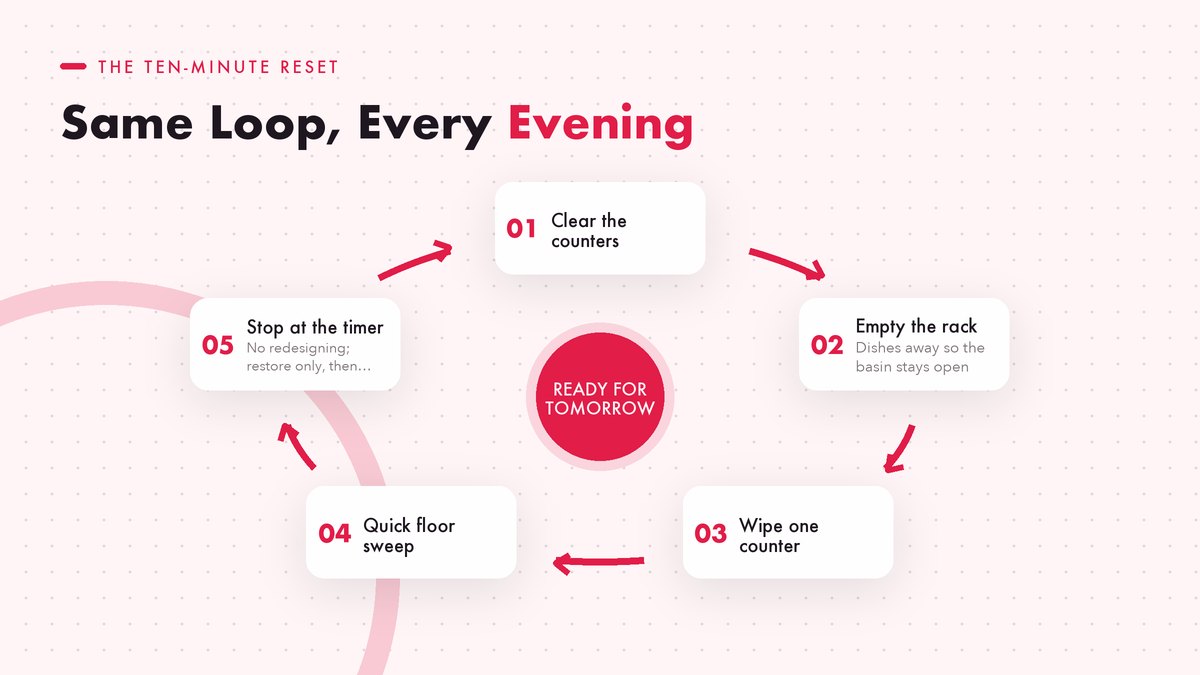
What you don’t do in the reset matters almost as much as what you do. No reorganizing, no reorganizing-adjacent fiddling, no deciding where the whisk “really” belongs, because the reset restores and never redesigns. Redesigning happens on the weekend, deliberately, maybe once a season, when you can actually think. Mixing the two is how a ten-minute reset stretches to forty and then gets abandoned entirely. Consistency, boring as it sounds, is what keeps the whole system working.
If You Do Nothing Else
Small kitchens reward consistency over cleverness, and the bins, the racks, the carts are all decoration on top of a simpler skeleton. The skeleton is zones where the tools live at their stations, a ladder that puts daily things low and rare things high, a gadget drawer that got honest with itself, and a ten-minute daily reset that keeps the machine tuned. Get those four running and the kitchen stops being the room you avoid; it becomes a room that mostly cooperates with you, which is about all anyone asks of a kitchen.
Start tonight if you like, with one drawer, the timer on your phone, and ten minutes. The rest can wait for the weekend, and some of it can wait until next month without anything breaking.
Sources checked November 2026: FoodSafety.gov cold storage charts, ENERGY STAR refrigerator guidance, U.S. Fire Administration cooking-fire prevention, National Center for Home Food Preservation (UGA), IKEA US kitchen gallery. Update policy: kitchen links and temperatures re-verified each revision.