A reading corner is the cheapest luxury in a house: one comfortable seat, a good lamp, and a flat spot for a mug. This is how to build one that actually gets used, even in a home where every room already has a job.
For years I read in bed, which mostly meant reading the same page four times and then falling asleep with the light on. The reading corner fixed that, and it took one Saturday, a secondhand armchair, and a lamp I already owned. No renovation, no contractor, and the setup has since survived three apartment moves because everything in it packs into the trunk of a small car.
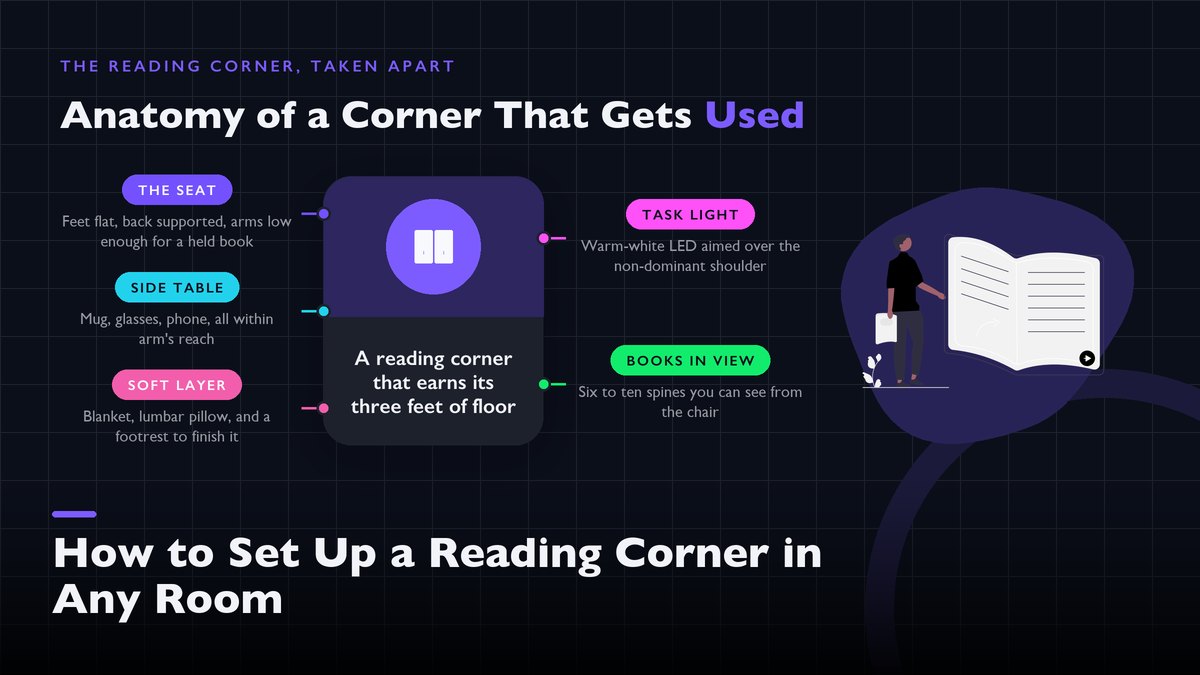
A reading corner is smaller than most people picture: one seat put there on purpose, light arriving from the right direction, and something soft within reach of your free hand. Every failed nook I’ve visited failed on one of those three conditions, and the culprit was usually the light, because people buy a lovely chair, stick it in the dim corner on the theory that an empty corner is an invitation, and then wonder why nobody ever sits there. Within a month the chair has become furniture-shaped storage, and by winter it’s holding the laundry.
Almost any room can host one, at least in my experience. Hallway landings, wide windowsills, the dead two feet at the end of a kitchen run. If a person can sit there and a lamp can reach an outlet, you’ve got a reading corner waiting to happen.
In this article
Start With the Light, Not the Chair
Almost everyone builds this backwards, since the instinct says to buy the chair first and chairs are a lot more fun to shop for than light bulbs. The light is what decides whether the corner gets used at all, though, and dim corners are where reading habits go to die. When the page is underlit, your eyes end up doing work the lamp should be doing, and twenty pages in the TV starts looking kind, because a glowing screen at that hour asks less of tired eyes than a gray page does.
Walk through your home at the hour you’d actually read, not at noon when every corner looks workable. Early-morning readers should check the sunrise side of the house; night readers need to look after dark, because daylight is a liar and a corner that seems bright at noon can turn cave-like by 8 p.m. What you’re hunting for is a spot where one task light can handle the whole job without lighting the rest of the room. Corners of living rooms work, so does a spot beside a bedroom window, and the end of a hallway can work if a plug-in swing-arm lamp can hover over a slim chair there.
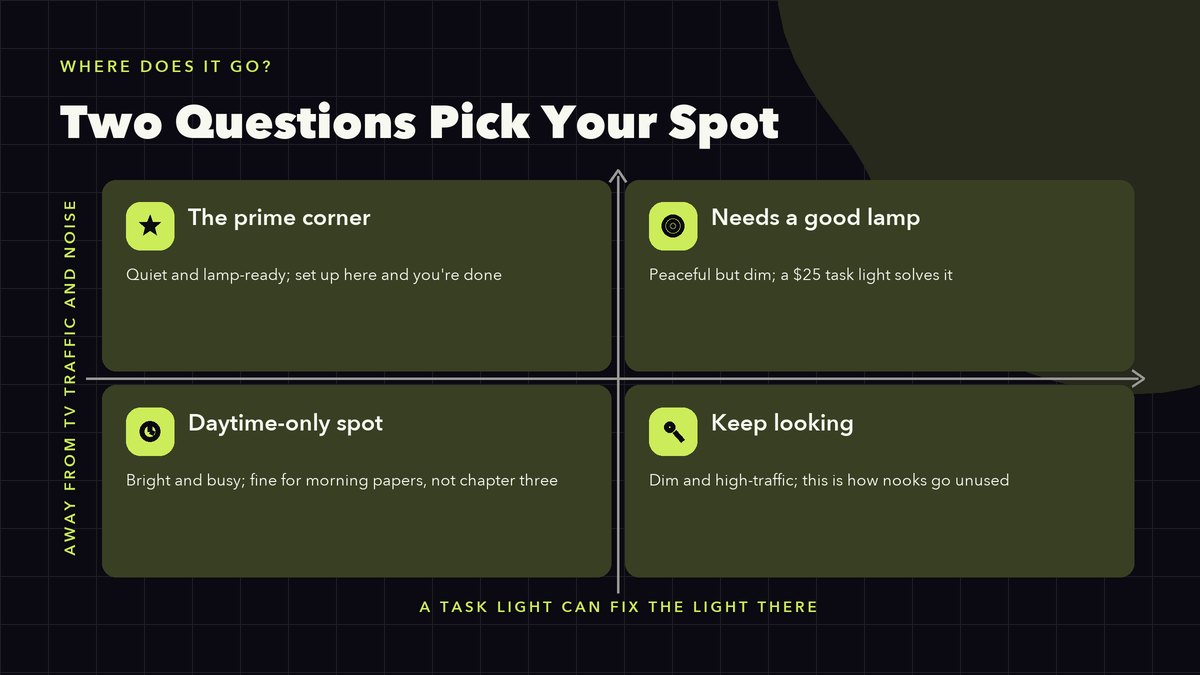
The numbers are worth thirty seconds of your time. The Illuminating Engineering Society, the body that writes the actual recommendations for how buildings get lit, puts task work somewhere around 300 to 500 lux (a lux is one lumen falling on one square meter, so the unit is precise even if your eye can’t measure it), and most people read comfortably inside that band. Skip the light meter. A 60-to-75-watt-equivalent LED bulb, roughly 800 lumens, in a lamp you can aim lands you in the zone, because aim beats raw brightness every time. The aiming rule comes down to shadows: light should fall on the page over your shoulder, from the side opposite your writing hand, so your own hand never throws a shadow across the text while you hold the book. Renters don’t need anyone’s permission for any of this, by the way. Plug-in sconces screw into a bulb socket or clip to a shelf edge, they move with you, and that’s exactly how a reading corner should behave.
The Chair: Four Ways to Get Comfortable
Now the fun purchase. “Buy a good chair” is useless advice until you define good for reading specifically, and the definition is plain enough once you sit down with an actual book: feet flat on the floor, lower back against the cushion, arms low enough that holding a book at chest height doesn’t drag your shoulders up toward your ears. Recliners are lovely, mind you, except that a chair tipping you back forty degrees and suspending a hardcover above your face is a nap machine with a reading problem, and some people count that as a feature, which I won’t argue with.
| Seat | Best for | Trade-off |
|---|---|---|
| Upholstered armchair | Daily reading sessions, a real sit-down-and-stay spot | Bulkiest option, and you’ll want to measure the door it’ll fit through as well as the corner. Tape measure beats optimism. |
| Accent or side chair | Small rooms, tight corners, tight budgets; easy to relocate later | Thin padding; add a lumbar pillow for anything past half an hour |
| Window bench or wide sill | Sun-adjacent daytime reading, kids’ rooms, under-window dead space | No back support; needs a wall or a stack of cushions behind you. Leaning on glass gets old fast. |
| Floor cushions or a papasan | Casual readers, low-slung rooms, the very smallest spaces | Standing back up is the tax, and knees over thirty file complaints |
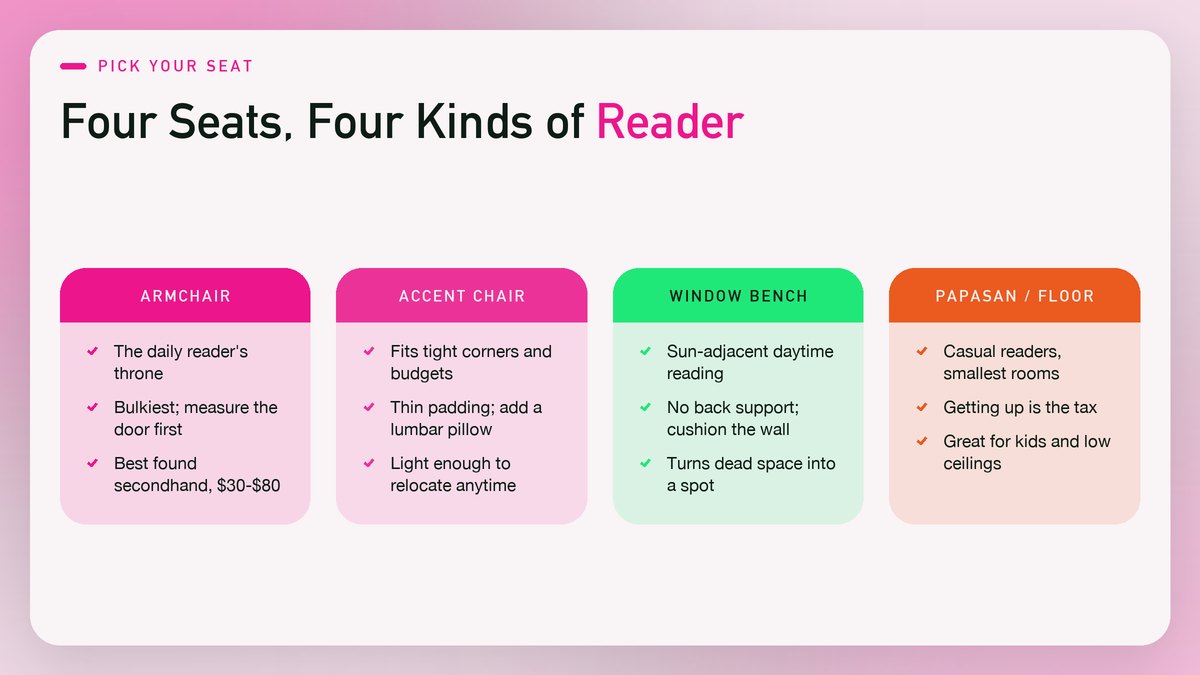
Buy used, if you take only one opinion from this whole article. Reading chairs get abandoned constantly as styles change and people move, which means the secondhand market stays full of solid, comfortable armchairs with decades of life left, often thirty to eighty dollars at a thrift store or through online marketplace listings. A new $900 “reading chair” is marketing, while a used one with good bones and a washable cover is the actual thing. If the upholstery is tired but the frame is sound, a fitted slipcover fixes it for roughly the price of two pizzas, and you can usually find one sized for common chair frames without paying for a custom order.
Sit-test before paying, and test the way you’ll actually read: book in hand, five minutes minimum, elbows on the arms. A chair that feels fine during a two-minute showroom sit can start pinching your shoulders by chapter three, and the only way to learn that before money changes hands is to stay put, so bring the book you’re currently reading rather than pretending with your phone.
Light picks the spot. The chair decides whether you stay. Everything after that is decoration.
The Table and the Books Within Arm’s Reach
The flat surface beside the seat does more work than its size suggests, even though nobody lists it as a purchase. It should sit within arm’s reach at roughly chair-arm height, and its job is unglamorous: hold the mug, the reading glasses, the phone you swear you’ll ignore, and the finished book that needs a landing pad before the next one opens. A side table works, a stool works, and a pair of sturdy crates stacked flat works about as well as either. The form barely matters. What matters is that you never stand up mid-chapter just to put something down, because standing up is exactly where a reading session ends.
Store books where their spines are visible from the seat, since walking to another room to choose the next book drains most of the pull out of the corner and browsing is half the ritual anyway. A slim bookcase beside the chair works, as does a picture-ledge shelf that turns covers into art, or a wall shelf at shoulder height. Keep six to ten titles in view, because a shelf that size keeps the ritual alive and reminds you what has been waiting there through three seasons of good intentions.
E-reader people, the corner works for you too. A reader with warm-tone front lighting solves the lamp question on its own, and most models will schedule the warm shift for evening hours so the screen matches the room as it darkens. I’d still keep a real lamp in the corner regardless. A spot that only works in daylight, or only while a battery holds, has a failure mode built in. Paper needs the lamp; screens don’t, so build for whichever one fusses more and you’re covered either way.
The Last Ten Percent of Comfort
The comfort details sound optional, and mostly they cost so little there’s no reason to skip them. A reading corner competes with the couch, the bed, and the phone, and it wins or loses on details that run almost nothing: a throw blanket over the chair back, a pillow shaped for the small of your back, a place for a warm drink. Probably the highest-value single item is a footrest, whether that’s a stool, an ottoman from the same thrift run as the chair, or even an old suitcase. Feet flat on the floor for an hour is fine; feet up turns a good chair into a destination.
Texture does more work than color in a corner like this. A spot that mixes two or three textures, say a nubby woven blanket against a smooth leather arm over a wool rug, reads as intentional and inviting even when every piece came from a different decade and a different store, and nothing has to match for it to work. My own corner has a corduroy chair and a linen pillow that matches nothing else I own, plus a sheepskin-ish throw I initially side-eyed as a gift, and it pulls together anyway, the same way a lived-in kitchen beats a styled one.
One caveat is worth stating plainly, since blankets and lamps end up neighbors. Keep fabric off hot bulbs, and if you light a candle in the corner, and the winter temptation is real, treat it like the small open fire it is. Ready.gov’s home fire safety guidance counts unattended candles among the everyday causes of home fires, and U.S. fire departments respond to several thousand candle fires a year by the National Fire Protection Association’s tally. The fix is boring and costs nothing: LED bulbs run cool, candle holders go in the center of the table, and nothing flammable drapes over a shade.
What to Skip
Restraint is most of the game here, so keep the skip-list short and stick to it. Built-in benches with custom cushions look wonderful in photos and run into the thousands, while the reading they enable is identical to what a fifty-dollar chair enables. Skip the floor-to-ceiling bookshelf crammed beside the seat, since it turns a corner into a storage depot and collects dust at eye level. Skip the elaborate decor wall as well; one framed print and one plant is enough, because the corner’s whole job is to disappear while you read, and decor that competes with the page keeps stealing your eyes. And if the only open spot faces the television, find another spot, since a reading chair aimed at a TV is a TV chair that occasionally holds a book, and we all know which activity wins when the remote is in reach.
A One-Weekend Build Plan
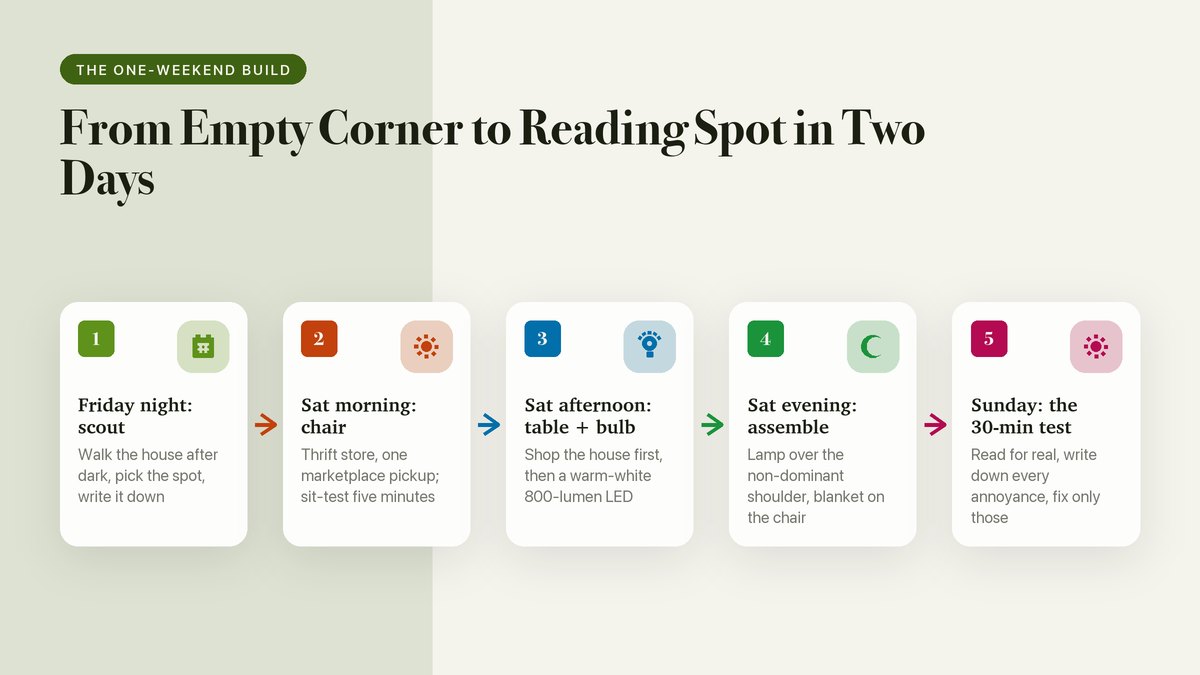
The entire build fits in one weekend if you sequence it and refuse scope creep. Friday evening, do the light walk-through and pick the spot, and write the spot down somewhere, because by Saturday morning the couch will have convinced you that where it sits is the right answer. While you’re at it, scroll through local secondhand listings for chairs, because decent ones move fast and you want first look on Saturday morning.
- Saturday morning. Chair hunt. One thrift store, one marketplace pickup, one furniture resale shop, maximum. Buy the first chair that passes the five-minute sit-test and fits the budget, then stop looking, because option paralysis is how this project dies on the vine.
- That afternoon. Table and lamp. Check your own house before buying anything; the table you need might currently be holding a plant in the guest room. Then the hardware store for one warm-white LED bulb in the 800-lumen range.
- Evening. Assemble in place. Chair, lamp over the shoulder on the non-dominant side, table on the other. Drag your six-to-ten-book shelf into view. Drape the blanket over the chair back where it can be grabbed without looking.
- Sunday. The only step that matters is the test: sit down with a real book for thirty minutes and notice what annoyed you. Write it down. Feet dangling means add the footrest. A page shadow means move the lamp. Most people build the corner, photograph it, and never sit in it long enough to find the flaw. Half an hour of honest reading produces a better punch list than any amount of decorating.
Fifty to a hundred fifty dollars usually covers it: a secondhand chair, a table, plus the bulb, assuming one lamp already lives somewhere in the house. The all-new version runs four hundred and up, and it reads exactly the same from the inside. The seat doesn’t know what you paid for it.
Keeping the Corner Alive
An unused reading corner usually has a logistics problem rather than a comfort problem. The books you actually want live in another room, or the corner gets colonized, first by a laptop bag, then by folded laundry, then by guilt. The counter-move is a standing rule: the chair holds one reader and one book, and anything else left there goes back to its home on sight. A week of that and it becomes automatic.
Fresh books are the other half of keeping the spot in use. A public library card is the cheapest reading subscription ever invented, and it costs nothing to test-drive ten books a month until you find the authors worth owning. Most US and Canadian library systems also lend ebooks and audiobooks through apps like Libby, so the stack beside the chair doesn’t even need to be paper. For older works, Project Gutenberg has been digitizing public-domain books since 1971 and offers over seventy thousand of them free with no account. Neither is sponsored or affiliate, as it happens. They’re simply the two cheapest ways to keep the shelf beside the chair from running dry.
Posture comes up often enough to answer directly. You’re settling in with a novel, not working an eight-hour desk shift, so perfection isn’t the goal. Still, if your neck or back complains after long sessions, the basics from Cornell’s ergonomics program carry over to armchairs almost unchanged, since a body in a chair is a body in a chair. Feet supported. Lower back against the cushion. The book raised toward eye level instead of letting your head drop to the page. That last point is the reading-specific one, and it’s the one people miss. Prop the book on a pillow or rest the e-reader on the blanket and the neck bend disappears. A good share of reading discomfort is just the head-hang, fixed in five seconds.
The corner gets used when there’s a good book in reach and the light is warm, and it helps more than any pillow if the phone is charging in another room. Some Sunday evening you’ll glance up and realize an hour passed and the television never came on, and that’s the moment the thirty dollars at the thrift store turns into the best money spent on the house all year. Mine still earns its keep every winter. The lamp hums a little. I don’t mind.
Sources checked November 2026: U.S. Department of Energy ENERGY Saver, Ready.gov home fire safety, Cornell University Human Factors and Ergonomics, Project Gutenberg, OverDrive’s Libby app. Prices are ballparks rather than endorsements. Thrift first.