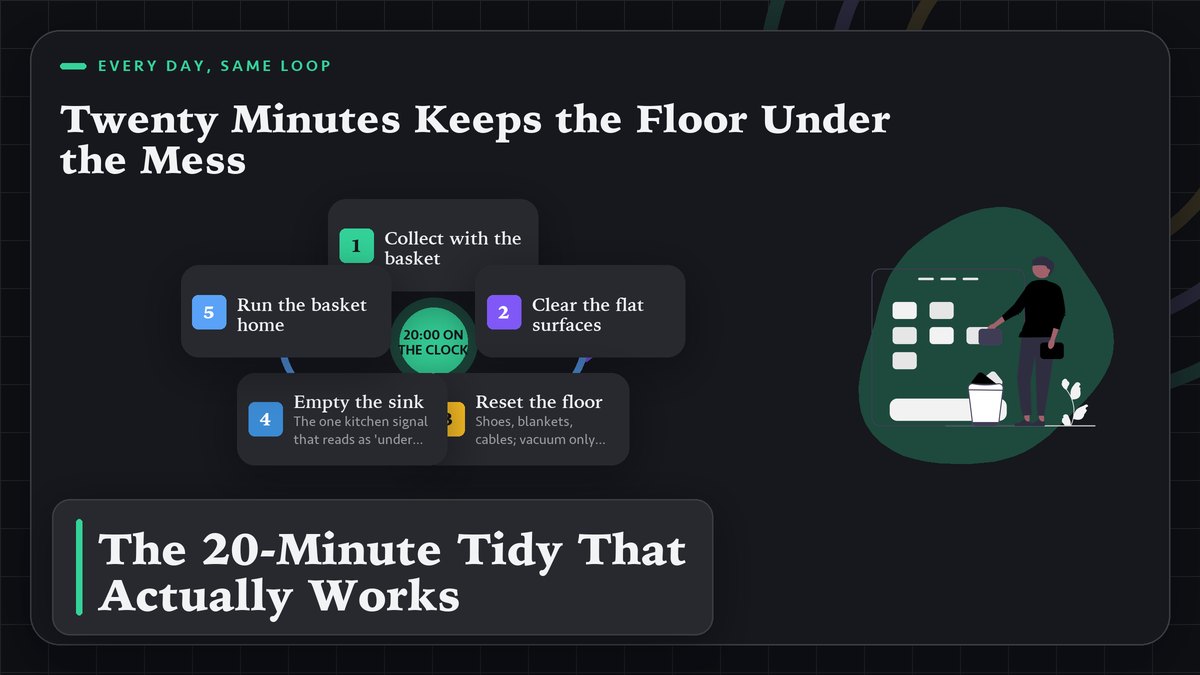
A daily reset you can finish on a weeknight, with a timer, one basket, and a hard rule against reorganizing anything. The house stays “company could knock” level all the time, and deep cleaning becomes a choice instead of an emergency.
I used to clean in marathons. You probably know the cycle. Saturday arrives, the apartment has drifted for two weeks, and suddenly it’s three in the afternoon and you’re on your knees scrubbing grout with a toothbrush, furious at everyone including the toothbrush. The place then looks amazing for about forty hours. By Wednesday the mail is back on the counter, a sweater has migrated over a chair, and the whole thing gets ignored until the next blowout. A few years ago I stopped running that cycle, and what replaced it is a smaller mechanism than I would have believed: twenty minutes a day, same time, timer running, basket in hand. The rest of this article is just the details that keep it from dying off the way every other cleaning system I tried died.
The twenty-minute tidy is not a deep clean, and it isn’t trying to be. It functions as a reset, a hard floor under the mess that gets held at the same level every single day so the house never slides far enough to need a rescue mission. If your place is currently in rescue-mission territory, which for a lot of people it will be, you can still start this week; there’s a section below on clearing the backlog first, because the daily habit only works once it has a floor to stand on.
In this article
Why Twenty Minutes Beats Two Hours
There’s a psychological trick buried in the timer, and it is the entire reason this holds up. Two hours of cleaning is a project, and projects get negotiated with: you’ll do it after lunch, then after the errands, then next weekend, while the pile grows the whole time. Twenty minutes is an appointment. Nobody negotiates with an appointment; you show up, and then it’s over. I have never once talked myself out of a twenty-minute tidy, and I have talked myself out of every marathon I ever planned, which is a record I’d rather not examine too closely.
The scope does some of the work too. With only twenty minutes on the clock you can’t set out to clean the house, which means you never start the way marathon cleaning starts: standing in the middle of the room, turning in a slow circle, wondering where to even begin. The timer usually makes that decision for you. You start wherever the basket happens to be, and you keep moving, with no strategy session and no optimizing, and no watching a video about cleaning systems instead of cleaning, a category I have contributed to more than I’d like to admit.
And there’s peer-reviewed weight behind the “why bother” question. A much-cited UCLA study of families and their homes, Darby Saxbe and Rena Repetti’s 2010 paper in Personality and Social Psychology Bulletin, had 60 dual-income spouses give self-guided home tours and then tracked the stress hormone cortisol across three weekdays. The wives whose tour language painted a cluttered, unfinished home showed flatter diurnal cortisol slopes, meaning the hormone failed to drop through the day the way it normally would, and the pattern held even after the researchers controlled for marital satisfaction and neuroticism. I’m not going to pretend a twenty-minute tidy rebalances anyone’s hormones. A counter that stays clear and a floor you can walk across do, though, change how a room feels at 7 pm when you walk in with the groceries, and after reading that study I stopped treating that part as trivial.
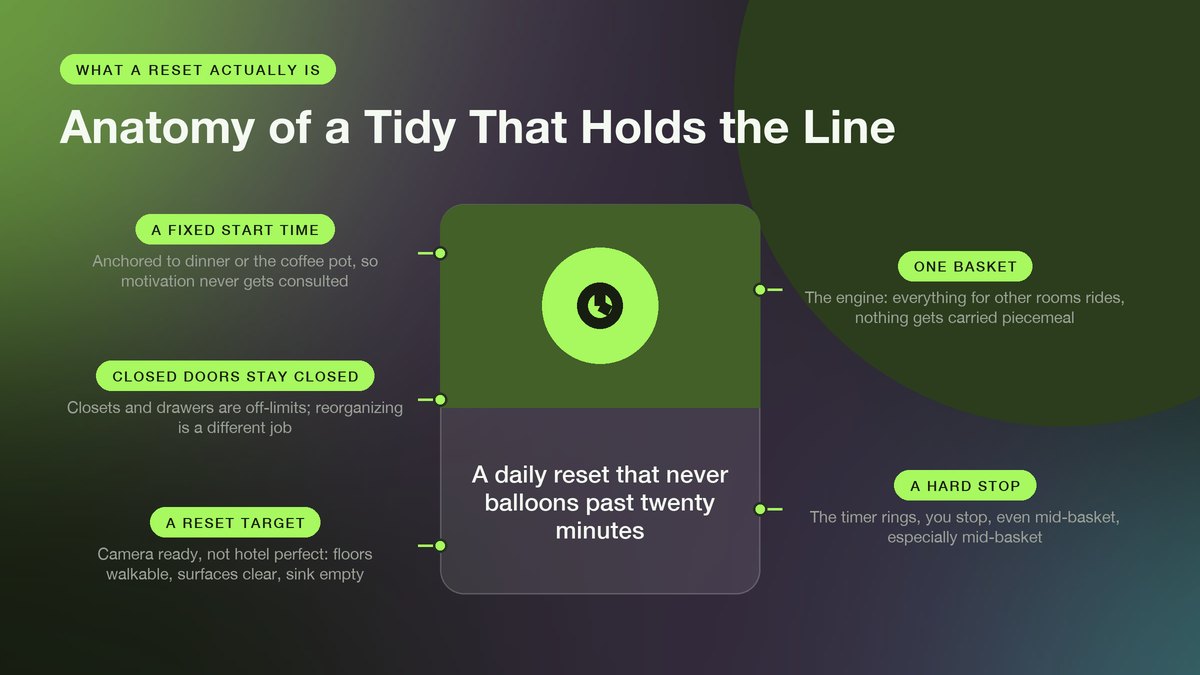
The goal of the daily tidy is “camera ready,” not “hotel perfect.” You’re removing the evidence of the week and leaving the house otherwise alone.
One more honest reason twenty minutes a day works is that it keeps the emotional temperature down. Marathon cleaning tends to carry a faint accusation with it, someone silently tallying who left what where, and a short daily reset doesn’t leave enough time for that resentment to build. It reads as maintenance, the way brushing your teeth does, and nobody resents brushing their teeth.
What You Need: The Five-Thing Kit
Cleaning systems collapse at the preamble more often than anywhere else. You buy the caddy, the special brushes, the matching spray bottles, and by the time the kit is assembled you’ve usually spent an afternoon and roughly $80 without the actual cleaning having happened once. This kit is five things, most of which you already own, and it lives in one spot so you never burn the first ten minutes of the timer hunting for supplies.
- The timer. Your phone works fine. The kitchen timer works better, mostly because it doesn’t have a screen full of other things on it. Twenty minutes, started the moment the basket comes off its hook.
- One basket or tote bag. Anything that belongs in another room goes in the basket rather than under your arm, and definitely not one item at a time, because carrying single items between rooms is exactly how twenty minutes stretches into an hour of house wandering.
- Trash bags and a recycling bag. These hang on the same hook as the basket. In my experience at least half of a typical mess is stuff that’s done being used: mail already read, packaging, the tissue box with three tissues left in it.
- Microfiber cloth plus one all-purpose cleaner. Not five products. The Bob Vila’s cleaning guides repeat what any experienced housekeeper will tell you, which is that one decent all-purpose cleaner covers most daily jobs and the cloth does more of the work than the spray does. If you’re buying a product anyway, the EPA’s Safer Choice label is the quickest way to vet a cleaner’s ingredients without a chemistry degree.
- One designated “landing spot” per room. The landing spot is the least visible item on this list, and in my house it’s the one holding the whole room together between sessions. Every room gets a single small tray, bowl, or corner where today’s odds and ends are permitted to live, and the tidy resets that spot to empty at the end of each session. Without one, clutter just migrates from surface to surface like it’s on tour.
That’s the whole kit, five items and nothing else. No caddy, no color-coded system, no label maker, and the total cost if you own none of it lands around twenty-five dollars, with most of that going to the basket if you want a nice one.
Two small notes on the kit before we move on. First, microfiber cloths are one of the few cleaning products worth buying deliberately rather than improvising, because a dry one lifts dust off shelves and screens with no spray at all and a damp one handles most wipe-downs. Buy a ten-pack for about ten dollars at any grocery or hardware store, keep half in the basket and half near the kitchen, and toss them in the wash with the towels, though you should skip the fabric softener since it coats the fibers and ruins the point of them. Second, resist upgrading the kit for at least a month. A spray bottle you already own cleans exactly as well as the one with the ergonomic trigger, and in my experience fancy tools are usually procrastination in a nicer outfit.
The 20-Minute Sequence
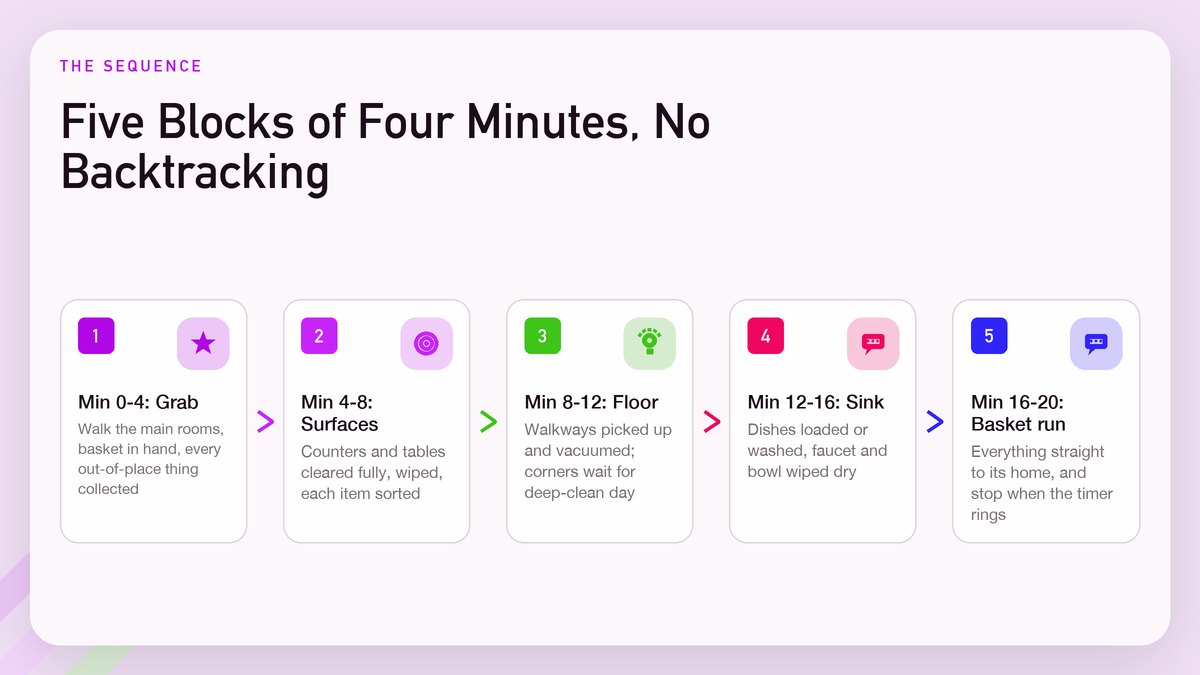
Run the order exactly as written for at least two weeks before changing anything. The sequence rests on one principle, which is that you handle each category of stuff once and you never backtrack, since doubling back to a room you already cleared is where the twenty minutes go to die.
The first four minutes are pure collection. Walk the main rooms with the basket and gather everything visibly out of place; don’t put anything away yet and don’t evaluate anything yet, because you’re just building one mobile pile of strays with your hands moving the whole time, at a pace of roughly one room per minute. Pull the trash bags off their hook on the way past, too, so you’re not revisiting the closet later.
Next come the flat surfaces, minutes 4 through 8: kitchen counters, coffee table, desk, the shelf by the door. Clear each one fully, wipe it with the cloth, and sort whatever you removed into three outcomes, namely back where it lives, into the basket for another room, or into a bag because it’s trash. This block changes how the whole apartment reads, mostly because counters are the biggest visual real estate in most homes, and a cleared counter fools everyone, including you, into thinking the place is nearly done.
The floor gets minutes 8 through 12. Everything on it that shouldn’t be there goes somewhere else: shoes to the mat, blankets folded over the couch arm, the charger cable coiled on the side table instead of stretched across the walkway. Then vacuum or sweep only the high-traffic lanes, meaning the path from the door to the kitchen and the path to the couch, and leave the corners for deep-clean day on the grounds that nobody walks in corners.
Then the dishes, minutes 12 through 16. A full sink is most of what makes a kitchen read as out of control, and an empty one does the opposite, so load or run the dishwasher, hand-wash the three things that never fit, and wipe the faucet and sink bowl dry. A dry, empty sink reads as clean even on a day when the rest of the kitchen is merely okay.
One thing worth deciding before your first run is what goes in your ears. Some people tidy to music with a strong beat, some to a podcast, some to nothing at all, and I’m not going to litigate any of those. What I will say after a couple of years of running this system is that the twenty minutes passes noticeably faster with audio running, and since the point is for the tidy to feel like a small daily ritual rather than a chore you’re serving a sentence for, pick whatever soundtrack makes the basket feel lighter. The one thing to avoid is putting on a TV show “in the background,” because twenty minutes of television will beat twenty minutes of tidying every single time, and the timer will ring while you’re still on the couch deciding it counts.
Minutes 16 through 20 belong to the basket run. Carry the basket room to room and empty it, putting each thing directly where it lives, which is where the whole “home for everything” idea starts paying rent. If every item has a spot, the basket empties in about five minutes flat; if half your basket items have no home, you’ll feel the drag immediately, and that drag is useful information about what to fix on the weekend.
When the timer rings, you stop, even mid-basket, and especially mid-basket. Stopping on time is what keeps tomorrow’s tidy down to twenty minutes, and for me it’s the single most discipline-requiring part of the whole system. The half-finished basket by the door simply becomes tomorrow’s first five minutes, and it will still be there in the morning.
The One Rule That Protects the Whole System
I mean this literally, so I’ll put it plainly. During the twenty minutes you are not allowed to reorganize anything, which means no switching the pantry bins around, no finally sorting the junk drawer, no “while I’m here.” Those jobs are real and they deserve their own time, but they take a different kind of time, and smuggling them into the daily tidy is how twenty minutes becomes fifty and then becomes a system nobody touches.
A tidy is a reset, and the two words are not interchangeable. A reset returns things to their homes; reorganizing changes where the homes are. If you notice mid-tidy that the umbrella stand by the door is obviously wrong and the closet is obviously right, write it on a sticky note, stick it on the fridge, and let Saturday deal with it. It does not get to become a Tuesday-night detour.
This rule matters more than any other part of the article, so I’ll say it twice in different words. The twenty-minute tidy exists to hold a floor; improving the house is a separate job with its own scheduled time. When the two get mixed, both of them die.
Where Everything Goes: The Four-Way Sort
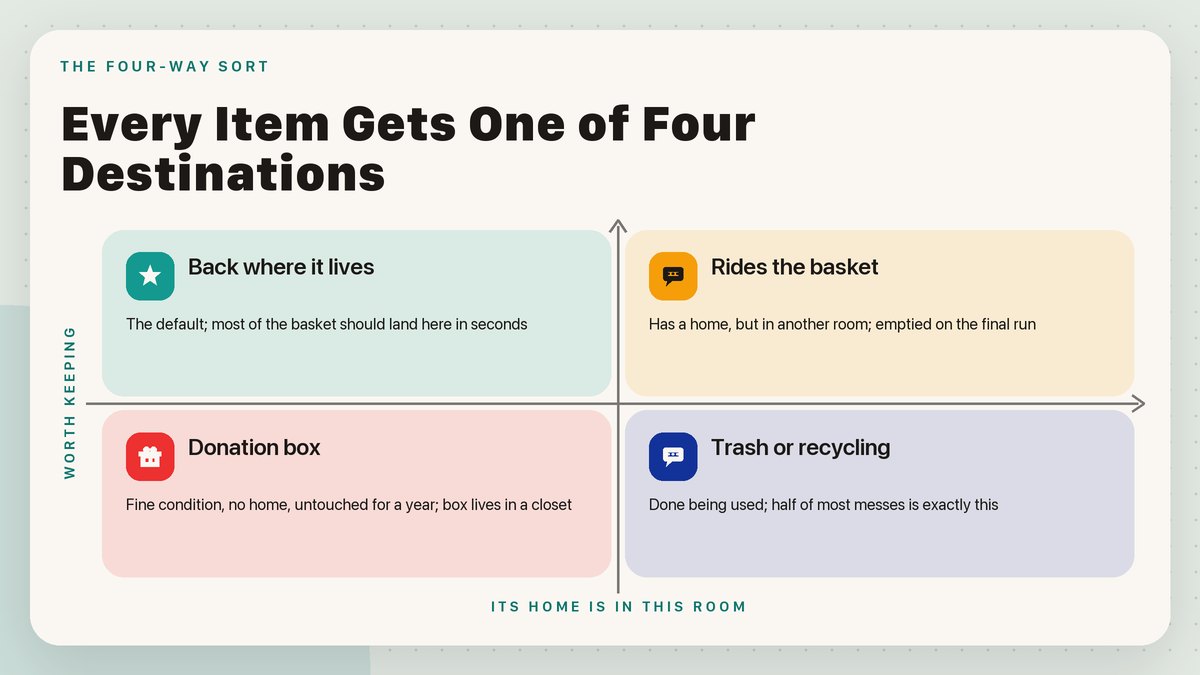
Every item you pick up during the tidy gets exactly one of four destinations, decided in about two seconds. The speed matters more than it seems to, because sorting slowly is really just decision fatigue wearing a costume, and most of the stuff in a basket doesn’t deserve a committee meeting.
The first destination is back where it lives, which stays the default for anything with a working home. Mug to the shelf, charger to the drawer, book to the nightstand pile. In my house this destination eats about 3 of every 4 items in the basket on a normal evening; when it doesn’t, the problem sits upstream, in a house where too many things lack homes and the tidy keeps tripping over them.
Then there are the things whose homes happen to be in other rooms. They ride in the basket until the basket run, and the discipline is refusing to walk them over one at a time the moment you touch them. That feels efficient, I know. It isn’t; it’s a trail of breadcrumbs that ends with you in the bedroom folding laundry that was never part of the plan.
Third, the easy calls, meaning food wrappers, dead pens, junk mail, the Amazon box you’ve been saving for no reason you could articulate under oath. If the trash bag fills, tie it off and take it straight to the bin, because a full bag waiting by the door is just clutter with extra steps attached.
The fourth destination is the awkward one: things that are perfectly fine but have no home anywhere and haven’t earned one yet. Those go to the donation pile, which deserves a permanent box in a closet or the garage rather than a growing mound of indecision on a chair. When the box is full, it goes to a Habitat for Humanity ReStore, the resale outlets run by local Habitat affiliates that sell donated furniture and housewares at a fraction of retail and put the proceeds toward affordable-home builds, or you can book a PickUp Please donation pickup, where you schedule online, leave the labeled bags outside, and a driver collects them rain or shine and leaves a tax-deduction receipt behind. My own test has two clauses. If I haven’t reached for something in a year and replacing it would cost under twenty dollars, the decision has effectively already been made.
The four-way sort has no fifth option. “I’ll deal with it later” is just destination four with extra guilt attached.
Making It Stick Past the First Two Weeks
Every cleaning habit fails the same way, with one skipped evening, then a skipped week, then a skipped week, then a slow forgetting. The fix is to anchor the tidy to something that already happens every day, so it doesn’t need its own motivation supply. After-dinner dishes works for most people, the ten minutes before a shower you’ll take anyway works for others, and mine rides on the coffee pot: the tidy starts when the morning’s grounds go in the compost, which means the apartment gets reset before I’ve fully woken up. That’s either brilliant or a little unhinged; the jury’s still out.
The second anchor is a rule I lifted from the exercise-habit people: never miss twice. Missing one day is just life; it happens to everyone, including me, probably once every couple of weeks. Missing two days in a row is the beginning of a new and worse habit, and that is the line I don’t cross. If yesterday got skipped, today’s tidy is non-negotiable, even when it turns into a grumpy half-speed run done while complaining about it, because a grumpy fifteen-minute tidy still holds the floor.
If you share the house with other people, from roommates to a full family, there’s one more piece to it. The tidy is yours, and it stays yours, at least at first. That sounds counterintuitive, but trying to launch a group cleaning program and a personal daily habit at the same time is how both of them fail. Run your own twenty minutes for a few weeks and something almost annoying happens: other people start joining in, because a visibly tidying person makes tidying look like the normal state of the house rather than a punishment being issued. You can formalize chores later if you want to; the daily reset needs no contract to work.
Third, keep the bar low on purpose. Some days you’ll glance around and think the place doesn’t really need it; tidy anyway, quickly, because the value of the daily tidy isn’t proportional to how messy the house was that day. It’s in the streak itself, in the reset being a permanent feature of the house rather than a reaction to mess. Houses that get tidied daily stay tidy at roughly the same cost over the long run, while houses that get tidied only when needed are always either messy or mid-recovery, and both of those states cost more than twenty minutes.
When Twenty Minutes Isn’t Enough
Some jobs are simply bigger than the system, and pretending otherwise is how the system breaks. Once a month or so, schedule a longer session, ninety minutes to two hours, for the things the tidy deliberately never touches: the inside of the microwave, baseboards, the fridge shelf with the sticky ring on it, washing the actual windows. Put it on the calendar like a dentist appointment, because it will never happen “when you feel like it,” and nobody in recorded history has felt like doing baseboards.
| Job | Time | How often |
|---|---|---|
| Daily tidy (the reset) | 20 minutes | Every day, anchored to an existing habit |
| Micro-clean add-ons | +5 minutes | As needed: sink scrub, mirror wipe, toilet swish |
| Zone clean | 30–45 minutes | Weekly, rotating one room per weekend |
| Deep clean | 90–120 minutes | Monthly, scheduled in advance |
Guests are the other common exception, and the tidy handles them better than you’d expect. Run the normal twenty minutes, then add one “guest lens” pass. Stand at your front door and walk in slowly, noting the first three things you’d notice if this were someone else’s house. Almost always it’s the entry shoes, one cluttered surface, and a bathroom mirror. Ten extra minutes covers all three, and the visit goes fine, because in my experience guests register “clean, cared-for house” off about four visual signals and rarely look closer.
Two seasonal moments deserve a mention here too. When the seasons turn, add one fifteen-minute add-on to the tidy for the rotation work: the closet swap, shaking out the entryway rug, clearing the porch of three months of drifted leaves. And if you’re about to move apartments or houses, this system becomes a gift you didn’t know you were buying, since a house that gets a daily twenty-minute reset never develops the terrifying final-week purge. You’ll pack in a calm, boring, mostly-finished house instead of a disaster site with a deadline.
And if life gets heavy, a week of skipped tidies is survivable. The floor you’re standing on is a habit, not a streak score, so restart the day you notice, with no catching up owed and no guilt tax. The apartment forgives immediately, which is more than I can say for some people I know.
So tonight, when dinner’s done, set the timer for twenty minutes, grab the basket, and go. Tomorrow it’ll be easier, because the basket will be lighter and the counters will already be clear, and in about two weeks you’ll catch yourself, mid-tidy, realizing the house hasn’t needed a marathon in a month.
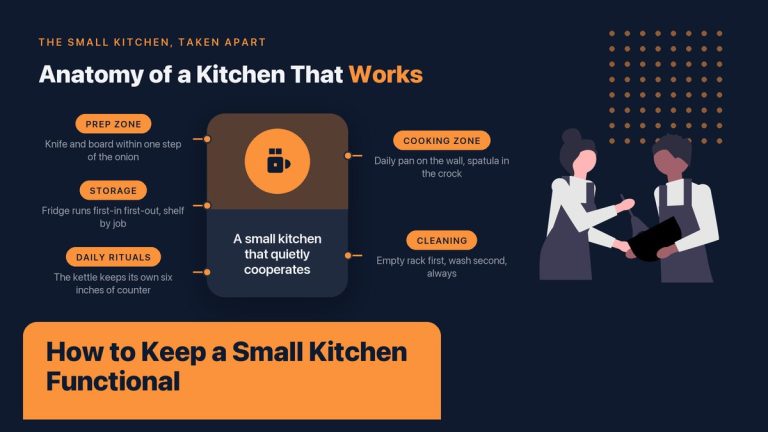
Related reads on this site: How to Stop Misplacing Things: A Home-for-Everything System (the upstream fix for basket items with no home), Small Space Organization Ideas, and How to Keep a Small Kitchen Functional (the nightly kitchen reset that pairs with this tidy).