The hardest part of learning something new usually isn’t the learning. It’s standing in front of a hundred plausible options, from coding to calligraphy to conversational French, and having no honest way to pick one. This filtering system gets you to a real answer in a couple of weekends, no vision board required.
Every so often I lose an entire Sunday afternoon to something I’ve done maybe a dozen times in my adult life: not learning a skill, but thinking about learning one. The scene barely changes from year to year. A browser with seventeen tabs open, a notebook page split into three columns of candidates, and a growing suspicion that I’m going about the whole thing backwards. Python, because everyone says Python is the one employers keep asking for. Bread baking, because at least the results are edible. Guitar, because the guitar I bought in 2019 sits within sight of my desk, still collecting its fine layer of guilt. Spanish, photography, woodworking, sketching. The list reads less like a plan than like a menu where every option costs roughly a year of evenings and none of them admit it.
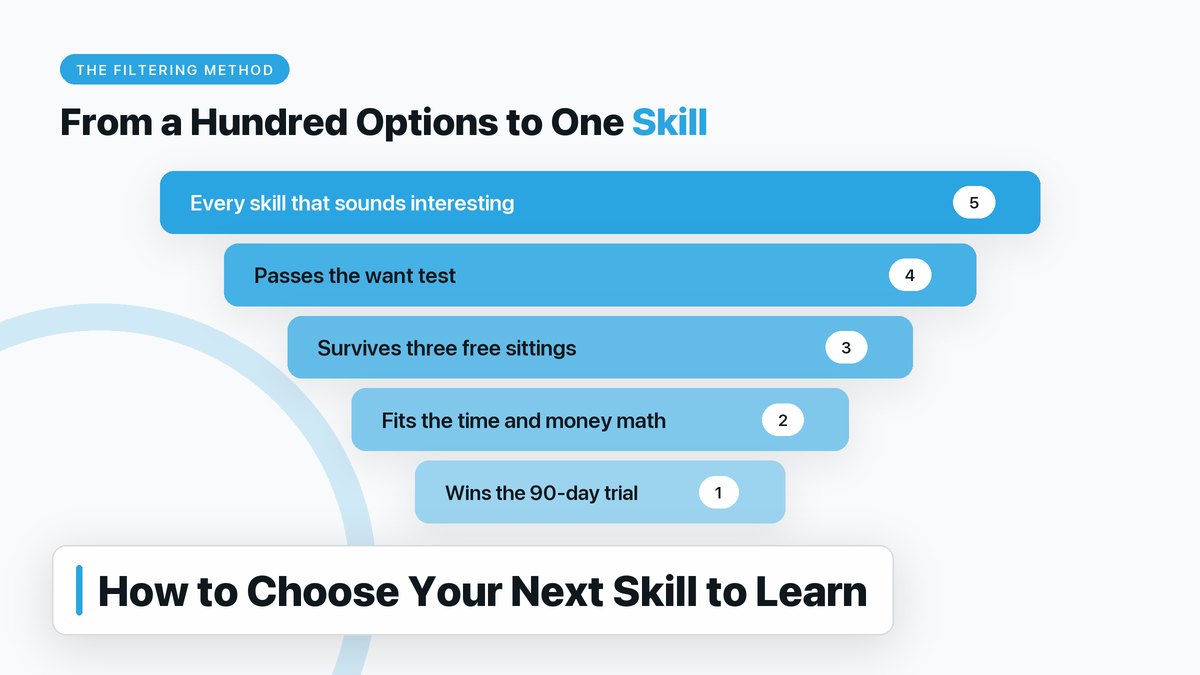
By dinner I’ve usually chosen nothing, closed the tabs, and watched a documentary about competitive dog grooming instead. The film was more relevant than it had any right to be. Nobody grooms a poodle for years because a list told them to; they pick one dog, one clipper, one Saturday morning, and the choosing takes ten minutes because every option is physically in front of them. Choosing a skill works the same way. The method I eventually cobbled together runs four filters in sequence, each one cheap enough to finish inside a single week: first you pin down what you want out of the skill, then you test your interest before your wallet, then you count the real cost in time and money, and last you commit to a ninety-day trial instead of a lifelong vow. No vision board or personality quiz is involved, just a sequence of small honest steps that gets shorter as your list does.
In this article
Filter One: What Do You Actually Want Out of This?
Most skill lists get built backwards, starting from the skills themselves, which is exactly why they stall somewhere around the second column. Flip the order and start from the outcome instead. Before you compare a single option, write down in one plain sentence what you want the skill to do for your life: the version you’d be glad to have eighteen months from now, as opposed to the one that merely sounds good at a dinner party.
Every honest answer I’ve collected, from friends and from my own three columns, lands in one of four buckets, and your bucket changes everything downstream. If the answer is career, you need a skill with a job market attached, and the later filters lean hard on data like the federal figures in Filter Four. If it’s making things, you want a craft with a tangible result you can hold up or mail to your sister, and interest matters far more than any market report. Fixing friction means a practical skill that quietly improves daily life, things like basic car care, home repair, better weeknight cooking, or touch typing. It’s the bucket that looks dull on paper and then pays you back every single Tuesday. And if it’s meeting people, almost any skill works, provided it comes with a built-in community, because skills learned alone in a spare bedroom rarely scratch the loneliness itch they were chosen to fix.
“I want to learn something” is a mood. “I want to fix my own leaky faucet instead of paying a plumber” is a goal, and goals pick skills almost by themselves.
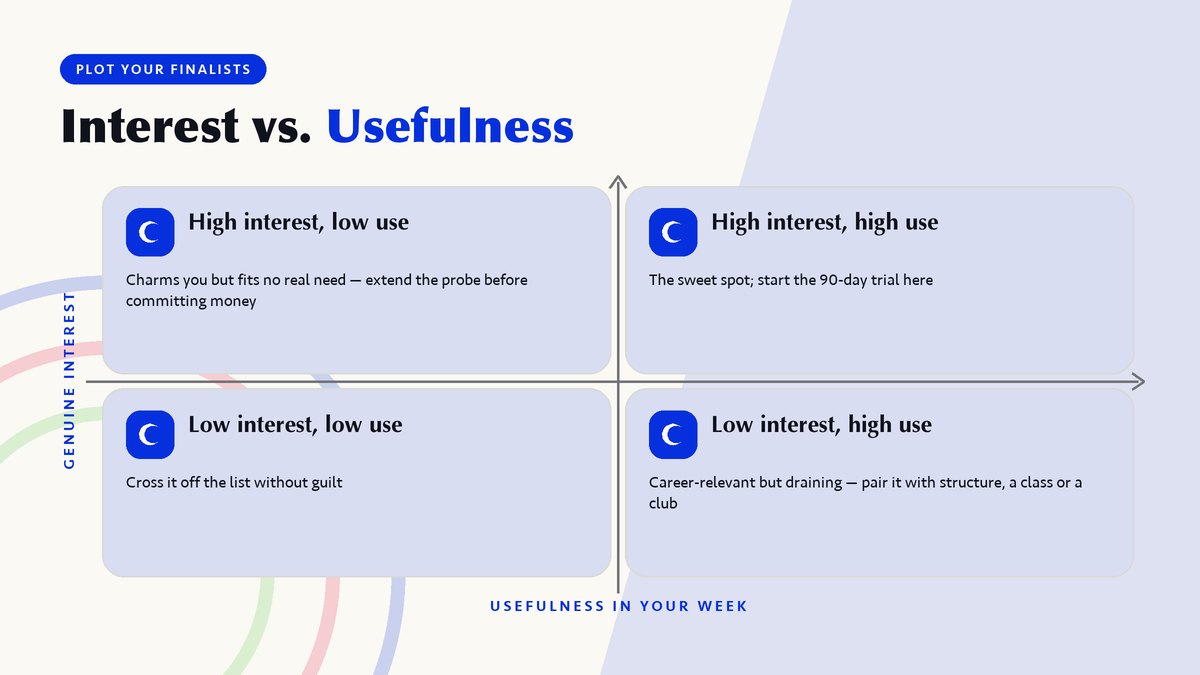
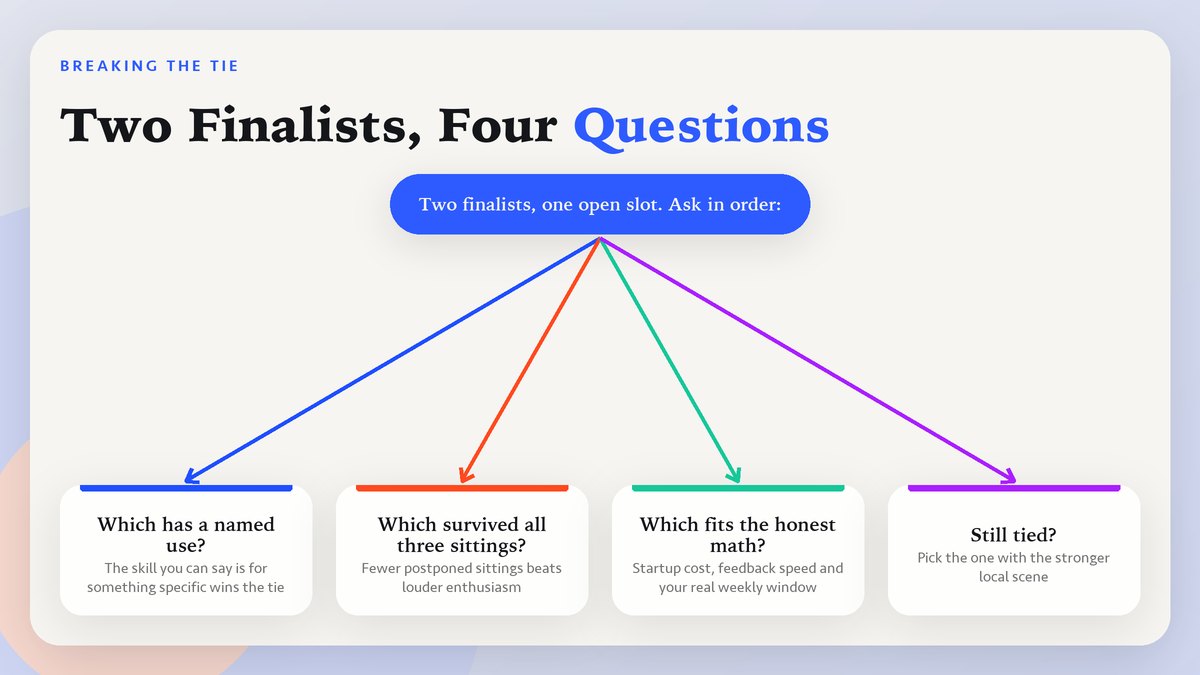
Notice what’s missing from that list, because it’s the motive I run into most often: learning a skill to become a generally more impressive person. It sounds like a fine reason, and it might be the one quietly driving your seventeen tabs right now. Skills chosen for image tend to die at the first boring plateau, in my observation and in the history of my own hallway closet, because no ordinary Tuesday ever requires them. The ones chosen for a use case survive, since a leaky faucet or an untranslated email shows up on its own schedule and drags the skill with it. If you can’t say what the skill is for in your actual week, keep digging before a single dollar moves.
Filter Two: Test Your Interest Before Your Wallet
Spend hours, not dollars, to find out if a skill survives contact with you
There’s a pattern I’ve watched play out more times than I can count, including in my own hallway closet. Someone gets excited about a skill, buys the complete beginner kit, the good one, the one the forums agree on, and discovers somewhere around day three that they enjoy the idea of the thing far more than the thing itself. The $400 camera becomes a very expensive paperweight with a strap, the pottery phase ends with two lopsided mugs and a bin of clay going stiff in the garage, and the forum thread where everyone swore the mid-price model was the smart buy gets deleted by spring.
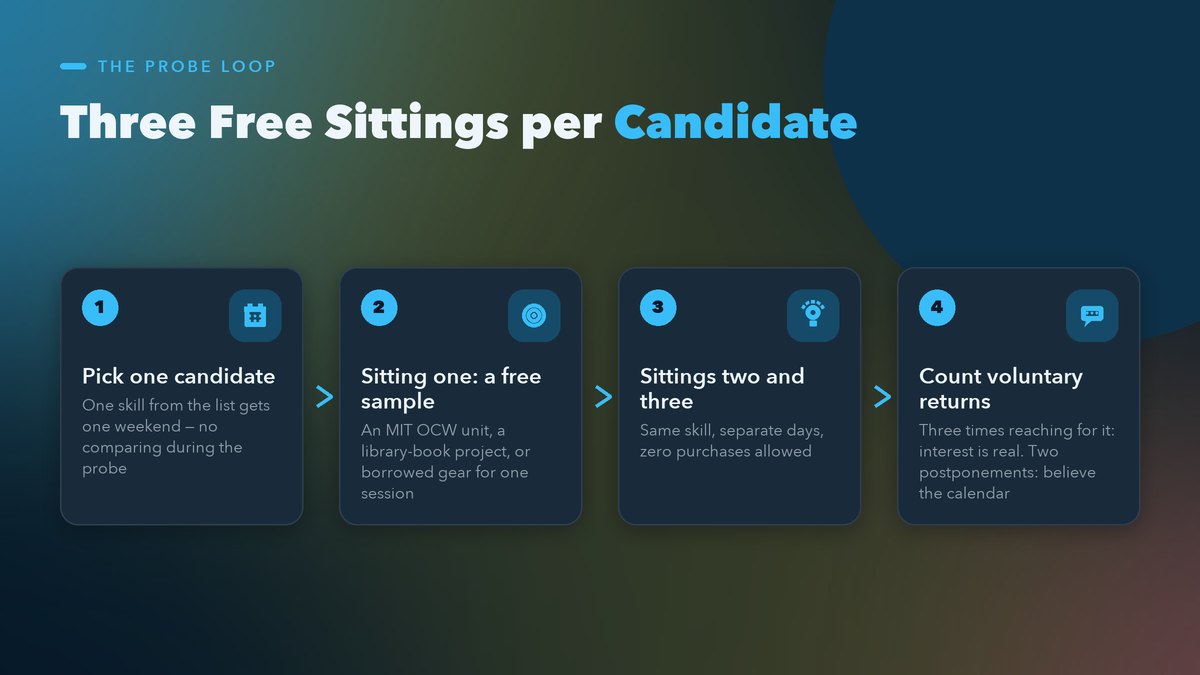
Interest is testable, and the test costs nearly nothing if you run it in the right order. For almost any skill you can name, a couple of evenings inside it are available before you own a single piece of dedicated equipment, so the rule is experience first and gear second, with the gap between those two doing most of the regret prevention. I think of each candidate as getting one weekend probe with a specific shape, and the shape depends on whether the skill lives mostly in your head or mostly in your hands.
Free university courseware is the underrated starting point for anything academic. MIT OpenCourseWare has published the actual materials from real MIT classes (lecture notes, assignments, exams) since 2001, and working through one introductory unit of anything from linear algebra to culinary chemistry tells you within the hour whether the subject grips you or glazes you over. Khan Academy, the free nonprofit Sal Khan started in 2008, covers the same territory a level below that and is gentler on people whose last math class happened during a previous presidency. One sitting is the test: do you want a second sitting? That single question carries most of the predictive weight, because motivation that survives a second voluntary evening is the raw material everything else in this article is built from.
Hands-on skills call for a different probe. Check out a library book and follow one project start to finish with whatever you already own; dozens of public libraries in the US and Canada now lend tools, instruments, and even sewing machines through a “library of things,” which removes the last excuse. Sketch with a regular pencil before the full marker set arrives. Bake one loaf in your current pans before buying a stand mixer, since a decent one runs somewhere around $300 and up, and a $5 bag of flour answers the same question faster. Rent, borrow, or improvise the tool for exactly one session, then watch what your attention does while you work, because if you kept drifting to your phone during hour one of the free version, the $600 version of that hour will not fix things.
Filter Three: The Honest Math of Time and Money
Once two or three candidates pass the interest test, run the numbers, because skills carry wildly different true costs and people are consistently surprised by which ones turn out cheap. The sticker price of a class is the least of it. What matters is the full package: gear, space, ongoing materials, feedback, and the stretch until anything satisfying comes out of it. That last one is the cost nobody budgets for, and it’s the one that kills most hobbies, since a skill that needs six months to produce its first satisfying result has to survive six months of unrewarded evenings before it pays out a single one.
| Skill archetype | Typical startup cost | Feedback speed | Time to first satisfying result | Hidden cost to watch |
|---|---|---|---|---|
| Coding | $0 (a computer you already own) | Instant. The program runs or it doesn’t. | Weeks | Endless tutorials; you can “learn” for a year without building anything |
| Cooking & baking | $30–100 in basic tools | Fast; you taste it tonight | Days | Ingredient costs compound; groceries don’t reset |
| A musical instrument | $150–400 for a decent used starter | Slow; months of sounding bad first | 2–4 months | Lessons, about $30–60 an hour in most US cities |
| Drawing / painting | $20–50 | Medium; progress is visible in weeks | Weeks | Supply creep; the upgrade itch never fully leaves |
| Woodworking | $200–600+ | Slow; each project eats a full weekend | A month or more | Space. Machines are loud, and sawdust goes everywhere |
| Languages | $0–30/month for apps and media | Slow; real conversation lags input by months | 3–6 months for basic conversations | It’s free to start and easy to stall; the plateau is long |
Two columns in that table do most of the deciding, in my view. Feedback speed, meaning how quickly the skill tells you whether you’re doing it right, and time to first satisfying result. Slow-feedback skills demand patience and usually some structure, a class or a teacher, because left alone you’ll repeat the same mistakes for months without ever knowing. Fast-feedback skills forgive self-teaching. If past attempts tell you that you quit during slow starts, then for heaven’s sake pick from the fast-feedback column; there’s no shame in matching a skill to the patience you actually have rather than the patience you wish you had. I’d rather watch someone become a good home cook than a lapsed luthier.
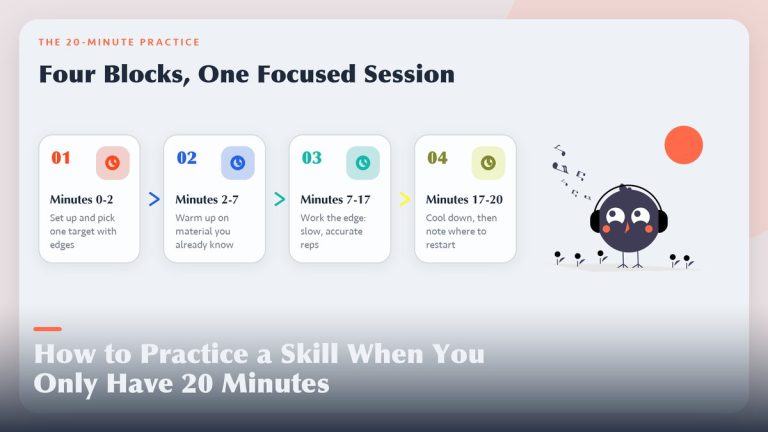
Be equally honest about the time budget, since “I’ll find time” is where skills go to die. If your realistic window is twenty minutes on weeknights, that favors some skills over others, and favors them hard: vocabulary apps, drawing drills, typing practice, and coding exercises all fit that shape, while anything needing setup and teardown, where twenty minutes shrinks to nine by the time the gear is out and the table is cleared, requires a different life to work. Our guide to practicing a skill in twenty minutes covers that system, and it’s worth reading before you commit, because a skill whose minimum session exceeds your free window fails before the interest test even starts.
Filter Four: Cross-Check the Skill Against Reality
For career-adjacent skills, the interest and cost filters aren’t sufficient on their own. You also want a look at demand and pay before investing a year. Two free government resources handle this well. The Bureau of Labor Statistics publishes the Occupational Outlook Handbook, which profiles several hundred occupations with median pay, projected growth for the 2024–34 decade, and typical entry paths. It’s dry in the way only a federal document can be, and I’ve never once minded the dryness. Dry means data. O*NET OnLine, run by the US Department of Labor, goes deeper into the skills each occupation actually uses day to day. Its database covers more than 900 job profiles, each broken into the tasks and tools it involves, so you can check whether “data analyst” means the spreadsheet work you picture or something rather different. Budget five minutes for this before any bootcamp purchase, or fifty if you’re the type to fall down the occupational rabbit hole.
Non-career skills get a different cross-check. Look for local infrastructure before buying in. Does your town have a makerspace with a pottery kiln you can rent by the hour, a community orchestra that accepts adult beginners (rarer than you’d hope), evening classes at the rec center, or a continuing-ed catalog at the community college, where a six-week course often runs a couple hundred dollars? A strong local scene means cheap access to equipment, feedback, and company, and it can flip the math on an otherwise pricey skill, since a makerspace membership around $50 a month beats a garage full of gear used twice.
A skill with a community attached is two skills. The skill itself, and the habit of showing up for it. The second one is what makes the first one happen.
Talk to one person who actually does the thing, if you can. Someone who does it, mind you, rather than someone who teaches it, because a teacher meets beginners on their best behavior while a practitioner sees the skill at its most ordinary. Ask what beginners get wrong, what the first year really looks like, and what they’d skip if they started over; write the answers down, since they consistently differ from the marketing, and sometimes they talk you out of something in the best way, saving you a year. Occasionally they do the reverse. My neighbor the woodworker described his first two years so unflatteringly (months of sharpening, he said, before anything he built was worth keeping) that I signed up for a class the following week. Misery described with that much precision is strangely motivating.
The 90-Day Trial Beats the Lifetime Vow
Everything up to this point has been elimination. Now the choosing part, and the biggest mistake people make here is treating the choice like a marriage. It isn’t. You can take a skill back to the store, and the return policy is called stopping. Framing your commitment as a bounded trial, ninety days with a clear end date and a clear question, takes most of the pressure off and, as a bonus, makes you far more likely to start at all, because an experiment with an exit is a much smaller ask than a vow.
Ninety days is long enough to pass the honeyed beginner phase and hit the first real plateau, yet short enough that you can actually picture it ending. Give the trial a written question instead of a vague hope: “After ninety days of guitar, can I play five songs start to finish?” or “After ninety days of Spanish, can I hold a ten-minute conversation with my coworker?” Both questions are concrete and testable, and a little uncomfortable in the way honest ones tend to be. Then decide in advance what happens at the verdict, because a trial with no verdict is a hobby with extra guilt stapled to it. Three outcomes sit on the table: continue because it earned it, extend once because the answer is unclear, or drop it with zero drama and fold what you learned into the next candidate.
Dropping a skill after a proper trial counts as a success, and I mean that literally rather than as consolation. You’ve learned something real about what holds your attention and what your schedule can absorb, along with what you actually want from an evening, and that information powers the next choice. People who treat dropped skills as personal failures eventually stop trying anything at all, which is the only true failure mode in this entire process. The ones who keep going are the ones who treat quitting a trial as one of the system’s ordinary moving parts, no different from the filters that came before it.
The Red Flags Worth Naming
A few warning signs show up again and again right before a skill choice goes sideways, and since I’ve personally planted most of these flags, let me save you the membership fees.
- Choosing for the identity, not the activity. “Carpenter” sounds great. Sanding a tabletop for three hours on a humid July afternoon is the actual job, and it stays the job whether or not anyone ever sees the table. Buy the experience, never the persona, since the persona costs nothing to imagine, and the experience is what you’re signing up for with your actual Saturdays.
- Big gear before small proof. Any purchase over about $100 before three genuine sittings is speculation, whatever the hobby forums insist. The forums, incidentally, are populated by people for whom the skill stuck, which is survivorship bias wearing a flannel shirt.
- Ignoring the feedback structure. Some skills punish solo learners brutally: golf, singing, lifting weights, anything with a form you can’t see yourself performing. If you can’t observe your own form, budget for feedback from day one: one lesson a month, a club, or a friend with a phone camera all count.
- Choosing what a successful person you admire chose. Their skill fit their life, their patience, and their starting point, none of which are yours. Admiration is a fine reason to run a weekend probe on something. It’s a poor reason to commit ninety days to it.
- Starting during the busiest month of your year. November for most people, or any month with a named holiday attached. Start in a boring month instead, like February or March, which are chronically under-booked, because boring months are underrated engines of personal change and almost nothing competes with them.
None of these flags means a skill is wrong for you. They mean the choice deserves one more weekend of honesty before money changes hands, and that extra weekend is the cheapest insurance in the whole process. The whole process, if you zoom out, is mostly just a series of those weekends stacked in the right order.
What Comes After the Choice
Choose, and then the real work begins, which happens to be the fun part. A few closing pointers from everything I’ve managed to stick with, a shorter list than the one in my seventeen tabs.
Expect the dip somewhere around week four to eight, where the novelty is spent and the competence hasn’t arrived. Everybody hits it, and the dip carries no information about your talent; it’s the standard shape of learning, the same curve whether the skill is cello or sourdough. Our breakdown of how long learning actually takes sets honest expectations for that stretch, and the guide to free resources that are actually worth your time keeps the trial cheap while you find your footing. If the skill you land on fits a twenty-minute daily window, the practice system from our twenty-minute practice guide will carry you through all ninety days without demanding a free evening you don’t have.
When verdict day comes and the answer is “keep going,” give yourself the small ceremony of saying so out loud to one other person. It sounds silly and it works, because a decision spoken aloud is much harder to walk back the following week than one filed away in a notebook. I kept the guitar, in case you’re wondering. The Python went back on the shelf for now, the dog-grooming documentary remains a cherished memory, and I regret neither the choice nor the film.
Prices and pay figures are ballparks for the US and Canada as of late 2026 and vary by city. Career data referenced above comes from the U.S. Bureau of Labor Statistics and O*NET OnLine. External links were checked before publication; if one has drifted, the site names will find them again.