The best road trips I’ve taken had almost nothing booked in advance, and the worst one had every night locked in months early. The middle path is a route with a spine and a lot of wiggle room.
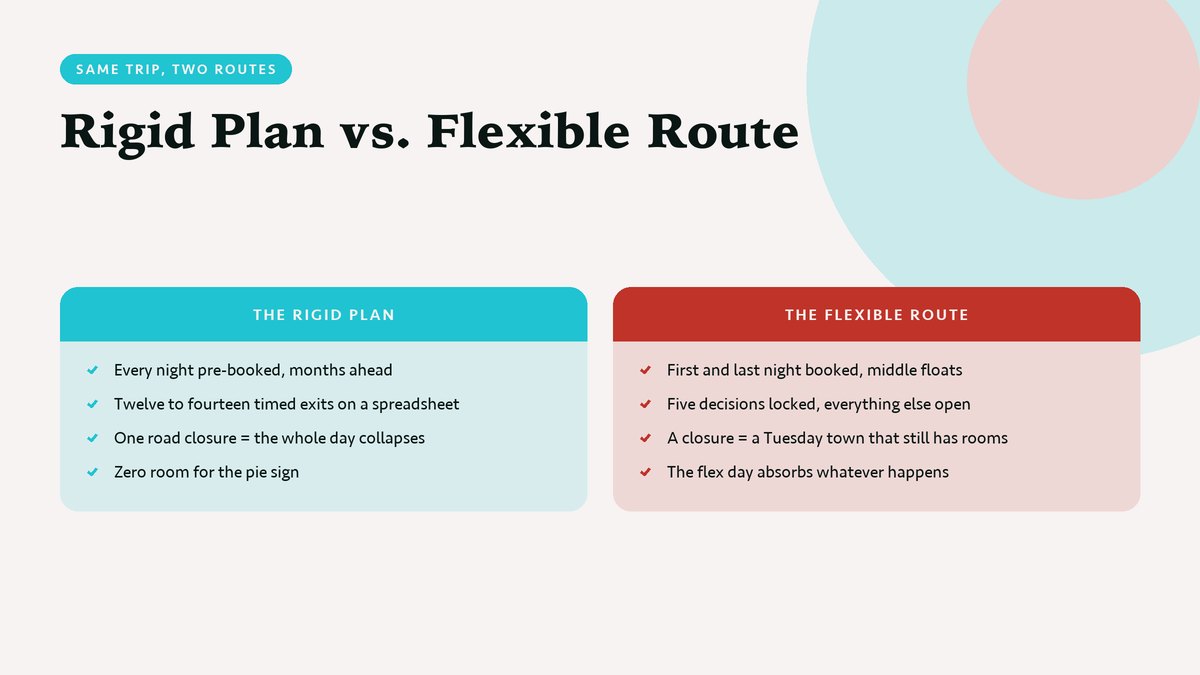
There’s a version of road trip planning that looks great on paper. Hour by hour, four prepaid motel bookings, rest stops timed to the minute in a spreadsheet. Then mile sixty happens, when a pass closes for a rock slide, a town festival eats every parking space, or the lake is just too inviting to leave. Rigid plans don’t survive contact with the road, and I’ve quit expecting them to, because nearly every good trip story I own starts with the plan cracking somewhere after breakfast on day two. Driving somewhere is supposed to have some give in it.
Swings the other way cause their own trouble. No plan at all means an eleven-hour day three because the interesting stuff sat farther apart than the map suggested, or $230 for the last room in a town nobody meant to sleep in. What works is a route with a firm skeleton and loose joints: a start, an end, a rough line between them, and uncommitted space in the middle. That’s how I plan routes now, after a few trips that taught me the expensive way.
The whole setup takes about an hour and a half, or closer to two if the small-town diner research pulls you in, and it will. What you get for that time is a route you can change at breakfast without breaking anything.
In this article
- Start With a Direction, Not an Itinerary
- Anchor the Ends, Leave the Middle Loose
- The Daily Drive Cap That Keeps Trips Fun
- Build a Skeleton Route in Google Maps
- Research Stops Without Pinning Yourself Down
- Know Your Fuel and Time Budget
- One Flex Day Changes Everything
- When the Plan Breaks Anyway
- A Sample Five-Day Flexible Route
- The Ten-Minute Morning Huddle
Start With a Direction, Not an Itinerary
Before opening any app, decide the one thing you won’t compromise on. Usually it’s the endpoint, “we’re ending at the coast,” or an experience, “three days of hiking somewhere green.” Everything else can move. Write that sentence down even though it looks too simple to matter, because every later decision gets measured against it, and decisions that take seconds in September are the ones that still hold up when you’re tired on day four.
Then draw a loose corridor on a map, a couple hundred miles wide, between home and that anchor. Inside the corridor almost anything goes, whether that’s a diner with forty pie varieties or a dirt road up to a fire lookout; outside it you’re forcing things, and I’ve cut whole detours for exactly that reason. Backtracking is the quiet budget-killer of road trips, because it costs driving time twice, forty minutes out and forty back, and pays you nothing the second time since the scenery is identical both ways.
A route is a corridor, not a rail line. One of them forgives a washed-out bridge.
Give yourself a day or two of slack by simply not scheduling the final weekend. If a hot spring keeps you an extra morning, the slack absorbs it; if not, you land at home with a quiet weekend for laundry before work starts again. Both outcomes are fine, which is exactly why the slack works, and it’s the cheapest flexibility in this whole article because leaving a weekend blank costs nothing at all.
Anchor the Ends, Leave the Middle Loose
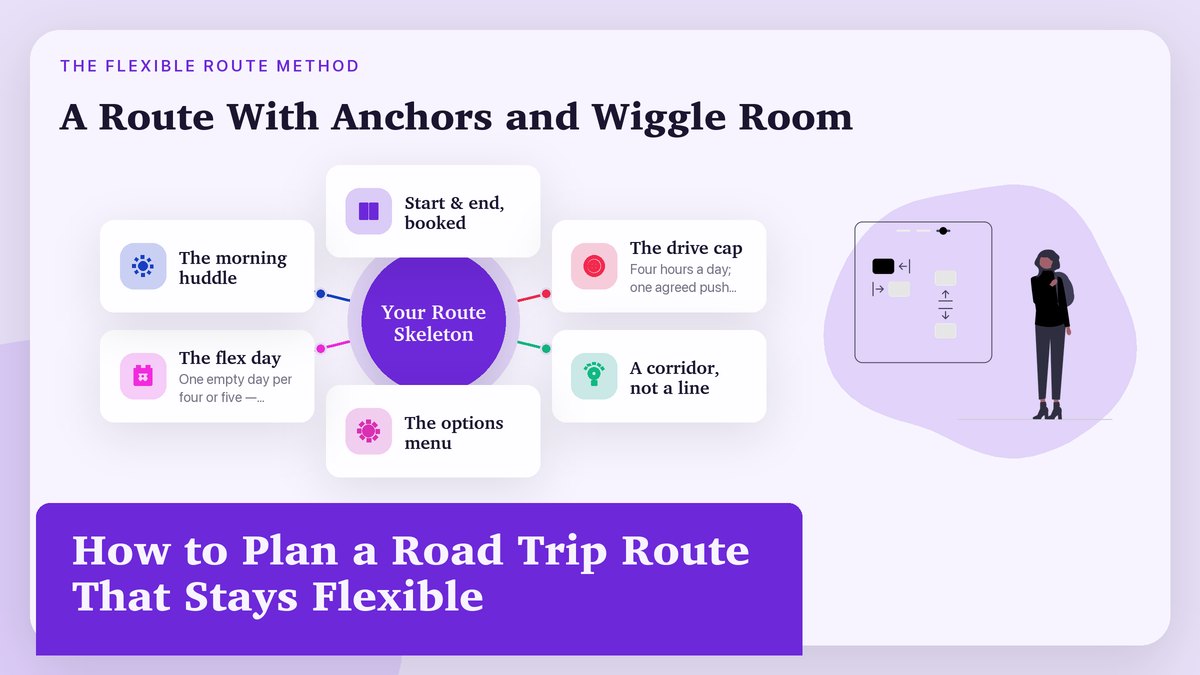
Book exactly two nights, the first one and the last one, and nothing in between. The first booking is insurance against pulling into town tired at 9 PM and finding the one motel full because of a fishing tournament you couldn’t have known about. The last booking is a different animal altogether: a guaranteed bed on the final stretch takes a real weight off the drive home, and you feel it by the second hour.
Everything in between stays open until the morning you need it. People who plan the spreadsheet way find this reckless, but mid-trip booking works better than you’d expect across most of the US and Canada, outside national-park peak weekends and holiday festivals. A Tuesday room in a small city is almost always findable by four in the afternoon, often cheaper than the advance rate, because unsold rooms get discounted same-day, at least in my experience. Some careful comparisons would call it a wash on price, and they may be right, but on my own trips the flexible weeks have come out ahead by a few hundred dollars, holiday towns excepted.
Where the open-middle rule really fails is anywhere with a hard capacity limit: park lodges in July, popular campgrounds, tiny resort towns on a holiday weekend. For those nights, book early. The National Park Service’s trip planning pages count more than 400 national parks and are blunt about how far ahead in-park lodging and timed-entry reservations sell out, and they’re right. So the rule refines itself over time: book any night where the alternative is sleeping in the car, and leave the rest loose.
The Daily Drive Cap That Keeps Trips Fun
Route mistakes rarely happen at the stops. They happen in the distance between them, because map apps shrink everything, and a 260-mile leg looks identical to a 60-mile one on a six-inch screen. Four hours on a screen is four hours of beautiful nothing, plus fuel stops, plus the burger that ran long, plus the antique mall nobody will admit wanting to see.
My cap is four hours of actual driving a day, with one push day allowed per week of trip. The push day is for repositioning between regions, and everyone in the car agrees to it in advance, which matters more than it sounds, because a known long day is fine and a surprise long day breeds mutiny by the second fuel stop, usually somewhere past 5 PM with two hours still to go.
| Daily drive | What it feels like | Best used for |
|---|---|---|
| Under 2 hours | Lazy. Two stops easily fit before lunch | Exploration days around a base town |
| 2–4 hours | The sweet spot. You arrive with energy to do things | Most days of a flexible route |
| 4–6 hours | Tiring. Plan only one activity after arrival | Repositioning between regions |
| 6+ hours | A travel day, full stop. Start early | Once per trip at most; start early |
The cap depends on who’s in the car, though. A solo driver tires roughly an hour sooner than a shared drive does, at least in my experience, and kids have a hard ceiling that has nothing to do with miles. Two-lane mountain or coastal roads take roughly half again as long as the highway option, which the mileage math never shows you, so if your route leans on winding secondary roads, treat the time estimates as optimistic and shave a full hour off the daily cap.
Build a Skeleton Route in Google Maps
With the corridor and the cap set, build the skeleton in Google Maps. You can drop up to nine stops into a single route there, which is more than enough for this. You’re not mapping every gas station, just the stops the plan actually depends on. I pin three to five things: the anchor destination, one or two would-love-to stops, and a rough midpoint to hunt for rooms around.
Then check the route against your cap by driving time instead of miles, and set the departure time to when you’ll actually leave. One road says 3 h 40 min on a Tuesday morning and something closer to five hours at Friday four in the afternoon, and that gap is the difference between a pleasant evening and pulling in after everything’s closed. For any metro-area stretch on the way home, I add a full hour of buffer without thinking about it.
Save the whole skeleton offline before you go, which in Google Maps means downloading the offline map of your corridor from your profile menu. Offline maps matter more than people expect, because canyon country, mountain passes, and long rural stretches in Canada regularly have zero signal, and a route that lives only in the cloud quits on you at the exact wrong moment, usually somewhere with no pull-off in sight. Do it at home on real Wi-Fi the night before, while you still remember.
Map apps tell you the fastest way. You still have to pick the nicest way. They’re rarely the same road.
Research Stops Without Pinning Yourself Down
A flexible route still needs a menu of options, and building the menu is the fun part of planning, the part that happens at the kitchen table with a laptop. Collect options instead of commitments: a waterfall an hour off-route is an option, but writing it into day three as a must-see turns it into an obligation, and obligations make a flexible route feel exactly like the rigid one you were trying to escape.
For the menu itself, Roadtrippers is the tool I’d reach for first, because it’s built for exactly this job. Set a start, an end, and a corridor width, and it surfaces the oddball stuff along it, the giant roadside statue, the overlook, the small museum nobody planned on. Cross-check anything promising against recent reviews, since roadside attractions close more often than their websites let on. One dead link across three states is a shrug; three in one afternoon is a pattern, and the pattern means call ahead or move on.
Keep the list short, around six to ten items for a week-long trip, maybe a dozen if you’re the thorough type. Forty maybes is procrastination in list form, and nobody reads forty options at a gas station; they freeze over the phone with the tank at a quarter. I’d rather carry seven good options and pick two than carry thirty and pick none.
Know Your Fuel and Time Budget
Flexibility costs money if you don’t budget for it, and two numbers are worth nailing down before you leave: fuel and a nightly lodging ceiling. For fuel, the US Department of Energy’s trip calculator beats napkin math by a mile, because it adjusts for your actual car on your actual route, and mountain grades, roof boxes, and 75-mph interstates all drag real-world mileage below the sticker number. I add about fifteen percent to whatever it estimates and I’ve never come up short. The same calculator, in case you’re curious, will judge your daily commute if you let it.
The lodging ceiling, at least the way I use it, does two jobs at once. Set it around $130 a night in most of the US, more in Canada, and considerably more near famous parks in July. It keeps the flexible middle from getting expensive, and it makes same-day booking decisions fast: six options under the ceiling means you stop scrolling and pick one in about four minutes, and you’re back on the road.
Food is where the budget surprises people, because restaurant meals three times a day for a week total to a number that shocks first-timers, somewhere north of $600 for two people in most of the US. One cooler meal a day knocks roughly a third off that. Buy groceries before leaving home, at your normal store, because the tourist-town store knows exactly what it’s doing with those prices, and it is not on your side.
One Flex Day Changes Everything
If you take one idea from this article, make it this one: for every four or five days of trip, leave one day completely unplanned, not lightly planned but empty, with no destination, no reservation, and no menu of options. Wake up where you are and decide at breakfast over coffee. Call it the flex day, and guard it from your own urge to fill it while planning, because the urge will absolutely come.
The flex day is where road trips earn their reputation. It’s staying two nights in the town that was supposed to be a stopover, or six hours at a lake because the weather turned perfect, or following a hand-painted sign to pie forty minutes off-route and talking to the owner for an hour. None of that fits a scheduled itinerary, and all of it is what you actually remember a year later. My flex days have been the highlights of whole trips, and I’ve never once regretted the empty square on the plan.
It works because of everything else in this article: the un-booked middles, the drive cap, the researched menu. They all converge on the ability to say “we’re staying” at nine in the morning with zero fallout, and even if your route keeps nothing else from this article, a flex day alone puts you ahead of most road trippers.
When the Plan Breaks Anyway
Even the loosest plan meets reality. Storms close passes, wildfire smoke grays out a scenic drive, a breakdown eats a day in a garage bay. The flexible route absorbs these hits far better than a rigid one, but only if the first hour of the problem goes well.
The habit that saves trips is checking weather and road conditions every morning before leaving the parking lot. The National Weather Service site is the reliable US source for forecasts and hazard warnings, and most states and Canadian provinces run 511 road-condition services that report closures and chain requirements in real time. Ten minutes of checking beats two hours sitting at a closure barricade, and it often reveals the trouble sits twenty miles ahead, close enough to detour around and far enough that you’d have hit it at noon otherwise.
When something does go wrong, run the corridor rule in reverse. Ask which direction keeps you inside your corridor, and take it. Closed pass to the south? The town you passed yesterday is still there, still has rooms on a Tuesday, and becomes an unplanned rest day rather than a disaster. The skeleton bends. It doesn’t snap, because nothing in the middle was load-bearing.
Breakdowns end more trips than weather does, so a quick word on those. Get the tires, battery, oil, and coolant checked about a week before a long trip, and don’t forget the spare, because everyone forgets the spare. It runs maybe fifty bucks at a quick-lube place and it’s the cheapest insurance on this entire list. Then keep a paper fallback for navigation, because a dead phone shouldn’t strand anyone; the eight-dollar state highway map in the glove box has rescued more trips than any app feature I know of.
A Sample Five-Day Flexible Route
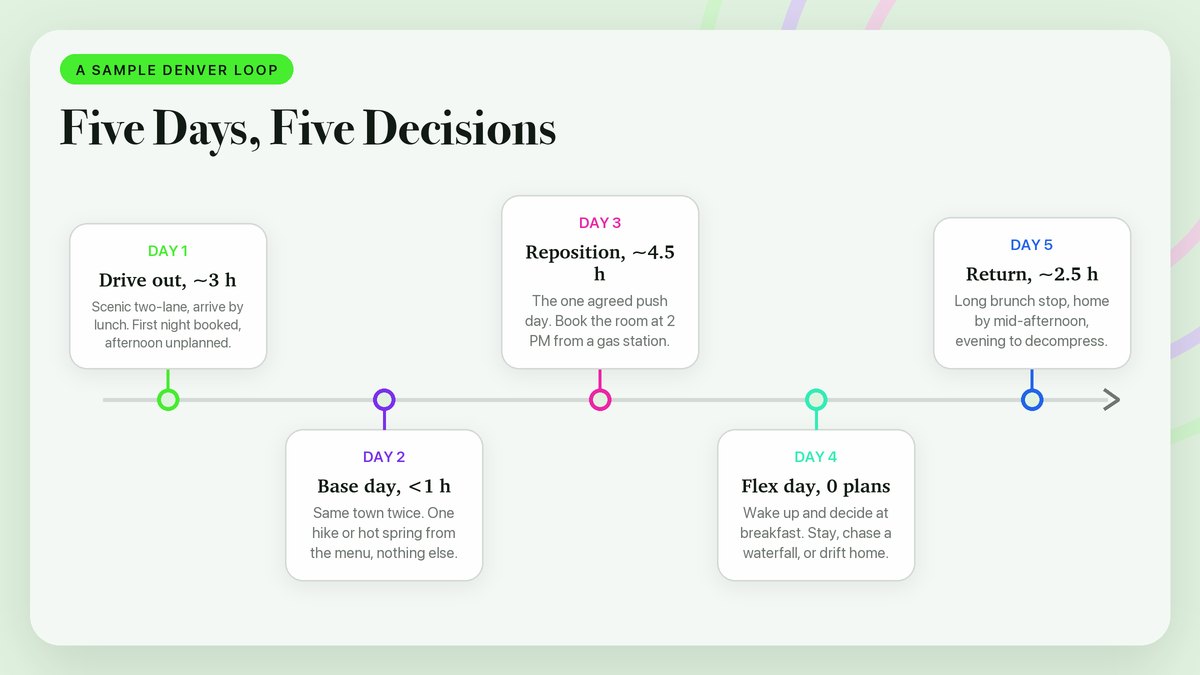
The whole system, assembled on a classic example, a loop from Denver out through the Colorado mountains. Five pinned items in the skeleton. Everything else floats.
- Drive out on day 1, about 3 h. Leave Denver by 8 AM, take the scenic two-lane instead of the interstate, and arrive in the first mountain town by lunch. First night is booked. The afternoon is unplanned, so walk the main street and see what the town offers on its own.
- Base day on day 2, under 1 h of driving. Sleep in the same town twice. One big hike or hot spring from the options menu, nothing else on the list. This is the day a rigid itinerary would have ruined by checking out at 10 AM.
- Reposition on day 3, roughly 4.5 h. The one agreed push day. Cross to the other side of the range on the fastest reasonable route, stop once at the single must-see overlook, and book the room around 2 PM from a gas station with good signal.
- Flex day on day 4, zero commitments. Wake up and decide. Stay a second night, chase a waterfall, or drift toward home a day early if everyone’s tired. The last-night booking near Denver doesn’t care either way.
- Return on day 5, about 2.5 h. Short morning drive home with a long brunch stop somewhere. Home by mid-afternoon with a whole evening to decompress before work.
Count the commitments in that plan. Two booked nights out of four, one agreed long drive, one pinned activity. That’s a full, memorable five-day trip resting on five locked-in decisions. The spreadsheet version of the same trip runs twelve or fourteen bookings with timed exits and no room for the pie sign. Same miles covered. Nothing alike in how they feel.
A year later you won’t remember the miles; you’ll remember the pie place you found forty minutes off-route.
The Ten-Minute Morning Huddle
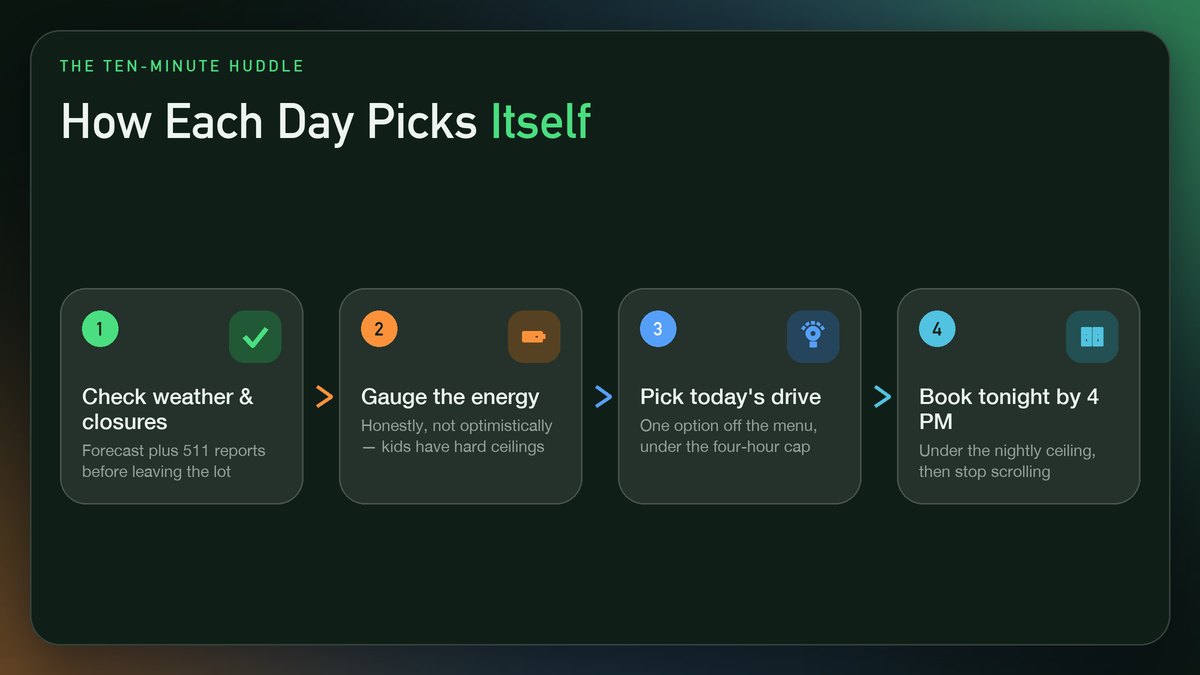
This system runs on one small daily ritual, and it’s the least glamorous part of this article. Before leaving wherever you slept, take ten minutes over coffee with everyone present, and run three questions: what is the weather doing where we’re headed, how is everyone’s energy, answered truthfully rather than optimistically, and which drive from the options menu fits those two answers. That’s the entire ritual, ten minutes including the coffee refill.
Book tonight’s room by mid-afternoon, four PM is my cutoff, keep the drive under the cap, and let the flex day absorb whatever the questions surface. The huddle is what turns a loose pile of ideas into a working route each morning, and it takes less time than the motel’s continental breakfast line.
One honest caveat. This style of trip asks a little more of the planner, because you’re making real decisions every day instead of executing decisions made months ago, and some people find that tiring by day six. If that sounds like you, split the difference and pre-book every other night, leaving the rest loose. Half the flexibility still buys most of the benefit. The point was never to reject planning; it’s to plan the things that matter, the ends, the cap, the one or two must-sees, and refuse to plan the things that don’t, like which exact motel or whether the waterfall happens before lunch.
The road, in the end, will have opinions about your trip no matter what you schedule, and a flexible route is just a way of leaving yourself room to agree with them early.
Related reads on this site: How to Plan a Road Trip Without Over-Scheduling Every Day and How to Find Interesting Stops on Long Drives (Beyond Gas Stations). External sources are linked inline above; all links checked before publication.