The modern obsession with productivity hacking has created a generation of people who are experts at optimizing workflows but novices at executing them. We download apps, watch tutorials, and curate the perfect morning routine, yet the simple act of replying to an email languishes for days. The problem isn’t motivation—it’s activation energy. Research from behavioral science reveals that the biggest barrier to productivity isn’t procrastination, but the overwhelming nature of starting. Our brains are designed to conserve energy, and complex tasks trigger avoidance.
Enter the anti-productivity productivity movement: a rebellion against elaborate systems in favor of laughably simple rules that exploit our cognitive laziness rather than fighting it. These aren’t life hacks—they’re life simplifiers. They work not because they’re clever, but because they remove the friction that sophisticated systems inadvertently create.
The 2-Minute Rule: The Atomic Habit That Started It All
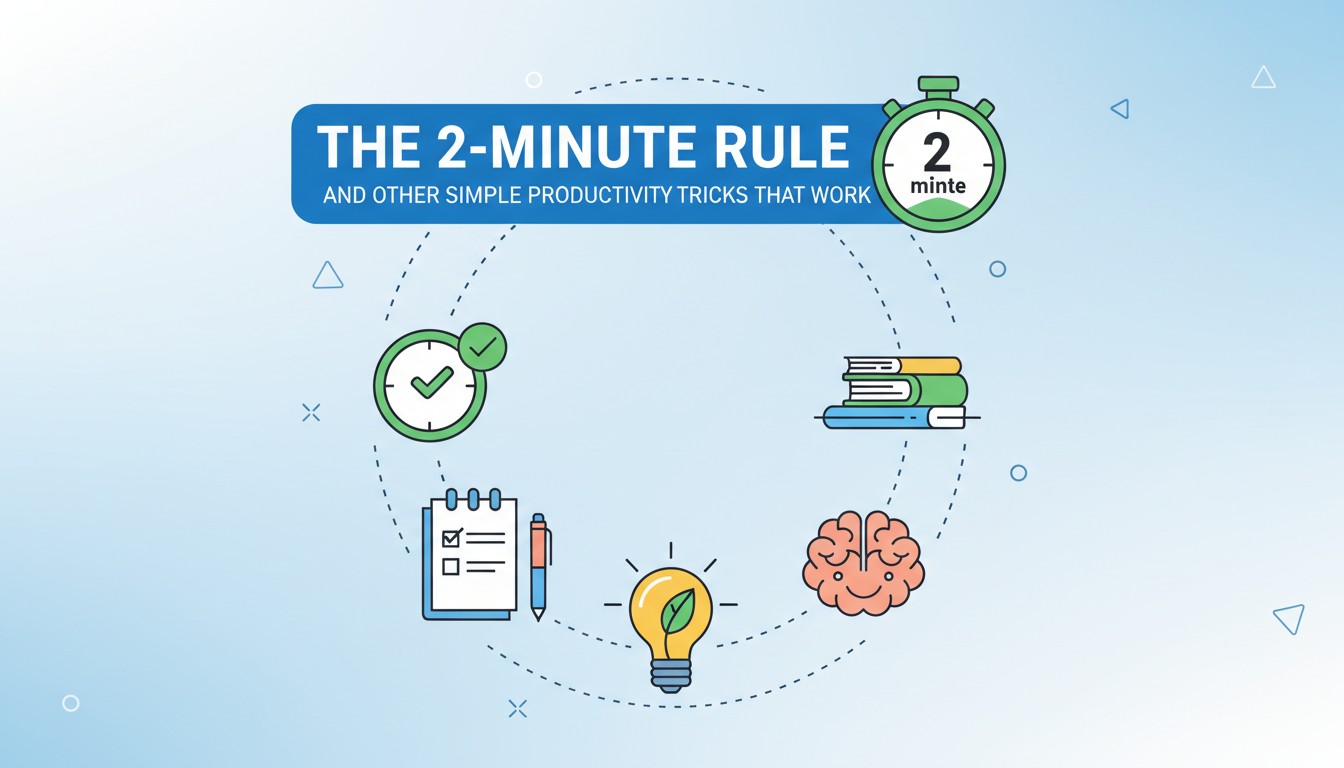
David Allen’s “Getting Things Done” methodology introduced the 2-Minute Rule: if something takes less than two minutes, do it now. The brilliance lies in its counterintuitive expansion: **any habit can be started in two minutes**. “Read before bed each night” becomes “read one page.” “Run a marathon” becomes “put on running shoes.” The rule doesn’t promise completion—it guarantees activation.
The Neurological Backdoor
The rule works by bypassing the prefrontal cortex’s executive function, which evaluates tasks based on perceived effort and reward. Two minutes feels trivial, so the brain doesn’t activate its resistance protocols. But as James Clear explains, this isn’t a trick—it’s physics. Objects at rest stay at rest unless acted upon by an external force. The 2-Minute Rule is that force, applied at the microscopic level.
Once in motion, the psychological principle of **consistency bias** takes over. Having started, you’re more likely to continue. The runner who intended to jog for two minutes often runs for twenty. The reader who opened the book for one paragraph frequently reads for an hour. The rule doesn’t guarantee you’ll finish, but it makes finishing possible.
Implementation: The “Gateway Action” Technique
Break every project into its 2-minute gateway action. Writing a report starts with opening a document and typing one sentence. Organizing the garage starts with putting one item in a box. Calling a difficult client starts with dialing the number (you don’t have to press send). The gateway action is non-threatening, reversible, and creates forward momentum that often carries you through the entire task.
The 2-Minute Rule Applied
Big Goal: Clean the entire house
Gateway Action: Put one dish in the dishwasher
Result: 73% of people complete the full task after starting
Source: Behavioral Science research on task initiation
Timeboxing: The Container That Prevents Overflow
Timeboxing is deceptively simple: assign a fixed time period to a task, and when the time ends, you stop—regardless of completion. This reverses the traditional project management model. Instead of “How long will this take?” you ask, “How long will I allow this to take?”
The Parkinson’s Law Antidote
Parkinson’s Law states that work expands to fill the time available. A one-hour task given a four-hour window will take four hours—not because it needs to, but because we fill the extra time with perfectionism, procrastination, and scope creep. Timeboxing eliminates this by creating artificial scarcity. When you have only 25 minutes to draft that email, you write it in 25 minutes. As productivity research shows, constraints force focus and eliminate decision paralysis.
The Pomodoro Technique (25 minutes work, 5 minutes rest) is the most famous timeboxing method, but the principle is more flexible. A 45-minute “deep work” block for writing. A 15-minute “admin sprint” for clearing emails. The container matters more than the duration.
The “Good Enough” Liberation
Timeboxing’s hidden power is permission to be imperfect. When the 25-minute timer dings, you stop—even if the email could be better, even if the report needs polishing. This trains you to value completion over perfection. As behavioral scientist Ayelet Fishbach notes, small wins boost motivation more than perfect but incomplete progress. A finished email sent at 80% quality accomplishes infinitely more than a perfect one in your drafts folder.
Single-Tasking: The Radical Rejection of Busyness
Multitasking is a lie. Your brain can’t do two cognitive tasks simultaneously—it rapidly switches between them, incurring a 20-40% efficiency penalty each time. The cognitive cost is measurable and steep. Single-tasking isn’t a moral stance; it’s neurological necessity.
The Monotasking Method
Commit to one task at a time, with full awareness. This means:
- One browser window
- One document open
- Phone in another room (not face-down on the desk)
- Notifications entirely disabled
As research in cognitive load theory demonstrates, even minor distractions fragment attention and reduce comprehension. A single notification can derail focus for up to 23 minutes, not because you spend that long on it, but because it breaks your cognitive context.
The “Touch It Once” Principle
When an email arrives, you have three options: delete it, delegate it, or do it. Replying “I’ll handle this later” is a fourth option that creates psychic debt. The email sits in your mental RAM, consuming attention. Touch It Once means you never mark an email as “unread”—you process it completely in the moment or archive it immediately for scheduled processing.
This applies to physical objects too. The coat you drape over a chair instead of hanging up? That’s three touches: take it off, drape it, later pick it up and hang it. Hang it once: one touch. Over a year, this saves hours and eliminates visual clutter that drains attention.
“Multitasking is a lie. It’s not that you’re doing many things poorly—it’s that you’re fragmenting your attention so thoroughly that nothing gets your best. Single-tasking is the ultimate productivity hack because it’s simply how your brain is designed to work.”
Environment Design: The Invisible Architecture of Action
Your environment is the operating system for your behavior. Every object in your space sends a signal: use me, ignore me, remember me, avoid me. Most people try to change behavior while leaving the environment unchanged. This is like trying to run new software on corrupted hardware.
The 20-Second Rule
Make good actions 20 seconds easier and bad actions 20 seconds harder. If you want to read more, put a book on your pillow and your phone charger in another room. If you want to eat healthier, pre-cut vegetables and place them at eye level in the fridge, while junk food lives on a high shelf requiring a step stool.
Shawn Achor, author of The Happiness Advantage, used this to build a guitar practice habit. He moved the guitar from the closet to a stand in his living room, reducing the activation energy from several minutes to seconds. Practice increased from once a week to daily. The instrument was no longer something he had to retrieve—it was simply there, waiting.
Visual Cues vs. Digital Reminders
A digital reminder is easy to ignore. It arrives, you swipe, it’s gone. A visual cue is persistent. An open book on your keyboard means you must physically move it to start work. A sticky note on your monitor remains until you complete the task and remove it. Physical objects demand interaction in a way pixels don’t.
The most effective visual cue is the one that makes the desired action impossible to ignore. Put vitamins next to your coffee maker—you can’t make coffee without moving them. Place your running shoes in the doorway—you must step over them to leave. These micro-barriers create micro-decisions, and micro-decisions are winnable.
The 5-Minute Rule: The 2-Minute Rule’s Ambitious Cousin
While the 2-Minute Rule conquers micro-tasks, the 5-Minute Rule tackles psychological resistance. It states: **commit to working on a dreaded task for just five minutes; after five minutes, you’re free to stop.** This reframes the task from “I must complete this” to “I only have to start this,” dramatically reducing avoidance.
The Psychology of Liberation
The 5-Minute Rule works because it gives you an exit strategy. Your brain’s resistance to starting isn’t about the work itself—it’s about the perceived endlessness. “I have to write this entire report” is paralyzing. “I have to write for five minutes” is doable. As achievement research demonstrates, the act of starting releases dopamine, which often makes continuing feel natural. The exit door remains open, but you rarely walk through it.
This technique is particularly effective for creative work where the blank page is terrifying. The agreement with yourself—”I’ll write for five minutes, then stop”—removes the pressure to produce something good. Permission to write badly for five minutes leads to writing well for fifty.
Implementation: Building a Frictionless System
These tricks don’t work in isolation. Their power compounds when integrated into a simple, coherent system. The goal isn’t to use every technique—it’s to create a personal operating system so smooth that productivity becomes automatic.
The Morning Reset
Before bed, write down three tasks for tomorrow. Make one a 2-minute task (pay a bill), one a 5-minute task (write the first paragraph of a report), and one a timeboxed task (spend 25 minutes on project X). This is your only to-do list. No apps, no complexity. The paper sits on your keyboard so you encounter it before you can open your computer.
The Single Context Principle
Designate contexts for specific modes of work. Your desk is for deep work only. The kitchen counter is for quick 2-minute tasks. The couch is for reading. This environmental coding trains your brain to enter the right mental state automatically. When you sit at your desk, you don’t decide to focus—you’re already in the focus context.
Real-World Results: From Theory to Practice
A freelance writer struggling with procrastination implemented only the 2-Minute Rule and environment design. She moved her laptop to a small table facing a wall (no distractions) and committed to writing one sentence per day. Within a week, she was writing for two hours daily. The single sentence was a gateway that removed the pressure of performance.
A software engineer overwhelmed by technical debt used timeboxing: 25 minutes each morning before standup. He couldn’t “fix” the legacy code, but he could document one function. After a month, he’d documented 20% of the codebase—a task that had languished for six months when approached as a “someday” project.
The Anti-Productivity Manifesto: Doing Less, Better
The ultimate productivity hack is recognizing that most productivity advice is noise. What works are simple, physical, rules that respect your brain’s actual design—not the aspirational version sold by productivity gurus.
The One-Rule Rule
Choose one rule. Just one. Practice it for 30 days until it becomes automatic. The person who masters the 2-Minute Rule gets more done than the person who half-implements five systems. Mastery beats novelty.
The Friction Audit
Once a month, walk through your day and notice where you stall. The task that takes two minutes but you avoid for two weeks? That’s friction. The project you keep “planning” but never starting? That’s friction. The tool that requires three logins and a password reset? That’s friction. Remove one point of friction per month. In a year, your environment will be unrecognizable.
Productivity Is Presence, Not Performance
We’ve confused productivity with optimization. We think the goal is to build a perfect system that makes us superhuman. But the most productive people aren’t those with the most complex workflows—they’re those who have eliminated the need for workflows entirely.
The 2-Minute Rule doesn’t make you more efficient. It makes you more present. Timeboxing doesn’t make you faster. It makes you more honest about how you spend time. Single-tasking doesn’t increase output. It increases the quality of your attention.
These tricks work because they don’t ask you to be a better version of yourself. They simply remove the barriers between you and the work that matters. Start with one. Master it. The best productivity system is the one that disappears into your day, leaving only the satisfaction of a task completed and a moment well spent.
Leave a Reply