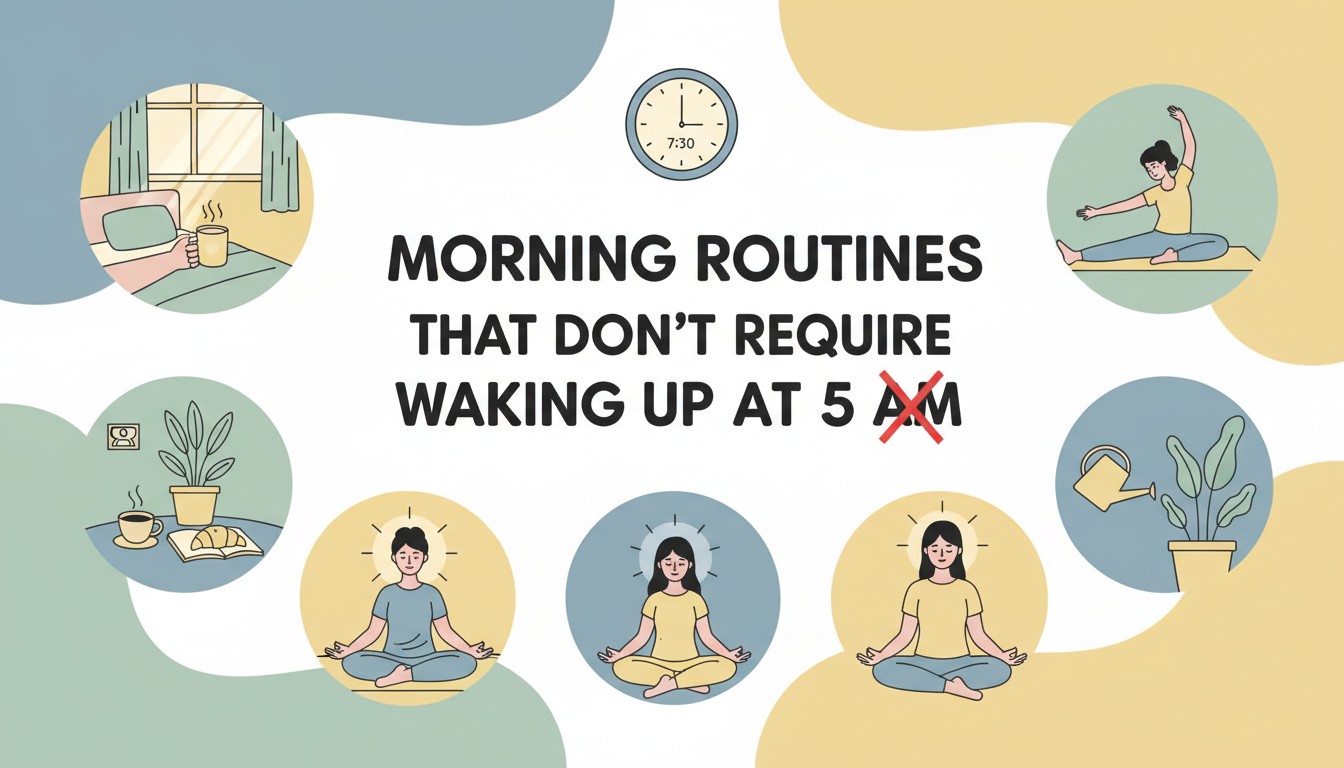
The 5 AM Industrial Complex has sold us a lie: that moral superiority rises with the sun. We’ve been conditioned to believe that waking before dawn is the price of admission to productivity, wellness, and success. But neuroscience tells a different story. Circadian rhythm research confirms that your internal clock is genetically programmed, not morally adjustable. Forcing yourself into a lark schedule when you’re biologically a night owl doesn’t build character—it builds sleep debt, cortisol spikes, and resentment.
The truth is more liberating: effective morning routines have nothing to do with wake-up time and everything to do with **alignment**. A routine that honors your chronotype—your body’s natural rhythm—outperforms any pre-dawn ritual that fights it. The goal isn’t to wake earlier; it’s to wake better.
The Chronotype Reality: Why Your Genes Set Your Alarm
Before you can build a morning routine that works, you must understand what you’re working with. Chronotype isn’t a preference—it’s a biological trait, as innate as eye color. The Sleep Foundation explains that the master clock in your suprachiasmatic nucleus runs slightly longer than 24 hours in most adults, requiring daily environmental cues (zeitgebers) to stay aligned. Some people’s clocks run fast (morning larks), others run slow (night owls), and most fall somewhere in between.
The Morning Lark Myth
Society is built for morning people. School starts at 8 AM, work at 9 AM, and the entire cultural narrative celebrates early risers. But only about 40% of the population are true larks. The rest are either neutral (50%) or night owls (10%). When you force an owl into a lark schedule, you’re fighting genetics.
The damage is measurable. Research on chronotypes shows that night owls forced into early schedules show performance impairments equivalent to being legally intoxicated. Their prefrontal cortex—responsible for decision-making and emotional control—operates at reduced capacity for the first several hours after waking. You’re not lazy; you’re operating on biological jet lag.
The Night Owl Advantage
Here’s what the wellness industrial complex won’t tell you: night owls show peak creativity and analytical thinking between 7 and 10 PM. Their brains are primed for complex problem-solving when the world is quiet. The 5 AM routine doesn’t just waste their natural talents—it actively sabotages them.
Instead of forcing a 5 AM wake-up, owls should optimize for a later schedule. Wake at 7:30 AM, yes, but protect your evening “on” time. Do your creative work after dinner. Save morning hours for rote tasks that don’t demand peak cognitive performance. This isn’t making excuses—it’s strategic alignment.
“An adult’s natural internal clock is on average 24.2 hours. We use external stimuli to help entrain this rhythm daily to 24 hours. Changing the amount and times of sunlight exposure, or changing our routines, can send signals to our ‘master clock’ and shift our natural circadian rhythms.” — Sleep Foundation
The Buffer Zone: A Gentle Entry Into Consciousness
The most successful non-5 AM routines share a common feature: they don’t start the moment you open your eyes. Instead, they create a **buffer zone**—a 15- to 30-minute bridge between sleep and full engagement that respects your body’s need for gradual arousal.
The Science of the Warm Start
When you wake, your core body temperature is at its lowest point of the day. Your brain transitions from delta waves (deep sleep) to alpha waves (wakefulness) through a process that can’t be rushed. Abruptly demanding peak performance during this transition floods your system with cortisol, the stress hormone that morning routines supposedly reduce.
A buffer zone works with this biology. It might look like this: you wake at 7 AM, but you don’t “start” your routine until 7:20. Those first 20 minutes are for gentle arousal—sitting up, drinking water, maybe looking out the window. No phone, no decisions, no productivity demands. This isn’t wasted time; it’s neurological priming.
Light as the Primary Cue
The most powerful zeitgeber (time-giver) is light. Rather than jolting yourself awake with a blaring alarm, use gradual light exposure. Open curtains immediately upon waking. If it’s still dark, turn on a bright light—ideally a full-spectrum lamp. This signals your suprachiasmatic nucleus that the day has begun, initiating the hormonal cascade that makes you feel alert.
For night owls who wake when it’s light out, this is natural. For anyone waking before sunrise in winter, a light therapy lamp becomes essential. Research shows that strategic light exposure can shift your circadian rhythm by up to two hours—but it takes days of consistency, not a single heroic morning.
Modular Morning Blocks: Build Your Own Routine
The fatal flaw of most morning routine advice is its rigidity: meditate, journal, exercise, cold shower, green juice, in that order, every day. This works for exactly one person—the one who created it. For everyone else, it’s a recipe for failure.
A sustainable approach treats morning routine as modular—a collection of blocks you can assemble based on time, energy, and priorities. Each block takes 5-10 minutes and serves a specific function. Choose 2-3 blocks daily; rotate based on need.
The Hydration Activation Block
Before coffee, before breakfast, before anything: 16 ounces of room-temperature water with a pinch of sea salt. Your brain is 75% water; overnight dehydration impairs cognitive function. This isn’t a wellness trend—it’s basic physiology. The salt adds trace minerals and helps cellular absorption.
Make it automatic: place a glass and water carafe by your bed the night before. When you wake, it’s already there. No decision, no effort. This is **habit stacking** at its simplest: wake up → drink water → become slightly more human.
The Movement Prime Block
You don’t need a 5 AM HIIT class. You need to tell your body it’s time to move. This can be 20 jumping jacks, a 5-minute yoga flow, or simply touching your toes 10 times. The goal isn’t fitness—it’s activation.
For night owls who feel like concrete at 7 AM, the movement block is non-negotiable. It doesn’t have to be intense. One traveler I know does “bed yoga”—stretching while still under the covers. It sounds ridiculous, but it works. Her body transitions from horizontal to vertical without the shock of leaping into action.
The 3-Block Morning Template
Block 1 (0-10 min): Hydration + Light exposure
Block 2 (10-20 min): Movement + Mindfulness
Block 3 (20-30 min): Nutrition + Planning
Select any 2 blocks based on your schedule. Rotate daily if needed.
The Mindfulness Micro-Dose Block
Meditation doesn’t require 20 minutes and a cushion. Research demonstrates that 5 minutes of daily meditation for just 7 days significantly reduces cortisol and strengthens neural connections between the prefrontal cortex and amygdala. This is the brain’s brake pedal for emotional reactivity.
The micro-dose approach: while your coffee brews, do nothing but breathe. Watch the water. Listen to the hiss. When your mind wanders (it will), gently return to the sound. That’s it. You’ve just mediated. The cue (coffee brewing) triggers the routine (breathing), which delivers the reward (reduced anxiety). This is **habit stacking** again—using an existing behavior to anchor a new one.
The 5-Minute Morning: The Ultimate Non-5 AM Routine
Here’s the radical reframe: your entire morning routine can be 5 minutes. Not as a compromise—as a design principle. The science of habit formation shows that simple, repetitive behaviors form habits faster than complex routines. Morning routines fail not from lack of ambition, but from excess complexity.
The 3 M’s Framework
Dr. Rangan Chatterjee’s “3 M’s”—Mindfulness, Movement, Mindset—provide a scalable template. Spend 1-2 minutes on each. That’s it. Five minutes total.
Mindfulness (1-2 min): While coffee brews, breathe deeply. Notice the aroma. Feel the warmth of the mug. This isn’t meditation—it’s presence.
Movement (1-2 min): Two bodyweight squats. Three push-ups against the counter. A 30-second stretch. The goal isn’t fitness—it’s signaling to your body that the day has begun.
Mindset (1-2 min): One sentence of gratitude. Not a journal entry—just a thought. “I’m grateful for this coffee.” “I’m grateful I have a bed to wake up in.” The psychological shift from scarcity to abundance happens in seconds.
The genius is in its unambitiousness. You can’t fail. You can’t “not have time.” You can do this at 7 AM, 8:30 AM, or whenever you wake. The routine bends to your life, not the reverse.
Evening Preparation: The Morning Routine That Starts at Night
The most effective morning routines are designed before bed. This isn’t about rigid preparation—it’s about reducing decision fatigue. Every choice you eliminate from your morning is one less obstacle between you and a successful start.
The 5-Minute Reset
Before sleep, spend 5 minutes setting up your morning. Fill the water glass. Lay out workout clothes (if you’re exercising). Put the coffee mug by the machine. Set out a notebook for the mindset block. This environmental design cuts habit initiation time by up to 50%, according to research on behavior change.
For night owls who struggle with morning inertia, this prep is non-negotiable. Your 7 AM brain isn’t capable of complex decisions. It needs to find everything ready, like a trail of breadcrumbs leading to the routine.
The Sleep Hygiene Foundation
You can’t have a good morning without a good night’s sleep. The Sleep Foundation’s guidelines are clear: maintain a consistent sleep schedule, avoid screens 30 minutes before bed, and keep your bedroom cool and dark. For night owls, this means protecting your late-evening creative time while ensuring you still get 7-8 hours. If you naturally fall asleep at midnight, waking at 7 AM gives you the same sleep duration as the 5 AM riser who sleeps at 10 PM.
The difference? The night owl’s routine respects their biology. The 5 AM riser might be cutting their sleep short, accumulating a “sleep debt” that impairs cognitive function and emotional regulation. Over time, this debt manifests as irritability, poor decision-making, and increased health risks.
Real-World Routines: Four Chronotypes, Four Approaches
Theory becomes useful when applied. Here are four morning routines, each designed for a different chronotype and schedule. Notice how none require 5 AM, yet all create a meaningful start.
The Night Owl Professional (Wakes 7:30 AM)
Sarah is a graphic designer who does her best work after dinner. She wakes at 7:30 AM for a 9 AM start.
7:30-7:40: Buffer zone. Sits up, drinks water, looks out window. No phone.
7:40-7:45: Movement block. 20 jumping jacks while coffee brews.
7:45-7:50: Mindfulness block. Watches coffee drip, breathes deeply.
7:50-8:00: Planning block. Reviews one priority for the day.
Total routine time: 20 minutes. She arrives at her desk alert, not resentful.
The Early Bird Parent (Wakes 6:00 AM)
James is naturally a morning person but has kids, so his time is limited. He wakes at 6 AM when his daughter does.
6:00-6:10: Hydration block. Drinks water while making his daughter breakfast.
6:10-6:15: Mindset block. Writes one sentence of gratitude on a sticky note while she eats.
6:15-6:20: Movement block. Stretches while she brushes her teeth.
The routine is integrated into existing responsibilities. It adds no time but transforms the morning’s emotional tone.
The Shift Worker (Wakes 10:00 AM)
Maria works nights and sleeps until 10 AM. Traditional morning routines are meaningless to her schedule.
10:00-10:10: Buffer zone. Opens curtains, drinks water.
10:10-10:15: Light exposure block. Sits by a bright window or uses a light therapy lamp while eating breakfast.
10:15-10:20: Movement block. Walks around the block (daylight + activity = double circadian reset).
Her “morning” is midday, but the principles are identical. She respects her sleep-wake cycle, not the clock on the wall.
The Psychology of Consistency: Why “Never Skip Twice” Works
Habit formation fails when we treat it as an all-or-nothing endeavor. Miss one day, and the streak is broken, so why continue? The research tells a different story. Studies show that habit formation takes a median of 59-66 days, but missing a day doesn’t reset the clock. What matters is the pattern, not perfection.
The Never Skip Twice Rule
This simple rule maintains momentum: you can skip one day, but never two. Life happens—kids get sick, alarms fail, you’re simply exhausted. One missed day is an anomaly; two consecutive misses becomes a new habit (of not doing the habit).
When you miss a day, make the next day non-negotiable. Lower the bar if needed: a 1-minute routine is better than a 0-minute routine. The goal is maintaining the pattern, not achieving perfect execution.
Identity-Based Habits
The neuroscience of habit formation shows that behaviors repeated in consistent contexts strengthen synaptic connections in the basal ganglia, making them automatic. But this process accelerates when the habit aligns with identity. “I am someone who moves in the morning” is more powerful than “I do exercise in the morning.”
Build your routine around who you want to be, not what you want to do. The night owl who identifies as “someone who protects their creative energy” will naturally craft a routine that preserves evening peak performance. The early bird who sees themselves as “someone who greets the day calmly” will prioritize buffer time over productivity.
The Habit Resilience Scorecard
Rate your morning routine on these factors (1-5):
- Does it respect my natural wake time?
- Can I complete it in under 30 minutes?
- Does it require minimal decision-making?
- Can I do it while traveling?
- Does it make me feel better, not worse?
Score 20+ = Sustainable. Score below 15 = Rethink your approach.
Digital Minimalism: Tools That Help Without Hijacking
The paradox of morning routine apps is that they often become another source of stress—another notification demanding attention, another streak to maintain. The solution is digital minimalism: use technology as a tool, not a taskmaster.
The Analog Advantage
A simple notebook by your bed outperforms most apps. No battery to charge, no login required, no algorithm tracking your “performance.” Each morning, write one sentence. That’s it. Over time, these sentences create a narrative of your mornings that no app can replicate.
For the hydration block, mark a glass with tape to show 16 ounces. When it’s empty, you’ve completed the block. Visual cues beat digital reminders.
Strategic App Use
If you must use apps, choose ones that reduce friction. A smart coffee maker that starts brewing at your wake time. A sunrise alarm clock that gradually brightens your room. A simple meditation timer that requires one tap.
Avoid apps that gamify your routine with streaks or scores. The research is clear: externally imposed habits have a 37% lower success rate than self-selected ones. When your routine becomes about maintaining a streak, you’ve lost the plot.
Your Morning, Your Rules
The 5 AM routine is a relic of industrial-age productivity worship, not a universal law of human flourishing. Your worth isn’t measured by how early you wake, but by how well you honor your biology. A 7 AM routine that respects your chronotype beats a 5 AM routine that fights it every single time.
Start where you are. Build a buffer zone. Choose 2-3 blocks that feel effortless. Prep the night before. Track consistency, not perfection. Let your identity guide your actions, not the other way around.
The best morning routine is the one you’ll actually do. It might take 66 days to become automatic, but it takes only one morning to begin. Not at 5 AM. At whatever time your eyes open and your body says, “Okay, let’s start.” That’s when the real miracle happens.
Leave a Reply