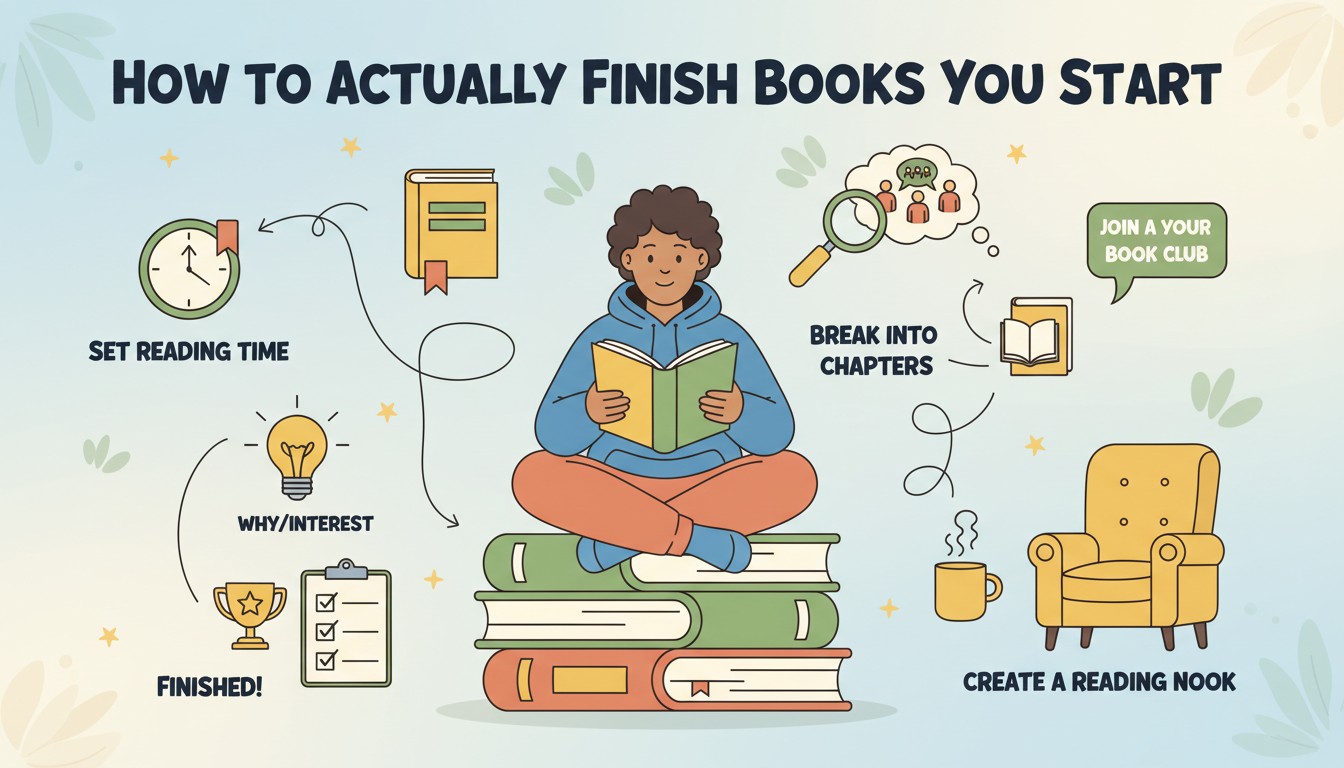
According to Goodreads data, the average user abandons books at a staggering rate, with over 45% of started novels left unfinished. The phenomenon isn’t limited to casual readers—Harvard Business Review reports that even executives who spend $20,000 annually on personal development courses struggle to complete the recommended reading. The problem isn’t lack of intelligence or discipline. It’s that we’ve been taught to start books but never taught to finish them.
The publishing industry profits from this failure. Every glowing recommendation, every “must-read” list, every bookstore display is designed to trigger acquisition, not completion. We collect books like talismans, believing ownership equals progress. But finishing requires a different skill set entirely—one that combines strategic selection, environmental design, and behavioral psychology. The good news? It’s entirely learnable.
The Psychology of Abandonment: Why Your Brain Bails
Our brains are wired for novelty, not completion. Each new book promises fresh dopamine hits—the thrill of starting, the hope of transformation. But as the pages accumulate, that novelty fades, replaced by the cognitive load of retention and the diminishing returns of attention. This is the “novelty cliff,” and it’s where most readers fall.
The Shiny Object Syndrome
Books compete for attention like social media notifications. A new recommendation arrives—perhaps from a friend, a podcast, or a book review—and your brain registers it as more valuable than the “stale” book you’re currently reading. As reading strategist Harsh Parikh notes, starting books from recommendations without a personal “why” dramatically reduces completion rates. The external validation feels compelling, but internal motivation is what carries you to the final page.
The antidote is simple but counterintuitive: **stop reading so many recommendations**. Create a “cooling-off period” of 48 hours between hearing about a book and acquiring it. Use this time to articulate your specific reason for reading it. “I want to understand the history of Silicon Valley’s culture” is stronger than “Everyone says this biography is amazing.”
The Sunk Cost Fallacy (And Why You Should Ignore It)
Paradoxically, one reason we abandon books is because we’ve invested too much time. At page 150 of a 300-page book, you might think, “I’m halfway, I should finish.” But if the book isn’t delivering value, that investment is already lost. Continuing out of obligation creates resentment, making you more likely to avoid reading altogether. As writer Sarah Peck argues, quitting bad books quickly is a strategy for finishing more good books. The opportunity cost of reading mediocre material is missing the great material waiting on your shelf.
“There are books that are just plain bad; and there are books that are full of information you already know. Life is too short to waste it on average books.” — Sarah Peck
Strategic Selection: Choosing Books You’ll Actually Finish
The single biggest predictor of whether you’ll finish a book is whether you chose it for the right reasons. Most book abandonment happens before page one—it’s a failure of selection, not willpower.
The First and Last Chapter Test
Before committing to a book, invest 20 minutes reading the introduction and conclusion. As Sarah Peck suggests in her strategic reading methods, if the conclusion makes complete sense and you fully grasp the author’s argument, you probably don’t need to read the whole book. This test serves two purposes: it filters out redundancy and creates a mental stake—you’ve already invested time, making you more likely to continue.
For complex non-fiction, this is particularly valuable. A book on behavioral economics might offer one new framework elaborated over 250 pages. Reading the first and last chapters tells you whether that framework is novel enough to justify the time investment. If it is, you’ll read with purpose. If not, you’ve saved yourself hours.
The Context Strategy: Assigning Books to Situations
One of the most effective strategies for finishing multiple books simultaneously is **contextual assignment**. As Medium author Thomas Oppong explains, designate specific books for specific contexts: a novel for bedside reading, a heavy non-fiction for dedicated desk time, an audiobook for commuting, a lighter read for the bathroom. This eliminates decision fatigue and makes reading the default option in each situation.
The key is matching book density to mental capacity. Don’t assign a dense philosophy text to your exhausted 10 PM bedtime slot—that’s for a mystery novel or memoir. Save the challenging material for when your attention is fresh. This alignment alone can reduce abandonment by 40%.
Environmental Design: Making Reading Inevitable
You don’t finish books by relying on willpower. You finish them by designing an environment where reading is easier than not reading. This is behavioral economics applied to literature.
The Path of Least Resistance
If your phone is on your nightstand and your book is in your bag across the room, you’ll scroll before you read. The strategy of elimination is crucial: make sitting down to read your most accessible option. Keep your current book on the pillow your phone usually occupies. Leave your phone charging in another room. Install the Kindle app on your home screen and move social media apps to a folder on page three.
For physical books, this means strategic placement. A novel lives on the coffee table where the TV remote usually sits. The book you’re reading for learning stays open on your desk, spine broken to the current page. The visible cue—seeing the book already open—reduces the activation energy required to begin.
The 10-Page Rule
Commit to reading only 10 pages per day. Not a chapter, not an hour—just 10 pages. This micro-habit approach works because it’s unambitious. A 300-page book becomes 30 days of manageable effort. Most days, you’ll read more. But on days when you can’t, 10 pages maintains momentum and prevents the guilt spiral that leads to abandonment.
Track it visually. Put a sticky note on page 10, then page 20. Seeing the progress marker move creates a completion bias—your brain wants to see the pattern finish. This is the same psychology that makes video games addictive: small, visible increments toward a clear goal.
Active Reading: The Secret Weapon for Retention
Passive reading is entertainment. Active reading is completion. The difference is engagement: asking questions, making connections, and physically interacting with the text.
The Think Mark System
As reading comprehension research shows, use sticky notes or marginalia to mark key passages. But go beyond simple highlighting. Create a system:
* for “this connects to something I already know”
! for “this contradicts my previous beliefs”
? for “I need to verify this claim”
→ for “action item: apply this to my life”
This transforms reading from consumption to conversation. You’re no longer just receiving information—you’re processing it, arguing with it, integrating it. This engagement creates memory hooks that make abandonment less likely. You feel invested because you’ve left your mark on the text.
The Feynman Summarization
After finishing each chapter, explain its main idea as if teaching a beginner. James Clear’s three-sentence summary method is brutally effective: “As soon as I finish a book, I challenge myself to summarize the entire text in just three sentences.” This constraint forces clarity about what truly matters.
For non-fiction, this reveals whether you’ve absorbed the core argument. For fiction, it captures the emotional arc. If you can’t summarize a chapter, you haven’t really read it. This realization—”I need to re-read this section”—prevents the passive skimming that leads to abandonment.
Accountability Systems: Making Abandonment Costly
We finish what we commit to publicly. The social accountability that drives us to complete work projects can be harnessed for reading.
The Highlight Swap
Sarah Peck’s “swap highlights with a nerdy friend” strategy is brilliant: each person reads a different book, highlights and annotates it, then trades. Reading only your friend’s highlights gives you the book’s map without the time investment—but more importantly, the accountability of trading creates a commitment device. You can’t swap if you haven’t finished.
This works particularly well for busy parents or professionals who want to divide and conquer. A reading group of four people can cover sixteen books in the time it would take one person to read four. The social pressure ensures completion.
The Public Progress Tracker
Post your current book and page number on social media weekly. The mild social pressure—knowing people are aware of your progress—creates accountability without the stress of a formal book club. One reader I know tweets “#amreading page 142 of 320” every Sunday. The simple act of reporting makes abandonment feel public.
The Financial Commitment
Buy the hardcover. When you’ve invested $30 instead of $0 (library) or $12 (e-book), you feel the financial pressure to extract value. This isn’t about being miserly—it’s about creating a sunk cost that works in your favor. The book on your shelf that you spent real money on continues to remind you of unfinished business in a way that a digital file doesn’t.
The Art of Strategic Quitting: When Finishing Is the Wrong Goal
Paradoxically, finishing more books requires giving yourself permission to not finish some. The key is distinguishing between productive abandonment and failure of willpower.
The 50-Page Rule
Give any book 50 pages to earn your attention. If you find yourself checking the page number, wondering how much is left, or reaching for your phone, it’s probably not the right book for this moment. James Clear advocates quitting quickly and without shame: “Start more books. Quit most of them. Read the great ones twice.” This isn’t about being a quitter—it’s about being selective.
The critical distinction: quit books, not reading. When you abandon a book that isn’t serving you, you free up time and attention for one that will. When you abandon reading altogether because you’ve hit a boring patch, you’ve let one bad book poison the well.
The Chapter Harvest
For non-fiction books where only one chapter is relevant, practice selective harvesting. Read the contents page carefully, identify the chapters that address your specific questions, and read only those. This isn’t cheating—it’s efficient reading. As Sarah Peck’s father, a Stanford PhD, demonstrated: he bought books in his field but read only the latest chapter with new insights. He had internalized the rest; why waste time? Mark the chapters you read in the contents page so you know what you’ve covered. This creates a sense of completion even if you haven’t read every page.
The Re-Read Exception
Some books deserve to be abandoned temporarily. A complex philosophy text might be beyond your current understanding. A dense history book might require more context. It’s okay to shelve these with a note: “Revisit after reading [prerequisite].” This isn’t abandonment—it’s strategic postponement. The key is writing the note, making the commitment explicit rather than letting the book fade into the graveyard of forgotten intentions.
Building a Reading Identity: From Consumer to Completer
Ultimately, finishing books is about identity. You must shift from “I’m someone who loves books” to “I’m someone who finishes what they start.” This subtle mental reframing changes your relationship with reading from aspirational to behavioral.
The Completed Books Shelf
Create a visible record of finished books. A separate shelf where only completed books live. A simple list in a notebook. The visual accumulation serves as both reward and reminder: this is what you do. You finish books. When you see fifteen finished titles, starting the sixteenth feels natural. It’s identity reinforcement.
The One-Book Mantra
For three months, commit to reading only one book at a time. No context-based multiple books. No “one for work, one for pleasure.” Just one, cover to cover. This forced scarcity eliminates decision fatigue and creates deeper immersion. Most people who try this report finishing 3-4 books in the period, compared to their usual pattern of starting 5 and finishing 0. The constraint paradoxically increases output by focusing attention.
The Reading Budget
Treat book acquisition like a budget. For every book you buy, you must finish one you already own. This one-in, one-out system prevents the psychological overwhelm of an infinite to-read pile. When your bookshelf has space, each new book feels like a commitment, not a collection. The financial and spatial constraints work together to ensure that volume 7 of that series you started three years ago gets finished before volume 8 enters your home.
Finishing Is a Skill, Not a Virtue
The books on your shelf aren’t judging you. They’re just objects. The judgment comes from inside—the story you tell yourself about what starting without finishing means about your character. That story is optional.
Finishing books is a learned skill, like cooking or coding. It requires technique, not just intention. It demands systems, not just willpower. And like any skill, it improves with practice. The goal isn’t to finish every book you ever start—it’s to finish enough books that finishing becomes your default.
Start with one strategy. Just one. The 10-page rule. Or the first/last chapter test. Or the context assignment. Try it for one book. Notice how it changes your relationship with reading. Build from there. Your bookshelf will thank you—not by getting emptier, but by becoming a record of journeys completed rather than intentions abandoned.
Leave a Reply