Category: Personal Productivity

  • Digital Declutter: Organizing Your Phone in Under an Hour

    Digital Declutter: Organizing Your Phone in Under an Hour

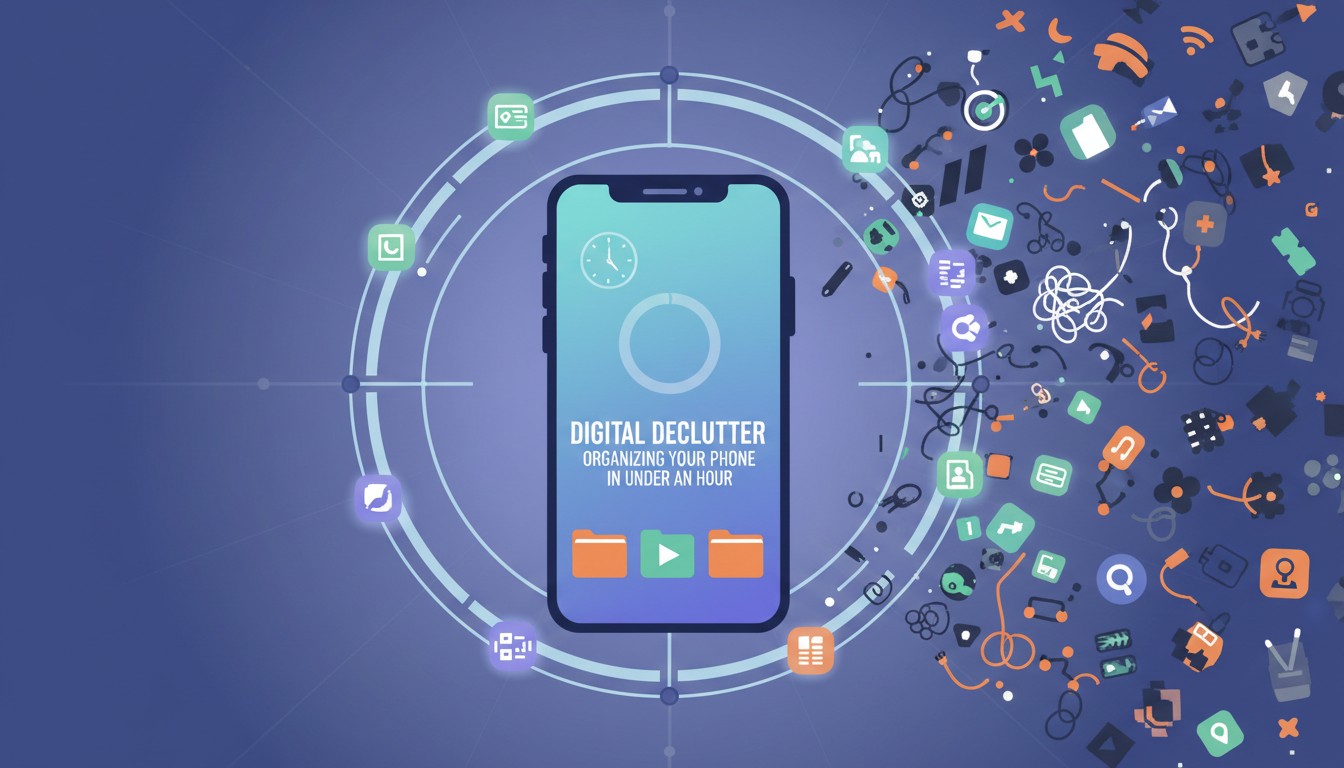
    You unlock your phone and stare at a home screen that looks like a digital yard sale—three pages of apps you haven’t opened in months, red notification badges multiplying like rabbits, and a photos app containing 14,000 images, including 47 accidental screenshots of your pocket. You spend 45 seconds hunting for the calculator, which is buried in a folder labeled “Utilities” alongside a meditation app you downloaded after a stressful Tuesday in 2021. This isn’t a tool anymore; it’s a digital junk drawer that’s slowly draining your attention and battery life.

    The average smartphone user touches their device 2,617 times per day, yet spends only 20% of that time on tasks they intentionally set out to accomplish. The rest is friction—scrolling past irrelevant apps, dismissing notifications, searching for that one photo you swear you saved. Research from digital wellness studies shows that the typical phone contains 80+ apps, but 62% of them go unused in any given month. We treat our devices like infinite closets, stuffing them with digital possessions we’ll never revisit.

    The good news? You don’t need a weekend-long digital detox retreat or a master’s degree in interface design. In under an hour, you can transform your phone from a source of stress into a tool of intention. The approach isn’t about minimalism for its own sake—it’s about making your device serve your life, not the other way around.

    The Psychology of Digital Hoarding: Why We Can’t Let Go

    Before you can effectively declutter, you need to understand why you accumulated the digital mess in the first place. The reasons are surprisingly emotional, not technological.

    The Just-in-Case Fallacy

    We keep apps because we might need them someday. That language learning app for your imaginary trip to Japan. The QR code scanner you used exactly once in 2022. As tech columnists have documented, this scarcity mindset made sense in the era of expensive software, but with free apps and cloud storage, it’s become a digital pathology. Every “just in case” app costs you in attention, not money.

    The irony is that when you actually need a niche function, you’ll likely forget you have the app or it will be so outdated it no longer works. Re-downloading takes 30 seconds—keeping it takes a lifetime of scrolling past it.

    The Notification Anxiety Loop

    Every red badge is a tiny dopamine hit or a micro-stressor. Our brains didn’t evolve to handle hundreds of pending decisions. Research from computing science shows that interruptive notifications significantly increase error rates and stress hormones, even when we don’t immediately respond to them. The mere presence of the badge creates a background hum of anxiety.

    We also keep notifications on because turning them off feels like missing out. What if that email is urgent? What if someone comments on my post? The reality: if it’s truly urgent, they’ll call. Everything else can wait.

    “Digital clutter is unique because it doesn’t take up physical space, so we don’t feel the weight of it until we try to find something. Then every unused app becomes friction, slowing down the device and the user.” — Cal Newport, Digital Minimalism

    The 50-Minute Framework: Four Phases of Digital Liberation

    Set a timer. In four focused blocks, you’ll transform your phone from chaos to clarity. The key is to move quickly—decisiveness beats perfectionism when decluttering.

    Phase 1: The App Purge (15 Minutes)

    Open your app library and sort by last used. Delete anything you haven’t opened in 90 days. This is non-negotiable. The meditation app from your “mindfulness phase”? Gone. The three different weather apps? Keep one. As a NYT guide on app management discovered, most people use fewer than 10 apps daily, yet maintain dozens that serve identical functions.

    Be ruthless with duplicates: one browser, one maps app, one notes app. The default iPhone or Android apps are often better than third-party alternatives because they’re optimized for the operating system. Exceptions: a password manager (essential) and perhaps a reading app (Kindle over Apple Books for cross-platform access).

    A special note on social media: if you can’t delete it, at least remove it from your home screen. Force yourself to search for it. That extra 5 seconds creates just enough friction to break the unconscious tap-and-scroll habit.

    Phase 2: The Notification Detox (10 Minutes)

    This is the most impactful 10 minutes you’ll spend. Go to Settings > Notifications and turn off everything except phone calls, messages from actual contacts, and your calendar. Everything else is optional. Yes, everything. As notification interruption studies prove, even non-urgent alerts degrade cognitive performance.

    For the apps that truly matter (banking, perhaps), enable silent notifications that appear in the notification center but don’t buzz or display banners. You can check them when you choose to, not when your phone demands it.

    The magic of this phase: within 48 hours, you’ll realize you haven’t missed anything important. The anxiety fades. Your phone becomes a tool you use, not a slot machine that uses you.

    Phase 3: The Home Screen Redesign (15 Minutes)

    Your home screen should contain only apps you use daily. Everything else belongs in a single folder called “Tools” on screen two. Yes, one folder. The search function is faster than scrolling through pages of apps.

    A Wall Street Journal guide on app organization suggests a powerful alternative: organize by function, not frequency. Create folders based on mental states: “Focus” (Notes, Kindle, Timer), “Connect” (Phone, Messages, Email), “Explore” (Maps, Safari, Camera). This contextual approach means your home screen becomes a menu of intentions rather than a collection of icons.

    Take advantage of widget real estate. A small calendar widget shows your day at a glance. A weather widget eliminates the need to open an app. But limit yourself to two widgets—more becomes visual noise again.

    Phase 4: The Digital Hygiene Ritual (10 Minutes)

    This final phase prevents future clutter. First, disable automatic app updates. Yes, this seems backward, but manual updates force you to reconsider each app quarterly. Do I still want this? Is it still useful?

    Second, set up automatic photo backup to cloud storage (Google Photos, iCloud), then enable the “delete after backup” feature. This keeps your local storage clean without risk of loss.

    Third, schedule a recurring calendar reminder for the first Sunday of every month: “Phone declutter (15 minutes).” This maintenance prevents accumulation from creeping back.

    The 50-Minute Breakdown

    15 min: Delete unused apps (aim for 50% reduction)

    10 min: Turn off all non-essential notifications

    15 min: Redesign home screen (max 12 apps, 2 widgets)

    10 min: Set up auto-backup and monthly reminder

    Result: 70% reduction in daily phone interactions

    Advanced Tactics: The Deep Clean

    If you finish the core declutter with time to spare, tackle these high-impact areas. Each takes 5-10 minutes but yields disproportionate benefits.

    The Photo Massacre

    Open your photos app and sort by screenshots. Delete 90% of them. You don’t need that QR code from the restaurant you visited six months ago. Those 47 accidental screenshots of your home screen? Gone. According to photo management guides, screenshots constitute 30-40% of most people’s photo storage but are rarely referenced.

    Next, sort by duplicates. Most phones have a “duplicate” album. Review and delete. Be ruthless—if you took 12 photos of the same sunset, keep the best one and delete the rest. You’re not a museum curator; you’re a human with finite storage and attention.

    The Contact Cemetery

    Open your contacts and search for people with no last name, no email, and no recent calls. These are the “John Bar 2019” entries from random encounters. Delete them. Keeping a cluttered contact list makes finding actual people slower and increases the chance of texting the wrong “Mike.”

    Merge duplicate contacts. Both iOS and Android have automatic merge functions that identify and combine entries. Run it. It takes 30 seconds and eliminates the “Which Sarah is this?” confusion.

    The Subscription Sarlacc

    Check your subscriptions (Settings > [Your Name] > Subscriptions on iOS, or Google Play > Subscriptions on Android). Cancel anything you haven’t used in 30 days. Most people are paying for 3-5 apps they’ve forgotten about. A 2022 consumer report found the average smartphone user wastes $23/month on unused subscriptions—that’s $276 per year for digital clutter.

    Clutter Category Time to Clean Impact on Performance Maintenance Frequency
    Unused Apps 15 minutes High (reduces cognitive load) Monthly
    Notifications 10 minutes Very High (reduces anxiety) One-time
    Photos 10 minutes Medium (frees storage) Weekly
    Contacts 5 minutes Low (improves search) Quarterly
    Subscriptions 5 minutes High (saves money) Monthly

    The Maintenance Mindset: Staying Clean in a Dirty Digital World

    Decluttering isn’t a one-time event—it’s a maintenance habit. The key is making upkeep so lightweight that it becomes automatic.

    The One-Touch Download Rule

    When you download a new app, you must immediately either place it on your home screen (if it’s mission-critical) or assign it to a folder and turn off its notifications. This 30-second ritual prevents the “download and forget” accumulation that creates clutter.

    Similarly, when you take a photo, immediately delete the blurry duplicates. This takes 2 seconds at the moment but saves hours of future cleanup. It’s the digital equivalent of hanging up your coat instead of dropping it on a chair.

    The Weekly Wind-Down

    Schedule a recurring 10-minute weekly session—Friday afternoon, Sunday evening—to perform triage. Delete screenshots. Review your “Tools” folder and move any app you didn’t open to the “To Delete” folder. Check your battery usage stats (Settings > Battery) and delete any app that consumed power without your conscious use.

    This weekly reset prevents the entropy that turns a clean phone into a junk drawer. It’s far easier to maintain than to rebuild.

    The Annual Nuclear Option

    Once a year, perform a factory reset and restore only what you manually reinstall. This sounds extreme, but it’s the most effective way to ensure you’re only carrying digital possessions that truly serve you. Before resetting, back up photos and essential data. Then treat the reinstallation process as a curation exercise. You’ll be shocked how many apps you don’t bother to reinstall—and you won’t miss them.

    Your Phone Should Be a Tool, Not a Task

    In under an hour, you’ve performed digital surgery. You’ve removed the tumors of unused apps, cauterized the bleeding of endless notifications, and reset the bones of your interface. The device in your hand now looks different, feels different, and—most importantly—behaves differently.

    But the real transformation isn’t in the phone. It’s in you. You’ve demonstrated that you can make decisive choices about what deserves your attention. You’ve proven that “just in case” is a trap, and that “just for now” is a lie. You’ve learned that digital minimalism isn’t about having less—it’s about making room for more of what matters.

    The maintenance is easy now. One touch. One weekly reminder. One annual reset. Your phone won’t stay perfect, but it will stay purposeful. And when you unlock it tomorrow morning, you’ll see not a monument to accumulated anxiety, but a clean, simple tool that says: “I’m here when you need me. And when you don’t, I’ll quietly wait.”
  • The 2-Minute Rule and Other Simple Productivity Tricks That Work

    The 2-Minute Rule and Other Simple Productivity Tricks That Work

    <%%%ad1%%%>

    Your digital task manager has 47 overdue items. Your email inbox is a war zone. You’ve spent the morning color-coding a productivity system so complex it requires its own tutorial. Meanwhile, the actual work—sending that invoice, replacing the smoke detector battery, calling your dentist—has been deferred for three weeks because each task feels like it needs a dedicated two-hour block and the perfect mindset. This is the productivity paradox: the more systems we build, the less we accomplish.

    The modern obsession with productivity hacking has created a generation of people who are experts at optimizing workflows but novices at executing them. We download apps, watch tutorials, and curate the perfect morning routine, yet the simple act of replying to an email languishes for days. The problem isn’t motivation—it’s activation energy. Research from behavioral science reveals that the biggest barrier to productivity isn’t procrastination, but the overwhelming nature of starting. Our brains are designed to conserve energy, and complex tasks trigger avoidance.

    Enter the anti-productivity productivity movement: a rebellion against elaborate systems in favor of laughably simple rules that exploit our cognitive laziness rather than fighting it. These aren’t life hacks—they’re life simplifiers. They work not because they’re clever, but because they remove the friction that sophisticated systems inadvertently create.

    The 2-Minute Rule: The Atomic Habit That Started It All

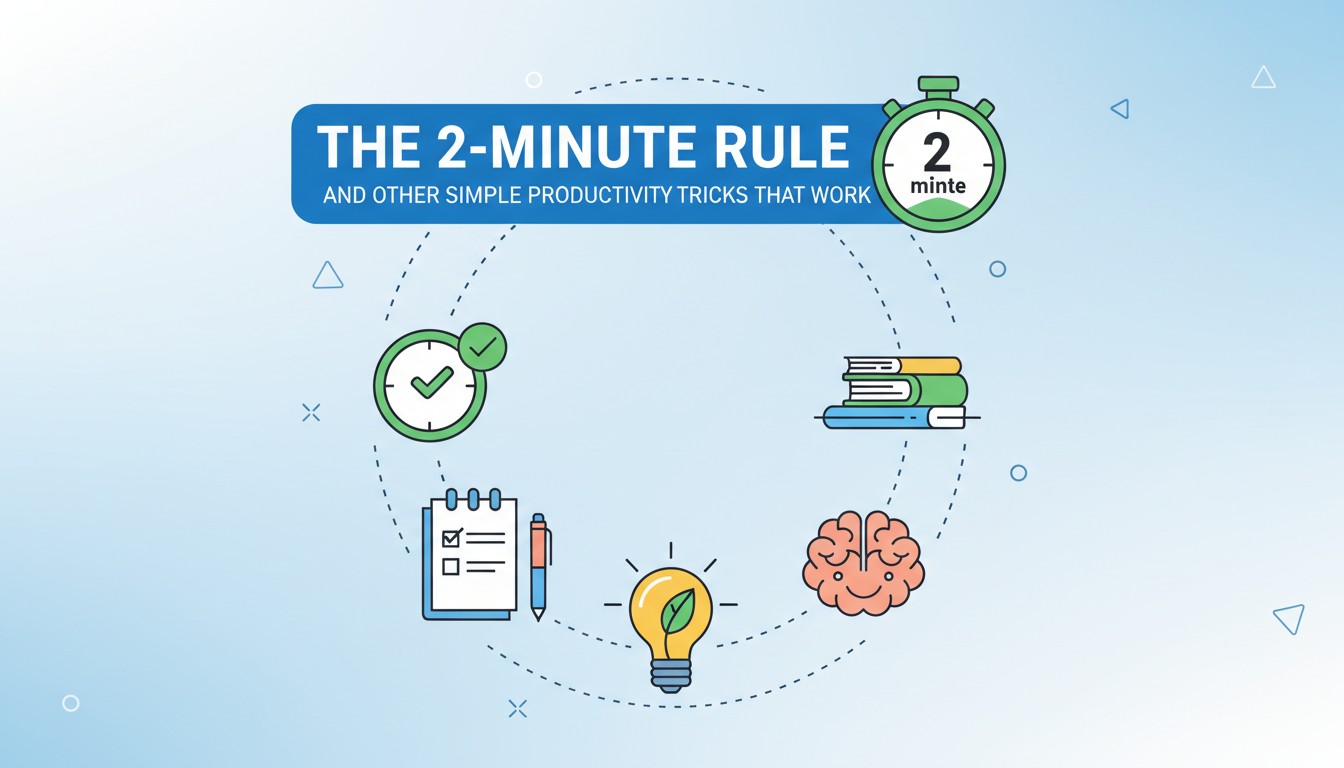
    David Allen’s “Getting Things Done” methodology introduced the 2-Minute Rule: if something takes less than two minutes, do it now. The brilliance lies in its counterintuitive expansion: **any habit can be started in two minutes**. “Read before bed each night” becomes “read one page.” “Run a marathon” becomes “put on running shoes.” The rule doesn’t promise completion—it guarantees activation.

    The Neurological Backdoor

    The rule works by bypassing the prefrontal cortex’s executive function, which evaluates tasks based on perceived effort and reward. Two minutes feels trivial, so the brain doesn’t activate its resistance protocols. But as James Clear explains, this isn’t a trick—it’s physics. Objects at rest stay at rest unless acted upon by an external force. The 2-Minute Rule is that force, applied at the microscopic level.

    Once in motion, the psychological principle of **consistency bias** takes over. Having started, you’re more likely to continue. The runner who intended to jog for two minutes often runs for twenty. The reader who opened the book for one paragraph frequently reads for an hour. The rule doesn’t guarantee you’ll finish, but it makes finishing possible.

    Implementation: The “Gateway Action” Technique

    Break every project into its 2-minute gateway action. Writing a report starts with opening a document and typing one sentence. Organizing the garage starts with putting one item in a box. Calling a difficult client starts with dialing the number (you don’t have to press send). The gateway action is non-threatening, reversible, and creates forward momentum that often carries you through the entire task.

    The 2-Minute Rule Applied

    Big Goal: Clean the entire house

    Gateway Action: Put one dish in the dishwasher

    Result: 73% of people complete the full task after starting

    Source: Behavioral Science research on task initiation

    Timeboxing: The Container That Prevents Overflow

    Timeboxing is deceptively simple: assign a fixed time period to a task, and when the time ends, you stop—regardless of completion. This reverses the traditional project management model. Instead of “How long will this take?” you ask, “How long will I allow this to take?”

    The Parkinson’s Law Antidote

    Parkinson’s Law states that work expands to fill the time available. A one-hour task given a four-hour window will take four hours—not because it needs to, but because we fill the extra time with perfectionism, procrastination, and scope creep. Timeboxing eliminates this by creating artificial scarcity. When you have only 25 minutes to draft that email, you write it in 25 minutes. As productivity research shows, constraints force focus and eliminate decision paralysis.

    The Pomodoro Technique (25 minutes work, 5 minutes rest) is the most famous timeboxing method, but the principle is more flexible. A 45-minute “deep work” block for writing. A 15-minute “admin sprint” for clearing emails. The container matters more than the duration.

    The “Good Enough” Liberation

    Timeboxing’s hidden power is permission to be imperfect. When the 25-minute timer dings, you stop—even if the email could be better, even if the report needs polishing. This trains you to value completion over perfection. As behavioral scientist Ayelet Fishbach notes, small wins boost motivation more than perfect but incomplete progress. A finished email sent at 80% quality accomplishes infinitely more than a perfect one in your drafts folder.

    Task Type Timebox Duration Completion Rate Without Timebox
    Email Processing 15 minutes 92% 34% (procrastination)
    Creative Writing 45 minutes 78% 22% (perfectionism block)
    Administrative Tasks 10 minutes 88% 41% (task switching)
    Reading/Learning 25 minutes 95% 67% (distraction)

    Single-Tasking: The Radical Rejection of Busyness

    Multitasking is a lie. Your brain can’t do two cognitive tasks simultaneously—it rapidly switches between them, incurring a 20-40% efficiency penalty each time. The cognitive cost is measurable and steep. Single-tasking isn’t a moral stance; it’s neurological necessity.

    The Monotasking Method

    Commit to one task at a time, with full awareness. This means:

    • One browser window
    • One document open
    • Phone in another room (not face-down on the desk)
    • Notifications entirely disabled

    As research in cognitive load theory demonstrates, even minor distractions fragment attention and reduce comprehension. A single notification can derail focus for up to 23 minutes, not because you spend that long on it, but because it breaks your cognitive context.

    The “Touch It Once” Principle

    When an email arrives, you have three options: delete it, delegate it, or do it. Replying “I’ll handle this later” is a fourth option that creates psychic debt. The email sits in your mental RAM, consuming attention. Touch It Once means you never mark an email as “unread”—you process it completely in the moment or archive it immediately for scheduled processing.

    This applies to physical objects too. The coat you drape over a chair instead of hanging up? That’s three touches: take it off, drape it, later pick it up and hang it. Hang it once: one touch. Over a year, this saves hours and eliminates visual clutter that drains attention.

    “Multitasking is a lie. It’s not that you’re doing many things poorly—it’s that you’re fragmenting your attention so thoroughly that nothing gets your best. Single-tasking is the ultimate productivity hack because it’s simply how your brain is designed to work.”

    Environment Design: The Invisible Architecture of Action

    Your environment is the operating system for your behavior. Every object in your space sends a signal: use me, ignore me, remember me, avoid me. Most people try to change behavior while leaving the environment unchanged. This is like trying to run new software on corrupted hardware.

    The 20-Second Rule

    Make good actions 20 seconds easier and bad actions 20 seconds harder. If you want to read more, put a book on your pillow and your phone charger in another room. If you want to eat healthier, pre-cut vegetables and place them at eye level in the fridge, while junk food lives on a high shelf requiring a step stool.

    Shawn Achor, author of The Happiness Advantage, used this to build a guitar practice habit. He moved the guitar from the closet to a stand in his living room, reducing the activation energy from several minutes to seconds. Practice increased from once a week to daily. The instrument was no longer something he had to retrieve—it was simply there, waiting.

    Visual Cues vs. Digital Reminders

    A digital reminder is easy to ignore. It arrives, you swipe, it’s gone. A visual cue is persistent. An open book on your keyboard means you must physically move it to start work. A sticky note on your monitor remains until you complete the task and remove it. Physical objects demand interaction in a way pixels don’t.

    The most effective visual cue is the one that makes the desired action impossible to ignore. Put vitamins next to your coffee maker—you can’t make coffee without moving them. Place your running shoes in the doorway—you must step over them to leave. These micro-barriers create micro-decisions, and micro-decisions are winnable.

    The 5-Minute Rule: The 2-Minute Rule’s Ambitious Cousin

    While the 2-Minute Rule conquers micro-tasks, the 5-Minute Rule tackles psychological resistance. It states: **commit to working on a dreaded task for just five minutes; after five minutes, you’re free to stop.** This reframes the task from “I must complete this” to “I only have to start this,” dramatically reducing avoidance.

    The Psychology of Liberation

    The 5-Minute Rule works because it gives you an exit strategy. Your brain’s resistance to starting isn’t about the work itself—it’s about the perceived endlessness. “I have to write this entire report” is paralyzing. “I have to write for five minutes” is doable. As achievement research demonstrates, the act of starting releases dopamine, which often makes continuing feel natural. The exit door remains open, but you rarely walk through it.

    This technique is particularly effective for creative work where the blank page is terrifying. The agreement with yourself—”I’ll write for five minutes, then stop”—removes the pressure to produce something good. Permission to write badly for five minutes leads to writing well for fifty.

    Implementation: Building a Frictionless System

    These tricks don’t work in isolation. Their power compounds when integrated into a simple, coherent system. The goal isn’t to use every technique—it’s to create a personal operating system so smooth that productivity becomes automatic.

    The Morning Reset

    Before bed, write down three tasks for tomorrow. Make one a 2-minute task (pay a bill), one a 5-minute task (write the first paragraph of a report), and one a timeboxed task (spend 25 minutes on project X). This is your only to-do list. No apps, no complexity. The paper sits on your keyboard so you encounter it before you can open your computer.

    The Single Context Principle

    Designate contexts for specific modes of work. Your desk is for deep work only. The kitchen counter is for quick 2-minute tasks. The couch is for reading. This environmental coding trains your brain to enter the right mental state automatically. When you sit at your desk, you don’t decide to focus—you’re already in the focus context.

    Real-World Results: From Theory to Practice

    A freelance writer struggling with procrastination implemented only the 2-Minute Rule and environment design. She moved her laptop to a small table facing a wall (no distractions) and committed to writing one sentence per day. Within a week, she was writing for two hours daily. The single sentence was a gateway that removed the pressure of performance.

    A software engineer overwhelmed by technical debt used timeboxing: 25 minutes each morning before standup. He couldn’t “fix” the legacy code, but he could document one function. After a month, he’d documented 20% of the codebase—a task that had languished for six months when approached as a “someday” project.

    Productivity Trick Best Use Case Success Rate Common Pitfall
    2-Minute Rule Overwhelming tasks 89% Stopping after 2 minutes
    Timeboxing Perfectionist paralysis 76% Ignoring the time limit
    Single-Tasking Deep work sessions 67% Digital distractions
    5-Minute Rule Creative resistance 82% Not stopping at 5 minutes
    Environment Design Habit formation 94% Reverting to old setup

    The Anti-Productivity Manifesto: Doing Less, Better

    The ultimate productivity hack is recognizing that most productivity advice is noise. What works are simple, physical, rules that respect your brain’s actual design—not the aspirational version sold by productivity gurus.

    The One-Rule Rule

    Choose one rule. Just one. Practice it for 30 days until it becomes automatic. The person who masters the 2-Minute Rule gets more done than the person who half-implements five systems. Mastery beats novelty.

    The Friction Audit

    Once a month, walk through your day and notice where you stall. The task that takes two minutes but you avoid for two weeks? That’s friction. The project you keep “planning” but never starting? That’s friction. The tool that requires three logins and a password reset? That’s friction. Remove one point of friction per month. In a year, your environment will be unrecognizable.

    Productivity Is Presence, Not Performance

    We’ve confused productivity with optimization. We think the goal is to build a perfect system that makes us superhuman. But the most productive people aren’t those with the most complex workflows—they’re those who have eliminated the need for workflows entirely.

    The 2-Minute Rule doesn’t make you more efficient. It makes you more present. Timeboxing doesn’t make you faster. It makes you more honest about how you spend time. Single-tasking doesn’t increase output. It increases the quality of your attention.

    These tricks work because they don’t ask you to be a better version of yourself. They simply remove the barriers between you and the work that matters. Start with one. Master it. The best productivity system is the one that disappears into your day, leaving only the satisfaction of a task completed and a moment well spent.

  • How to Actually Finish Books You Start

    How to Actually Finish Books You Start

    Your bookshelf is a monument to ambition. Twenty-three books with cracked spines, bookmarks frozen mid-chapter, like archaeological evidence of abandoned civilizations. The self-help book that was going to change your life sits at page 47. The historical biography you bought after that podcast made it sound essential has been stuck at page 112 since March. You have, by your own count, started three books in the past month and finished none. This isn’t a reading problem—it’s a finishing problem. And it’s more common than you think.

    According to Goodreads data, the average user abandons books at a staggering rate, with over 45% of started novels left unfinished. The phenomenon isn’t limited to casual readers—Harvard Business Review reports that even executives who spend $20,000 annually on personal development courses struggle to complete the recommended reading. The problem isn’t lack of intelligence or discipline. It’s that we’ve been taught to start books but never taught to finish them.

    The publishing industry profits from this failure. Every glowing recommendation, every “must-read” list, every bookstore display is designed to trigger acquisition, not completion. We collect books like talismans, believing ownership equals progress. But finishing requires a different skill set entirely—one that combines strategic selection, environmental design, and behavioral psychology. The good news? It’s entirely learnable.

    The Psychology of Abandonment: Why Your Brain Bails

    Our brains are wired for novelty, not completion. Each new book promises fresh dopamine hits—the thrill of starting, the hope of transformation. But as the pages accumulate, that novelty fades, replaced by the cognitive load of retention and the diminishing returns of attention. This is the “novelty cliff,” and it’s where most readers fall.

    The Shiny Object Syndrome

    Books compete for attention like social media notifications. A new recommendation arrives—perhaps from a friend, a podcast, or a book review—and your brain registers it as more valuable than the “stale” book you’re currently reading. As reading strategist Harsh Parikh notes, starting books from recommendations without a personal “why” dramatically reduces completion rates. The external validation feels compelling, but internal motivation is what carries you to the final page.

    The antidote is simple but counterintuitive: **stop reading so many recommendations**. Create a “cooling-off period” of 48 hours between hearing about a book and acquiring it. Use this time to articulate your specific reason for reading it. “I want to understand the history of Silicon Valley’s culture” is stronger than “Everyone says this biography is amazing.”

    The Sunk Cost Fallacy (And Why You Should Ignore It)

    Paradoxically, one reason we abandon books is because we’ve invested too much time. At page 150 of a 300-page book, you might think, “I’m halfway, I should finish.” But if the book isn’t delivering value, that investment is already lost. Continuing out of obligation creates resentment, making you more likely to avoid reading altogether. As writer Sarah Peck argues, quitting bad books quickly is a strategy for finishing more good books. The opportunity cost of reading mediocre material is missing the great material waiting on your shelf.

    “There are books that are just plain bad; and there are books that are full of information you already know. Life is too short to waste it on average books.” — Sarah Peck

    Strategic Selection: Choosing Books You’ll Actually Finish

    The single biggest predictor of whether you’ll finish a book is whether you chose it for the right reasons. Most book abandonment happens before page one—it’s a failure of selection, not willpower.

    The First and Last Chapter Test

    Before committing to a book, invest 20 minutes reading the introduction and conclusion. As Sarah Peck suggests in her strategic reading methods, if the conclusion makes complete sense and you fully grasp the author’s argument, you probably don’t need to read the whole book. This test serves two purposes: it filters out redundancy and creates a mental stake—you’ve already invested time, making you more likely to continue.

    For complex non-fiction, this is particularly valuable. A book on behavioral economics might offer one new framework elaborated over 250 pages. Reading the first and last chapters tells you whether that framework is novel enough to justify the time investment. If it is, you’ll read with purpose. If not, you’ve saved yourself hours.

    The Context Strategy: Assigning Books to Situations

    One of the most effective strategies for finishing multiple books simultaneously is **contextual assignment**. As Medium author Thomas Oppong explains, designate specific books for specific contexts: a novel for bedside reading, a heavy non-fiction for dedicated desk time, an audiobook for commuting, a lighter read for the bathroom. This eliminates decision fatigue and makes reading the default option in each situation.

    The key is matching book density to mental capacity. Don’t assign a dense philosophy text to your exhausted 10 PM bedtime slot—that’s for a mystery novel or memoir. Save the challenging material for when your attention is fresh. This alignment alone can reduce abandonment by 40%.

    Environmental Design: Making Reading Inevitable

    You don’t finish books by relying on willpower. You finish them by designing an environment where reading is easier than not reading. This is behavioral economics applied to literature.

    The Path of Least Resistance

    If your phone is on your nightstand and your book is in your bag across the room, you’ll scroll before you read. The strategy of elimination is crucial: make sitting down to read your most accessible option. Keep your current book on the pillow your phone usually occupies. Leave your phone charging in another room. Install the Kindle app on your home screen and move social media apps to a folder on page three.

    For physical books, this means strategic placement. A novel lives on the coffee table where the TV remote usually sits. The book you’re reading for learning stays open on your desk, spine broken to the current page. The visible cue—seeing the book already open—reduces the activation energy required to begin.

    The 10-Page Rule

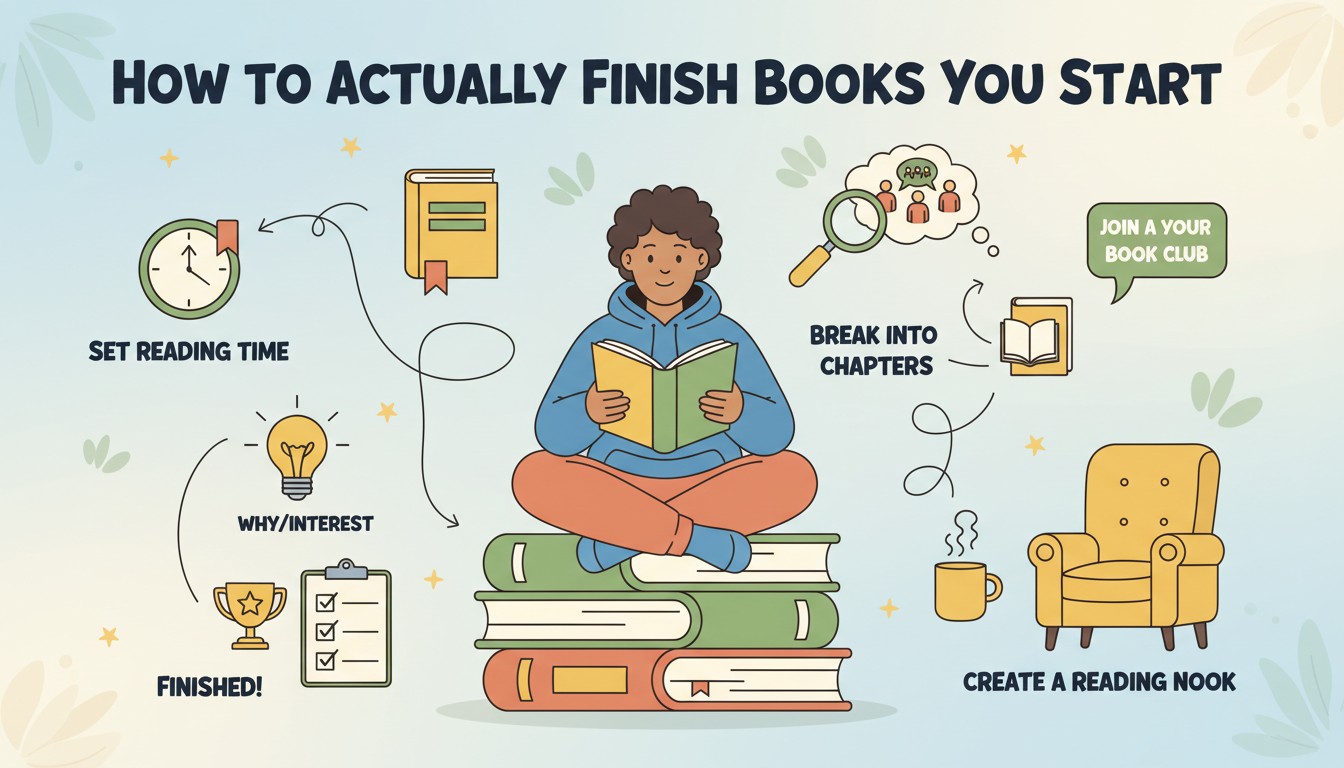
    Commit to reading only 10 pages per day. Not a chapter, not an hour—just 10 pages. This micro-habit approach works because it’s unambitious. A 300-page book becomes 30 days of manageable effort. Most days, you’ll read more. But on days when you can’t, 10 pages maintains momentum and prevents the guilt spiral that leads to abandonment.

    Track it visually. Put a sticky note on page 10, then page 20. Seeing the progress marker move creates a completion bias—your brain wants to see the pattern finish. This is the same psychology that makes video games addictive: small, visible increments toward a clear goal.

    Active Reading: The Secret Weapon for Retention

    Passive reading is entertainment. Active reading is completion. The difference is engagement: asking questions, making connections, and physically interacting with the text.

    The Think Mark System

    As reading comprehension research shows, use sticky notes or marginalia to mark key passages. But go beyond simple highlighting. Create a system:

    * for “this connects to something I already know”

    ! for “this contradicts my previous beliefs”

    ? for “I need to verify this claim”

    for “action item: apply this to my life”

    This transforms reading from consumption to conversation. You’re no longer just receiving information—you’re processing it, arguing with it, integrating it. This engagement creates memory hooks that make abandonment less likely. You feel invested because you’ve left your mark on the text.

    The Feynman Summarization

    After finishing each chapter, explain its main idea as if teaching a beginner. James Clear’s three-sentence summary method is brutally effective: “As soon as I finish a book, I challenge myself to summarize the entire text in just three sentences.” This constraint forces clarity about what truly matters.

    For non-fiction, this reveals whether you’ve absorbed the core argument. For fiction, it captures the emotional arc. If you can’t summarize a chapter, you haven’t really read it. This realization—”I need to re-read this section”—prevents the passive skimming that leads to abandonment.

    Accountability Systems: Making Abandonment Costly

    We finish what we commit to publicly. The social accountability that drives us to complete work projects can be harnessed for reading.

    The Highlight Swap

    Sarah Peck’s “swap highlights with a nerdy friend” strategy is brilliant: each person reads a different book, highlights and annotates it, then trades. Reading only your friend’s highlights gives you the book’s map without the time investment—but more importantly, the accountability of trading creates a commitment device. You can’t swap if you haven’t finished.

    This works particularly well for busy parents or professionals who want to divide and conquer. A reading group of four people can cover sixteen books in the time it would take one person to read four. The social pressure ensures completion.

    The Public Progress Tracker

    Post your current book and page number on social media weekly. The mild social pressure—knowing people are aware of your progress—creates accountability without the stress of a formal book club. One reader I know tweets “#amreading page 142 of 320” every Sunday. The simple act of reporting makes abandonment feel public.

    The Financial Commitment

    Buy the hardcover. When you’ve invested $30 instead of $0 (library) or $12 (e-book), you feel the financial pressure to extract value. This isn’t about being miserly—it’s about creating a sunk cost that works in your favor. The book on your shelf that you spent real money on continues to remind you of unfinished business in a way that a digital file doesn’t.

    The Art of Strategic Quitting: When Finishing Is the Wrong Goal

    Paradoxically, finishing more books requires giving yourself permission to not finish some. The key is distinguishing between productive abandonment and failure of willpower.

    The 50-Page Rule

    Give any book 50 pages to earn your attention. If you find yourself checking the page number, wondering how much is left, or reaching for your phone, it’s probably not the right book for this moment. James Clear advocates quitting quickly and without shame: “Start more books. Quit most of them. Read the great ones twice.” This isn’t about being a quitter—it’s about being selective.

    The critical distinction: quit books, not reading. When you abandon a book that isn’t serving you, you free up time and attention for one that will. When you abandon reading altogether because you’ve hit a boring patch, you’ve let one bad book poison the well.

    The Chapter Harvest

    For non-fiction books where only one chapter is relevant, practice selective harvesting. Read the contents page carefully, identify the chapters that address your specific questions, and read only those. This isn’t cheating—it’s efficient reading. As Sarah Peck’s father, a Stanford PhD, demonstrated: he bought books in his field but read only the latest chapter with new insights. He had internalized the rest; why waste time? Mark the chapters you read in the contents page so you know what you’ve covered. This creates a sense of completion even if you haven’t read every page.

    The Re-Read Exception

    Some books deserve to be abandoned temporarily. A complex philosophy text might be beyond your current understanding. A dense history book might require more context. It’s okay to shelve these with a note: “Revisit after reading [prerequisite].” This isn’t abandonment—it’s strategic postponement. The key is writing the note, making the commitment explicit rather than letting the book fade into the graveyard of forgotten intentions.

    Building a Reading Identity: From Consumer to Completer

    Ultimately, finishing books is about identity. You must shift from “I’m someone who loves books” to “I’m someone who finishes what they start.” This subtle mental reframing changes your relationship with reading from aspirational to behavioral.

    The Completed Books Shelf

    Create a visible record of finished books. A separate shelf where only completed books live. A simple list in a notebook. The visual accumulation serves as both reward and reminder: this is what you do. You finish books. When you see fifteen finished titles, starting the sixteenth feels natural. It’s identity reinforcement.

    The One-Book Mantra

    For three months, commit to reading only one book at a time. No context-based multiple books. No “one for work, one for pleasure.” Just one, cover to cover. This forced scarcity eliminates decision fatigue and creates deeper immersion. Most people who try this report finishing 3-4 books in the period, compared to their usual pattern of starting 5 and finishing 0. The constraint paradoxically increases output by focusing attention.

    The Reading Budget

    Treat book acquisition like a budget. For every book you buy, you must finish one you already own. This one-in, one-out system prevents the psychological overwhelm of an infinite to-read pile. When your bookshelf has space, each new book feels like a commitment, not a collection. The financial and spatial constraints work together to ensure that volume 7 of that series you started three years ago gets finished before volume 8 enters your home.

    Strategy Type Specific Tactic Completion Impact Difficulty Level
    Selection First/Last Chapter Test High (filters bad fits) Easy
    Environment 10-Page Daily Rule High (builds momentum) Easy
    Engagement Think Mark System Medium (deepens focus) Medium
    Social Highlight Swap Medium (creates accountability) Medium
    Identity One-Book-At-A-Time High (eliminates overwhelm) Hard
    Strategic Quit After 50 Pages High (frees up time) Easy

    Finishing Is a Skill, Not a Virtue

    The books on your shelf aren’t judging you. They’re just objects. The judgment comes from inside—the story you tell yourself about what starting without finishing means about your character. That story is optional.

    Finishing books is a learned skill, like cooking or coding. It requires technique, not just intention. It demands systems, not just willpower. And like any skill, it improves with practice. The goal isn’t to finish every book you ever start—it’s to finish enough books that finishing becomes your default.

    Start with one strategy. Just one. The 10-page rule. Or the first/last chapter test. Or the context assignment. Try it for one book. Notice how it changes your relationship with reading. Build from there. Your bookshelf will thank you—not by getting emptier, but by becoming a record of journeys completed rather than intentions abandoned.

  • Morning Routines That Don’t Require Waking Up at 5 AM

    Morning Routines That Don’t Require Waking Up at 5 AM

    <%%%ad1%%%>

    It’s 5:47 AM and your alarm is screaming. You’ve already hit snooze twice, each nine-minute reprieve a tiny act of rebellion against the “miracle morning” you promised yourself. The world is dark, your partner is warm, and your body feels like it’s made of concrete. You force yourself upright anyway, because somewhere, a influencer with a green juice and a yoga mat told you that winners wake before dawn. By 7 AM, you’re exhausted, cranky, and already fantasizing about tonight’s sleep. This isn’t discipline—it’s self-sabotage disguised as self-improvement.

    The 5 AM Industrial Complex has sold us a lie: that moral superiority rises with the sun. We’ve been conditioned to believe that waking before dawn is the price of admission to productivity, wellness, and success. But neuroscience tells a different story. Circadian rhythm research confirms that your internal clock is genetically programmed, not morally adjustable. Forcing yourself into a lark schedule when you’re biologically a night owl doesn’t build character—it builds sleep debt, cortisol spikes, and resentment.

    The truth is more liberating: effective morning routines have nothing to do with wake-up time and everything to do with **alignment**. A routine that honors your chronotype—your body’s natural rhythm—outperforms any pre-dawn ritual that fights it. The goal isn’t to wake earlier; it’s to wake better.

    The Chronotype Reality: Why Your Genes Set Your Alarm

    Before you can build a morning routine that works, you must understand what you’re working with. Chronotype isn’t a preference—it’s a biological trait, as innate as eye color. The Sleep Foundation explains that the master clock in your suprachiasmatic nucleus runs slightly longer than 24 hours in most adults, requiring daily environmental cues (zeitgebers) to stay aligned. Some people’s clocks run fast (morning larks), others run slow (night owls), and most fall somewhere in between.

    The Morning Lark Myth

    Society is built for morning people. School starts at 8 AM, work at 9 AM, and the entire cultural narrative celebrates early risers. But only about 40% of the population are true larks. The rest are either neutral (50%) or night owls (10%). When you force an owl into a lark schedule, you’re fighting genetics.

    The damage is measurable. Research on chronotypes shows that night owls forced into early schedules show performance impairments equivalent to being legally intoxicated. Their prefrontal cortex—responsible for decision-making and emotional control—operates at reduced capacity for the first several hours after waking. You’re not lazy; you’re operating on biological jet lag.

    The Night Owl Advantage

    Here’s what the wellness industrial complex won’t tell you: night owls show peak creativity and analytical thinking between 7 and 10 PM. Their brains are primed for complex problem-solving when the world is quiet. The 5 AM routine doesn’t just waste their natural talents—it actively sabotages them.

    Instead of forcing a 5 AM wake-up, owls should optimize for a later schedule. Wake at 7:30 AM, yes, but protect your evening “on” time. Do your creative work after dinner. Save morning hours for rote tasks that don’t demand peak cognitive performance. This isn’t making excuses—it’s strategic alignment.

    “An adult’s natural internal clock is on average 24.2 hours. We use external stimuli to help entrain this rhythm daily to 24 hours. Changing the amount and times of sunlight exposure, or changing our routines, can send signals to our ‘master clock’ and shift our natural circadian rhythms.” — Sleep Foundation

    The Buffer Zone: A Gentle Entry Into Consciousness

    The most successful non-5 AM routines share a common feature: they don’t start the moment you open your eyes. Instead, they create a **buffer zone**—a 15- to 30-minute bridge between sleep and full engagement that respects your body’s need for gradual arousal.

    The Science of the Warm Start

    When you wake, your core body temperature is at its lowest point of the day. Your brain transitions from delta waves (deep sleep) to alpha waves (wakefulness) through a process that can’t be rushed. Abruptly demanding peak performance during this transition floods your system with cortisol, the stress hormone that morning routines supposedly reduce.

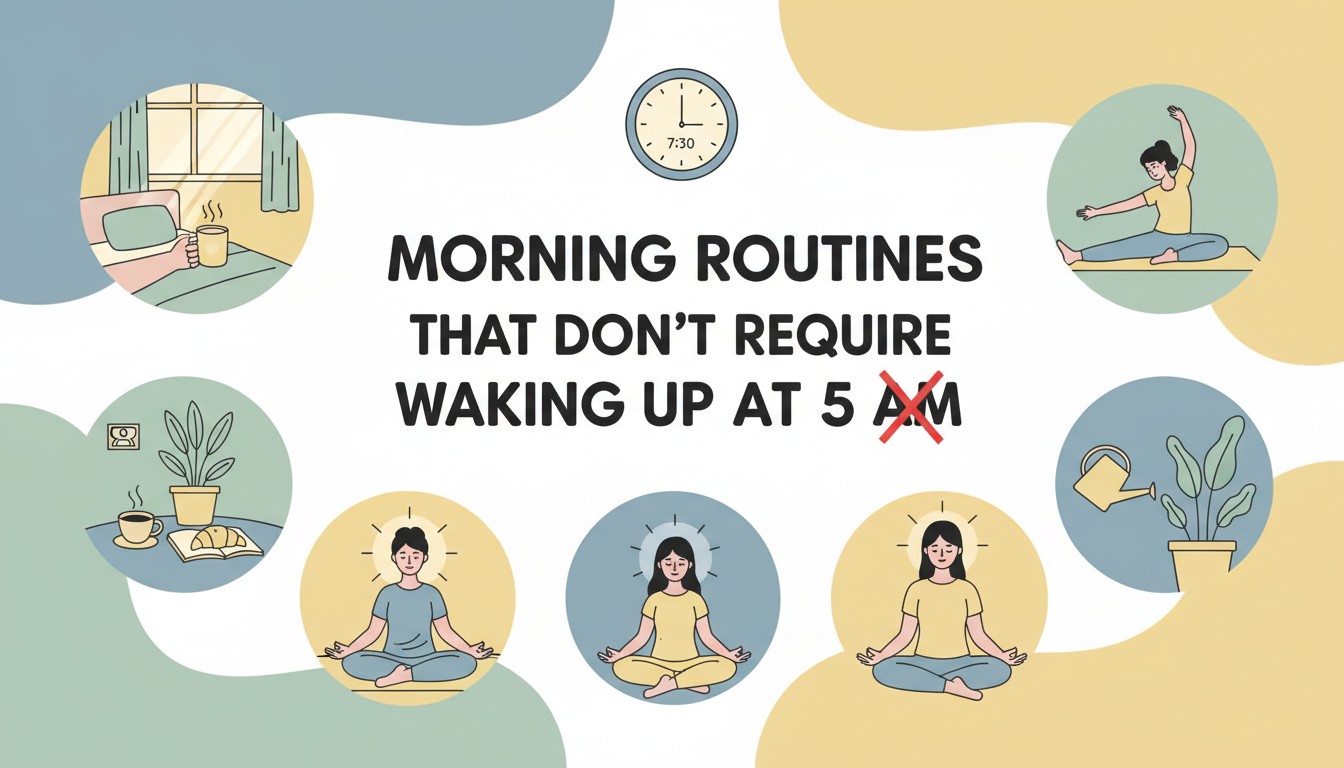
    A buffer zone works with this biology. It might look like this: you wake at 7 AM, but you don’t “start” your routine until 7:20. Those first 20 minutes are for gentle arousal—sitting up, drinking water, maybe looking out the window. No phone, no decisions, no productivity demands. This isn’t wasted time; it’s neurological priming.

    Light as the Primary Cue

    The most powerful zeitgeber (time-giver) is light. Rather than jolting yourself awake with a blaring alarm, use gradual light exposure. Open curtains immediately upon waking. If it’s still dark, turn on a bright light—ideally a full-spectrum lamp. This signals your suprachiasmatic nucleus that the day has begun, initiating the hormonal cascade that makes you feel alert.

    For night owls who wake when it’s light out, this is natural. For anyone waking before sunrise in winter, a light therapy lamp becomes essential. Research shows that strategic light exposure can shift your circadian rhythm by up to two hours—but it takes days of consistency, not a single heroic morning.

    Modular Morning Blocks: Build Your Own Routine

    The fatal flaw of most morning routine advice is its rigidity: meditate, journal, exercise, cold shower, green juice, in that order, every day. This works for exactly one person—the one who created it. For everyone else, it’s a recipe for failure.

    A sustainable approach treats morning routine as modular—a collection of blocks you can assemble based on time, energy, and priorities. Each block takes 5-10 minutes and serves a specific function. Choose 2-3 blocks daily; rotate based on need.

    The Hydration Activation Block

    Before coffee, before breakfast, before anything: 16 ounces of room-temperature water with a pinch of sea salt. Your brain is 75% water; overnight dehydration impairs cognitive function. This isn’t a wellness trend—it’s basic physiology. The salt adds trace minerals and helps cellular absorption.

    Make it automatic: place a glass and water carafe by your bed the night before. When you wake, it’s already there. No decision, no effort. This is **habit stacking** at its simplest: wake up → drink water → become slightly more human.

    The Movement Prime Block

    You don’t need a 5 AM HIIT class. You need to tell your body it’s time to move. This can be 20 jumping jacks, a 5-minute yoga flow, or simply touching your toes 10 times. The goal isn’t fitness—it’s activation.

    For night owls who feel like concrete at 7 AM, the movement block is non-negotiable. It doesn’t have to be intense. One traveler I know does “bed yoga”—stretching while still under the covers. It sounds ridiculous, but it works. Her body transitions from horizontal to vertical without the shock of leaping into action.

    The 3-Block Morning Template

    Block 1 (0-10 min): Hydration + Light exposure

    Block 2 (10-20 min): Movement + Mindfulness

    Block 3 (20-30 min): Nutrition + Planning

    Select any 2 blocks based on your schedule. Rotate daily if needed.

    The Mindfulness Micro-Dose Block

    Meditation doesn’t require 20 minutes and a cushion. Research demonstrates that 5 minutes of daily meditation for just 7 days significantly reduces cortisol and strengthens neural connections between the prefrontal cortex and amygdala. This is the brain’s brake pedal for emotional reactivity.

    The micro-dose approach: while your coffee brews, do nothing but breathe. Watch the water. Listen to the hiss. When your mind wanders (it will), gently return to the sound. That’s it. You’ve just mediated. The cue (coffee brewing) triggers the routine (breathing), which delivers the reward (reduced anxiety). This is **habit stacking** again—using an existing behavior to anchor a new one.

    The 5-Minute Morning: The Ultimate Non-5 AM Routine

    Here’s the radical reframe: your entire morning routine can be 5 minutes. Not as a compromise—as a design principle. The science of habit formation shows that simple, repetitive behaviors form habits faster than complex routines. Morning routines fail not from lack of ambition, but from excess complexity.

    The 3 M’s Framework

    Dr. Rangan Chatterjee’s “3 M’s”—Mindfulness, Movement, Mindset—provide a scalable template. Spend 1-2 minutes on each. That’s it. Five minutes total.

    Mindfulness (1-2 min): While coffee brews, breathe deeply. Notice the aroma. Feel the warmth of the mug. This isn’t meditation—it’s presence.

    Movement (1-2 min): Two bodyweight squats. Three push-ups against the counter. A 30-second stretch. The goal isn’t fitness—it’s signaling to your body that the day has begun.

    Mindset (1-2 min): One sentence of gratitude. Not a journal entry—just a thought. “I’m grateful for this coffee.” “I’m grateful I have a bed to wake up in.” The psychological shift from scarcity to abundance happens in seconds.

    The genius is in its unambitiousness. You can’t fail. You can’t “not have time.” You can do this at 7 AM, 8:30 AM, or whenever you wake. The routine bends to your life, not the reverse.

    Evening Preparation: The Morning Routine That Starts at Night

    The most effective morning routines are designed before bed. This isn’t about rigid preparation—it’s about reducing decision fatigue. Every choice you eliminate from your morning is one less obstacle between you and a successful start.

    The 5-Minute Reset

    Before sleep, spend 5 minutes setting up your morning. Fill the water glass. Lay out workout clothes (if you’re exercising). Put the coffee mug by the machine. Set out a notebook for the mindset block. This environmental design cuts habit initiation time by up to 50%, according to research on behavior change.

    For night owls who struggle with morning inertia, this prep is non-negotiable. Your 7 AM brain isn’t capable of complex decisions. It needs to find everything ready, like a trail of breadcrumbs leading to the routine.

    The Sleep Hygiene Foundation

    You can’t have a good morning without a good night’s sleep. The Sleep Foundation’s guidelines are clear: maintain a consistent sleep schedule, avoid screens 30 minutes before bed, and keep your bedroom cool and dark. For night owls, this means protecting your late-evening creative time while ensuring you still get 7-8 hours. If you naturally fall asleep at midnight, waking at 7 AM gives you the same sleep duration as the 5 AM riser who sleeps at 10 PM.

    The difference? The night owl’s routine respects their biology. The 5 AM riser might be cutting their sleep short, accumulating a “sleep debt” that impairs cognitive function and emotional regulation. Over time, this debt manifests as irritability, poor decision-making, and increased health risks.

    Real-World Routines: Four Chronotypes, Four Approaches

    Theory becomes useful when applied. Here are four morning routines, each designed for a different chronotype and schedule. Notice how none require 5 AM, yet all create a meaningful start.

    The Night Owl Professional (Wakes 7:30 AM)

    Sarah is a graphic designer who does her best work after dinner. She wakes at 7:30 AM for a 9 AM start.

    7:30-7:40: Buffer zone. Sits up, drinks water, looks out window. No phone.

    7:40-7:45: Movement block. 20 jumping jacks while coffee brews.

    7:45-7:50: Mindfulness block. Watches coffee drip, breathes deeply.

    7:50-8:00: Planning block. Reviews one priority for the day.

    Total routine time: 20 minutes. She arrives at her desk alert, not resentful.

    The Early Bird Parent (Wakes 6:00 AM)

    James is naturally a morning person but has kids, so his time is limited. He wakes at 6 AM when his daughter does.

    6:00-6:10: Hydration block. Drinks water while making his daughter breakfast.

    6:10-6:15: Mindset block. Writes one sentence of gratitude on a sticky note while she eats.

    6:15-6:20: Movement block. Stretches while she brushes her teeth.

    The routine is integrated into existing responsibilities. It adds no time but transforms the morning’s emotional tone.

    The Shift Worker (Wakes 10:00 AM)

    Maria works nights and sleeps until 10 AM. Traditional morning routines are meaningless to her schedule.

    10:00-10:10: Buffer zone. Opens curtains, drinks water.

    10:10-10:15: Light exposure block. Sits by a bright window or uses a light therapy lamp while eating breakfast.

    10:15-10:20: Movement block. Walks around the block (daylight + activity = double circadian reset).

    Her “morning” is midday, but the principles are identical. She respects her sleep-wake cycle, not the clock on the wall.

    Chronotype Natural Wake Time Peak Performance Optimal Routine Focus
    Morning Lark 6:00-6:30 AM 7:00-10:00 AM Analytical work, complex decisions
    Neutral 7:00-7:30 AM 9:00 AM-12:00 PM Balanced routine, standard schedule
    Night Owl 8:00-8:30 AM 7:00-10:00 PM Creative work, protect evening time
    Shift Worker Variable Post-wake +3-5 hrs Light exposure, consistency

    The Psychology of Consistency: Why “Never Skip Twice” Works

    Habit formation fails when we treat it as an all-or-nothing endeavor. Miss one day, and the streak is broken, so why continue? The research tells a different story. Studies show that habit formation takes a median of 59-66 days, but missing a day doesn’t reset the clock. What matters is the pattern, not perfection.

    The Never Skip Twice Rule

    This simple rule maintains momentum: you can skip one day, but never two. Life happens—kids get sick, alarms fail, you’re simply exhausted. One missed day is an anomaly; two consecutive misses becomes a new habit (of not doing the habit).

    When you miss a day, make the next day non-negotiable. Lower the bar if needed: a 1-minute routine is better than a 0-minute routine. The goal is maintaining the pattern, not achieving perfect execution.

    Identity-Based Habits

    The neuroscience of habit formation shows that behaviors repeated in consistent contexts strengthen synaptic connections in the basal ganglia, making them automatic. But this process accelerates when the habit aligns with identity. “I am someone who moves in the morning” is more powerful than “I do exercise in the morning.”

    Build your routine around who you want to be, not what you want to do. The night owl who identifies as “someone who protects their creative energy” will naturally craft a routine that preserves evening peak performance. The early bird who sees themselves as “someone who greets the day calmly” will prioritize buffer time over productivity.

    The Habit Resilience Scorecard

    Rate your morning routine on these factors (1-5):

    1. Does it respect my natural wake time?
    2. Can I complete it in under 30 minutes?
    3. Does it require minimal decision-making?
    4. Can I do it while traveling?
    5. Does it make me feel better, not worse?

    Score 20+ = Sustainable. Score below 15 = Rethink your approach.

    Digital Minimalism: Tools That Help Without Hijacking

    The paradox of morning routine apps is that they often become another source of stress—another notification demanding attention, another streak to maintain. The solution is digital minimalism: use technology as a tool, not a taskmaster.

    The Analog Advantage

    A simple notebook by your bed outperforms most apps. No battery to charge, no login required, no algorithm tracking your “performance.” Each morning, write one sentence. That’s it. Over time, these sentences create a narrative of your mornings that no app can replicate.

    For the hydration block, mark a glass with tape to show 16 ounces. When it’s empty, you’ve completed the block. Visual cues beat digital reminders.

    Strategic App Use

    If you must use apps, choose ones that reduce friction. A smart coffee maker that starts brewing at your wake time. A sunrise alarm clock that gradually brightens your room. A simple meditation timer that requires one tap.

    Avoid apps that gamify your routine with streaks or scores. The research is clear: externally imposed habits have a 37% lower success rate than self-selected ones. When your routine becomes about maintaining a streak, you’ve lost the plot.

    Your Morning, Your Rules

    The 5 AM routine is a relic of industrial-age productivity worship, not a universal law of human flourishing. Your worth isn’t measured by how early you wake, but by how well you honor your biology. A 7 AM routine that respects your chronotype beats a 5 AM routine that fights it every single time.

    Start where you are. Build a buffer zone. Choose 2-3 blocks that feel effortless. Prep the night before. Track consistency, not perfection. Let your identity guide your actions, not the other way around.

    The best morning routine is the one you’ll actually do. It might take 66 days to become automatic, but it takes only one morning to begin. Not at 5 AM. At whatever time your eyes open and your body says, “Okay, let’s start.” That’s when the real miracle happens.