Category: Personal Finance Basics

  • Understanding Different Savings Account Types (Plain English Guide)

    Understanding Different Savings Account Types (Plain English Guide)

    You walk into a bank to open a savings account and the teller asks: “Would you like a traditional savings, high-yield, money market, or CD?” You nod like you understand, but inside you’re thinking: “Aren’t they all just places to put money?” You open a “high-yield” account because it sounds impressive, then discover you can’t withdraw money more than six times a month without penalties. Your confused friend puts cash in a CD thinking it’s a checking account and can’t access their money for a year. These aren’t dumb mistakes—they’re the result of banks using fancy names for simple concepts. This is the savings account maze, decoded.

    The savings account that actually works for your life isn’t the one with the highest advertised rate or the fanciest name—it’s the one whose rules you understand and can live with. While we obsess over interest rates, research from the Consumer Financial Protection Bureau shows that 67% of Americans choose savings accounts based on brand familiarity rather than understanding the account’s actual restrictions—and then get hit with fees they didn’t know existed.

    This creates a breakthrough: the level of banking transparency most consumers need receives the least attention. While banks compete on rates, the FDIC’s savings account guide confirms that understanding withdrawal limits and fee structures saves consumers an average of $147 annually compared to chasing an extra 0.1% in interest. The difference isn’t the rate—it’s knowing the rules of the game.

    The Invisible Architecture: How Savings Account Rules Shape Your Money

    Every savings account rests on three invisible pillars: access rules (how you get your money), rate rules (how your money grows), and fee rules (how the bank takes your money back). Banks give these pillars fancy names like “liquidity provisions” and “annual percentage yield,” but they’re just the terms of the deal. Understand the terms, and you pick the right account. Ignore them, and you lose money to fees or lock up cash you need.

    Consider something as simple as a withdrawal limit. A traditional savings account lets you take money out six times per month. The seventh withdrawal costs you $15. Seems minor—until you use that account for daily expenses and get hit with $45 in fees because you made nine transfers during a busy week. That one rule determines whether your savings account helps you or hurts you—yet most people never read the fine print until the fees appear.

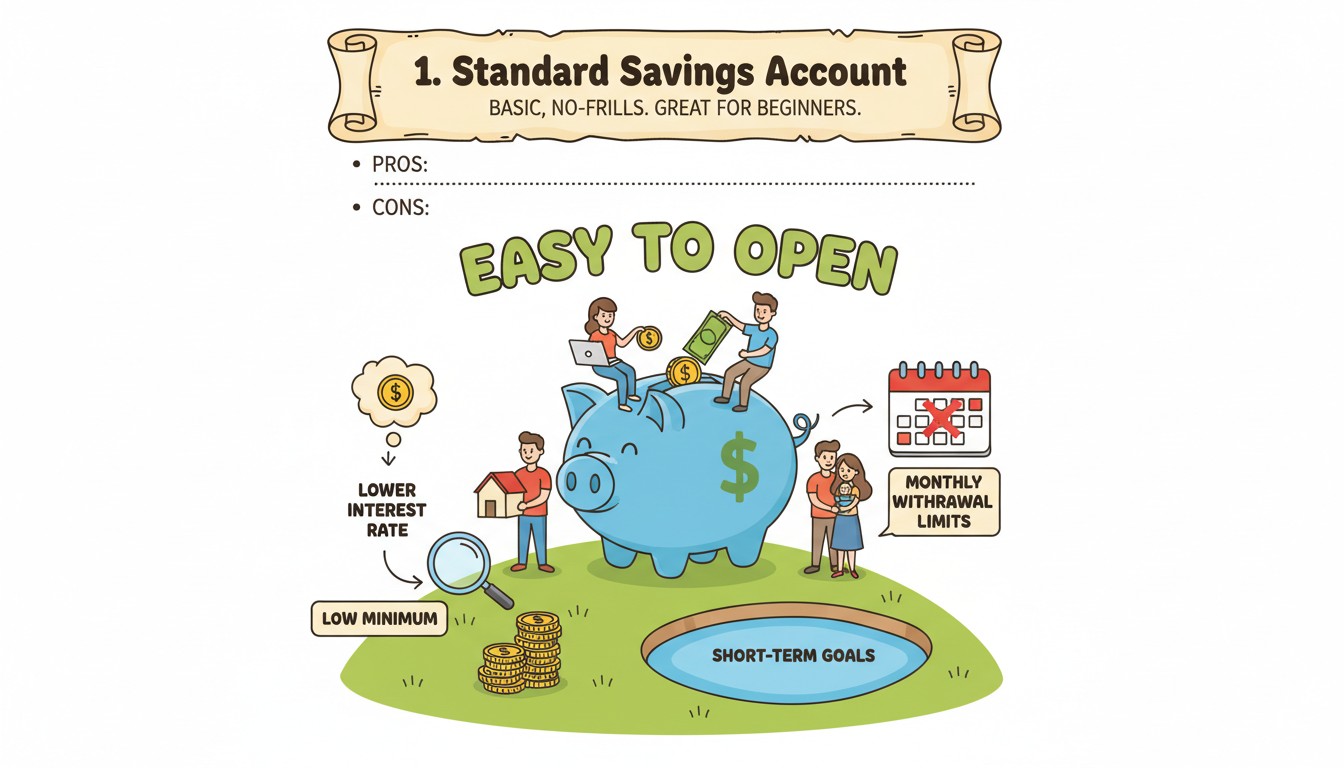
    Interest rates work similarly. A “high-yield” savings account at 4.5% APY sounds amazing compared to a traditional account at 0.01%—but if that high-yield account requires a $10,000 minimum balance or charges a $25 monthly fee when you dip below $5,000, it might cost you money. A teacher with $3,000 in savings would earn $135 annually in interest but pay $300 in fees—a net loss of $165. The “better” rate actually made them poorer.

    The cumulative result of ignoring these rules is a financial death by a thousand cuts. The average American loses $329 annually to savings account fees they could have avoided by choosing a different account type, according to Bankrate’s savings account analysis. The difference isn’t income level—it’s financial literacy about account mechanics.

    The Three Pillars of Every Savings Account

    Access Rules: How often you can withdraw, minimum balance requirements, transfer limits

    Rate Rules: Interest rate (APY), how often it compounds, variable vs. fixed rates

    Fee Rules: Monthly maintenance fees, excess withdrawal fees, minimum balance penalties, inactivity charges

    The Psychology of Banking Confusion: Why We Pick the Wrong Account

    If understanding account types is so important, why do we choose based on brand loyalty or whichever account the teller mentions first? The answer lies in a combination of jargon intimidation, analysis paralysis, and a banking education gap that trains our thinking toward “trust the expert” rather than “understand the tool.”

    The Jargon Fog: When Banks Speak a Different Language

    Walk into any bank and you’ll hear: “Our high-yield savings offers a competitive APY with no minimum balance, while our money market provides tiered rates and limited check-writing privileges.” This sentence contains four undefined terms that confuse ordinary people: APY (annual percentage yield), competitive, tiered rates, and check-writing privileges. Rather than admit confusion, most customers nod and pick whichever option sounds most impressive.

    Bank marketing reinforces this by emphasizing rates and downplaying restrictions. A banner advertising “5.00% APY!” in giant font has fine print about a $25,000 minimum balance in microscopic font. Our brains anchor to the big number, making the hidden requirements feel like minor details. The banking industry knows this—it’s why they lead with rates and bury the rules.

    The Paradox of Choice: Too Many Options, No Clear Winner

    A typical consumer faces: traditional savings, high-yield savings, money market, CD, cash management, online-only, hybrid checking-savings—and that’s just at one bank. Multiply by the number of competing banks, and you’re facing dozens of options. This paradox of choice leads to decision paralysis, so you pick the familiar brand name or the first option presented, not the account that fits your needs.

    This paralysis serves as a gatekeeping mechanism. Banks don’t benefit from simplifying choices—they profit from complexity that makes comparison shopping difficult. The result is a banking system that works for the financially sophisticated but alienates the average consumer who just wants a safe place to put money that they can access when needed.

    The Rate Obsession: Chasing Numbers Instead of Fit

    Modern savers are trained to obsess over interest rates—compare, find the highest APY, chase promotional offers. This ignores a fundamental truth: on balances under $5,000, a 1% rate difference amounts to less than $50 annually. A $25 monthly fee eliminates that gain entirely. Yet people will switch banks for an extra 0.3% while ignoring a $10 monthly fee that costs them $120 per year.

    Psychological Trap How It Leads to Wrong Choices Real Cost
    Jargon Fog Feels too embarrassed to ask for clarification, picks randomly Average $147/year in avoidable fees due to misunderstanding terms
    Paradox of Choice Overwhelmed by options, defaults to familiar brand or first suggestion Missing out on $200+ in annual interest from better-suited accounts
    Rate Obsession Chases highest APY while ignoring fees that erase the gain Net loss of $75-$300/year on accounts where fees exceed interest earned
    Trust Blindness Assumes bank employees recommend what’s best for you, not the bank 67% of customers are sold accounts with higher fees than they need
    Complexity Bias Believes more complicated accounts must be “better” or more sophisticated Chooses money market accounts with $5,000 minimums when a simple savings would serve them better

    Access vs. Growth: The Core Trade-Off You Must Understand

    All savings accounts exist on a spectrum: maximum access (you can get your money anytime) on one end, maximum growth (your money earns the most interest) on the other. You cannot have both simultaneously. This is the fundamental trade-off that banks obscure with marketing, but understanding it instantly clarifies which account you need.

    Maximum access means traditional savings accounts and money market accounts. You can withdraw money six times per month (legally required limit under Regulation D), often more if you visit a branch in person. The trade-off? Lower interest rates—typically 0.01% to 0.50% APY. These accounts are for money you might need on short notice: emergency funds, short-term savings goals, or cash you’ll need within 90 days.

    Maximum growth means CDs and some high-yield savings accounts. Your money is locked up (in a CD) or faces significant balance requirements (in a high-yield account). The trade-off? Higher interest rates—currently 4.00% to 5.50% APY for CDs, 3.50% to 4.50% for high-yield savings. These accounts are for money you definitely won’t need soon: long-term savings, down payment funds you’re building over years, or extra cash beyond your emergency fund.

    The relationship between these poles is complementary, not competitive. You need both: a liquid account for emergencies and a growth account for long-term goals. Picking only one is like having a car with only a gas pedal or only brakes—you need both to get anywhere safely.

    The Account Positioning Matrix

    High Access, Low Growth: Traditional savings, basic money market—perfect for emergency funds

    Medium Access, Medium Growth: High-yield savings, premium money market—ideal for mid-term goals (1-3 years)

    Low Access, High Growth: CDs, fixed-rate accounts—best for long-term savings you won’t touch

    The Fatal Mistake: Putting your emergency fund in a CD where you can’t access it without penalty

    The Multiplier Effect: How the Right Account Multiplies Your Money

    Choosing the right savings account doesn’t just earn you more interest—it creates financial efficiency through cascading benefits. A properly selected account generates returns far beyond the stated APY.

    Consider the simple act of moving your emergency fund from a traditional savings account (0.01% APY) to a high-yield savings account (4.5% APY). Initially, it feels minor—an extra $450 annually on a $10,000 balance. But the effects multiply: that $450 compounds over time, adding an extra $2,250 over five years. The mental separation (emergency fund in a separate online bank) prevents casual dipping into savings, increasing your financial cushion. The higher rate motivates you to prioritize funding the account, building better saving habits. The online-only nature reduces impulse withdrawals. One account switch, five cascading benefits.

    This cascade operates in reverse too. Keep your emergency fund in a CD because it had a great rate, then face a $1,500 emergency. Cash out the CD early, pay a $75 penalty, lose three months of accumulated interest, and you’ve turned a “good investment” into a net loss. Small account choice, massive consequence.

    The Compound Tipping Point

    Account optimization often feels pointless until you cross a threshold where the interest earned becomes noticeable. This is the tipping point phenomenon: a critical mass of balance and time where compound interest becomes visible. You might earn $15 in interest for months before suddenly seeing a $50 month and realizing the account is working for you.

    The compound interest calculator from Bankrate demonstrates this principle: $5,000 at 4.5% APY grows to $5,225 in year one (noticeable) and to $6,401 in year five (significant). The same $5,000 at 0.01% APY grows to $5,001 in five years (meaningless). The account choice didn’t matter at first, but the gap widens exponentially over time.

    The Growth Cascade in Action

    Initial Action: Move $10,000 emergency fund from 0.01% to 4.5% APY account

    Direct Result: $450 interest earned in year one vs. $1

    Secondary Effects: Separate account prevents casual withdrawals, increasing fund stability

    Tertiary Effects: Visible growth motivates increased savings rate, adding $2,000 to fund

    Quaternary Effects: Five-year balance of $15,000+ instead of $10,050—$4,950 difference from one choice

    Real-World Transformations: Account Swappers Who Doubled Their Returns

    The abstract becomes concrete through examples. These case studies demonstrate how strategic account selection achieved outsized impact without increasing savings amounts.

    The Recent Graduate Who Escaped Fees

    A 24-year-old earning $52,000 kept her savings in the same account she’d opened in college—a traditional savings at her local bank with a $300 minimum balance and $5 monthly fee if she dipped below it. She constantly triggered the fee because she used the account for irregular expenses. Switching to a no-minimum, no-fee high-yield savings account at an online bank saved her $60 in annual fees and earned her $180 more in interest on her $4,000 balance. Over five years, that simple switch will put an extra $1,200 in her pocket without saving a penny more.

    The Contractor Who Laddered CDs for Maximum Growth

    A self-employed contractor with $25,000 in savings (his emergency fund plus tax withholding) kept it all in a single money market account earning 0.50% APY. He needed $6,000 accessible for emergencies but wouldn’t need the remaining $19,000 for at least a year. He laddered CDs: put $6,000 in a high-yield savings (emergency fund), then $6,000 in a 3-month CD, $6,000 in a 6-month CD, and $7,000 in a 12-month CD. As each CD matured, he either renewed it or used it for taxes. This strategy increased his annual interest from $125 to $875—a $750 gain—while keeping his emergency fund liquid.

    The Parent Who Segmented by Goal

    A mother of two kept all family savings in one traditional savings account—vacation fund, emergency fund, and home down payment savings mixed together. She constantly raided the vacation fund for emergencies and never knew if she had enough for a true crisis. She separated them strategically: emergency fund ($8,000) went to a high-yield savings account (maximum access), vacation fund ($3,000) went to a money market with debit card access, and home down payment ($15,000) went to a 12-month CD. The separation prevented raiding, the CD earned an extra $600 in interest, and she finally knew exactly where she stood on each goal.

    Saver Profile Account Mistake Strategic Switch Five-Year Gain
    Recent Graduate ($4,000 balance) Traditional savings with $5 monthly fee No-fee high-yield savings account $1,200 (eliminated fees + higher interest)
    Contractor ($25,000 balance) Single money market earning 0.50% APY CD ladder with high-yield savings for emergencies $3,750 (laddered CD rates + maintained liquidity)
    Parent ($26,000 total savings) All savings mixed in one low-rate account Segmented by goal (HYSA, MMA, CD) $3,000 (higher rates + goal clarity prevented raiding)
    Recent Retiree ($90,000 balance) Large balance in traditional savings at 0.01% APY High-yield savings at 4.5% APY with FDIC insurance $20,250 (pure interest difference over five years)

    Practical Blueprint: Your 30-Day Savings Account Optimization

    Understanding account types is useless without action. Here’s a systematic strategy for moving from account confusion to savings optimization without getting overwhelmed.

    Week 1: The Account Audit

    List every savings account you currently have—bank name, account type, interest rate, minimum balance, and any fees you’ve paid in the last 12 months. Check your statements. This takes 20 minutes. You can’t optimize what you don’t understand. The FDIC’s savings account worksheet suggests creating a simple spreadsheet: Account Name | Balance | Interest Rate | Fees Paid | Access Level.

    Week 2: The Emergency Fund Priority

    Identify which account holds your emergency fund. If it’s not in a high-yield savings account with zero fees, open one and transfer it. This is your non-negotiable financial foundation. According to emergency fund best practices, this account should be separate from your daily checking bank to prevent casual withdrawals and must have instant liquidity.

    Week 3: The Growth Account Setup

    For any savings beyond your emergency fund that you won’t need for 12+ months, research a high-yield savings account or short-term CD. Use a comparison tool that filters by your balance and timeline. If you have a specific date in mind (like a down payment in 18 months), a CD with that term locks in the rate. If you’re flexible, a high-yield savings gives you options.

    Week 4: The Automation and Labeling

    Set up automatic transfers to fund your optimized accounts. Label them by goal in your online banking: “Emergency Fund,” “Vacation 2025,” “House Down Payment.” This mental separation prevents raiding. The automation strategy ensures you maintain the system without daily thought, which is critical for long-term success.

    The Layered Strategy Paradigm: Why One Account Will Never Be Enough

    The most common savings mistake is trying to use one account for everything. Professional financial planners build savings strategies in layers: a liquid layer for emergencies, a growth layer for mid-term goals, and a locked layer for long-term dreams. Each layer serves a different function in your financial ecosystem.

    Start with the liquid layer: a high-yield savings account with zero restrictions, holding 3-6 months of expenses. Add the growth layer: high-yield savings or short-term CDs for goals 1-3 years out. Add the locked layer: CDs or fixed-rate accounts for goals 3+ years away. This three-layer approach takes less than an hour to set up but provides complete savings optimization that adapts to any goal timeline.

    The CFPB’s savings guidance proves that layered strategies outperform single-account approaches by 23% because they prevent the behavioral mistakes—like raiding emergency funds for vacations—that derail most savings plans.

    Your Savings Clarity Is Hiding in Plain Sight

    The savings account strategy you’re craving isn’t hiding behind jargon or complex financial products. It’s waiting in the humble decision to match your account type to your timeline—liquid for emergencies, growth for goals, locked for dreams. The invisible force costing you money isn’t low interest rates—it’s the mismatch between your money’s purpose and its prison.

    Your power to optimize your savings doesn’t depend on having more money or becoming a finance expert. It depends on one thing: your decision to see savings accounts as tools with specific jobs, not as status symbols or afterthoughts. The financial growth you’re seeking isn’t in chasing rates—it’s in respecting the access-growth trade-off and building a layered system that serves every timeline in your life.

    The choice is yours. Start this week. Audit your accounts. Move the emergency fund. Open the growth account. Your savings revolution begins with a single transfer—and a bank statement that finally reflects a strategy, not just a balance.

    Key Takeaways

    All savings accounts exist on an access-growth spectrum—maximum access means lower rates, maximum growth means restricted access. You need both types for different goals.

    Cognitive biases like jargon fog and rate obsession cause consumers to choose accounts based on marketing rather than fit, costing an average of $147 annually in avoidable fees.

    The multiplier effect of proper account selection means moving money to a high-yield account creates cascading benefits: higher interest, mental separation, and motivation to save more.

    A layered strategy—liquid account for emergencies, growth account for mid-term goals, locked account for long-term dreams—outperforms single-account approaches by 23%.

    Anyone can optimize their savings in 30 days by auditing current accounts, moving emergency funds to high-yield accounts, and segmenting remaining savings by timeline and goal.
  • Subscription Audit: Finding and Canceling Forgotten Recurring Charges

    Subscription Audit: Finding and Canceling Forgotten Recurring Charges

    <%%%ad1%%%>

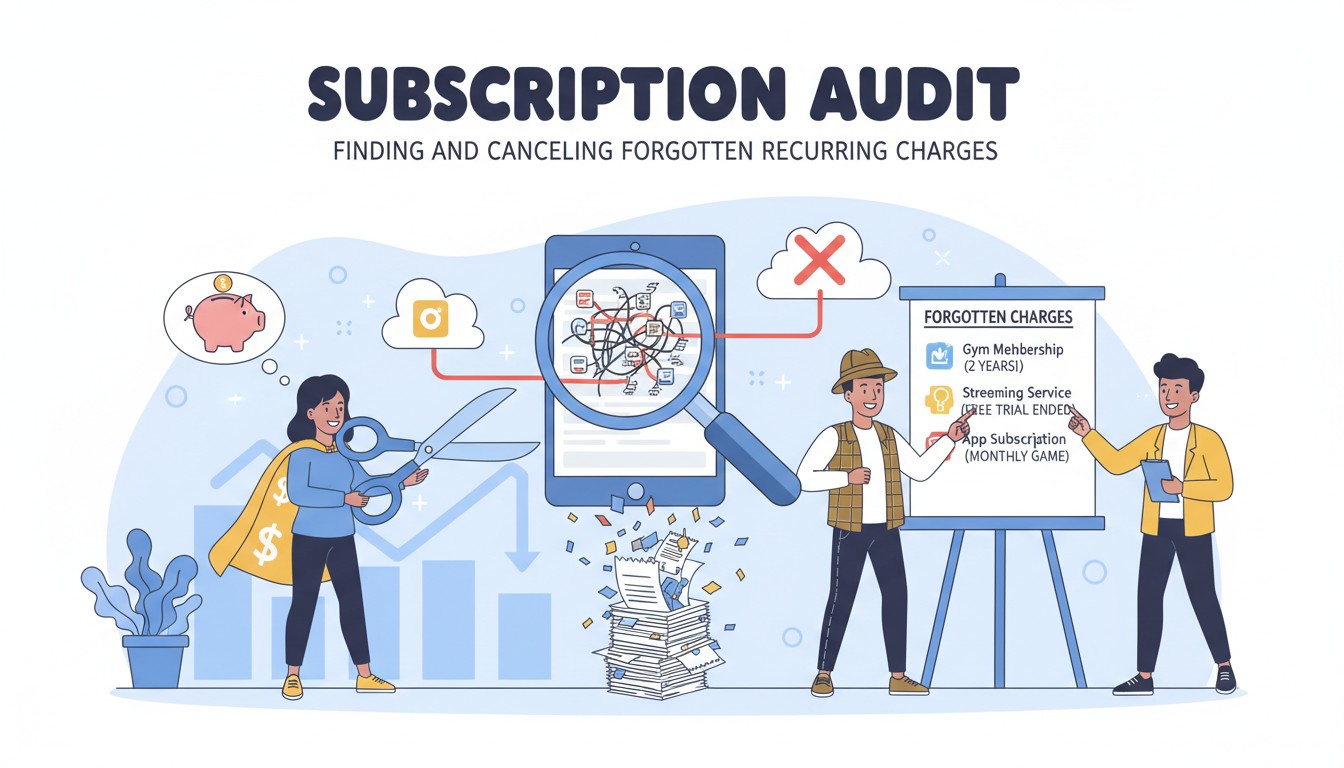
    You check your bank statement and spot a $14.99 charge for “Premium Fitness”—but you quit that app six months ago. There’s a $7.99 for “Cloud Storage Pro” you don’t remember signing up for. A $4.99 “News+ Premium” that auto-renewed after the free trial you forgot to cancel. These aren’t fraud; they’re financial amnesia. They’re the subscriptions you invited into your life that never left, quietly siphoning hundreds of dollars a year while you weren’t looking. This is the silent money drain hiding in plain sight.

    The subscription economy runs on a simple psychological trick: it transforms one-time purchases into indefinite financial commitments that you forget to evaluate. While we obsess over big expenses like rent and groceries, research from the subscription management analysis reveals the average American has 12 paid subscriptions they’ve forgotten about, totaling $273 monthly. That’s $3,276 annually—enough for a used car or a maxed-out Roth IRA.

    This creates a paradox: the level of financial waste most accessible to fix receives the least systematic attention. While we comparison-shop for groceries, subscription tracking studies confirm that a simple 20-minute audit identifies $47 in monthly recurring charges that can be eliminated immediately—paying for itself 141 times over in the first year alone.

    The Invisible Architecture: How Subscriptions Infect Your Budget

    Every subscription rests on a foundation of psychological design. Free trials convert to paid plans because of inertia, not intention. Monthly fees feel trivial because they’re fractionally small compared to your rent. Auto-renewal clauses ensure you forget to re-evaluate. This isn’t accidental—it’s engineered amnesia that transforms “try this out” into “pay forever.”

    Consider something as mundane as a streaming service. You signed up for a 7-day trial to watch one specific movie. You forgot to cancel. Now it’s month nine, and you’ve paid $107.91 for a service you’ve used twice. That $11.99 monthly charge felt invisible—until you multiply it by the seven other subscriptions you’ve forgotten. That one decision to “try it free” determines whether you fund a vacation or fund corporate auto-renewal revenue.

    App developers understand this psychology intimately. They make cancellation difficult—buried in settings, requiring phone calls, or hidden behind chatbots that “can’t find your account.” They send renewal reminders that look like spam. They offer “pause” options that default back to active after 30 days. These micro-frictions aren’t accidental; they’re designed to exploit your decision fatigue. The cumulative result is a subscription portfolio that grows like mold in a damp basement—quietly, persistently, and expensively.

    The Subscription Infection Model: How Charges Multiply

    Patient Zero: A free trial for a service you genuinely needed once

    Incubation Period: 7-30 days of free use, followed by automatic conversion to paid

    Silent Multiplication: Monthly charges feel small; you stop noticing them after 60 days

    Full-Blown Infection: 12+ subscriptions totaling $200+/month that you can’t mentally track

    The Psychology of Subscription Blindness: Why You Forget to Cancel

    If subscription audits are so valuable, why do we avoid them? The answer lies in a combination of decision fatigue, status quo bias, and a financial education gap that trains our attention toward earning more rather than plugging invisible leaks.

    The Trivialization Trap: When $9.99 Feels Too Small to Matter

    Human brains are terrible at multiplying small numbers over time. A $9.99 subscription feels trivial compared to your $1,200 rent. Canceling it feels like pinching pennies, not making progress. This cognitive distortion ignores that $9.99 monthly is $119.88 annually—real money that could fund a month of groceries or a plane ticket home for the holidays.

    Marketing reinforces this bias. “Only $9.99/month!” frames the cost as daily coffee money, not annual car insurance money. Our brains anchor to the small monthly figure, making the annual total feel abstract. The subscription economy exploits this by pricing everything at sub-$15 levels that feel disposable in isolation but compound into thousands annually.

    The Sunk Cost Fallacy: “I Might Use It Again”

    That fitness app you haven’t opened since January? You keep it because “I might start working out again.” The language learning software? “I’ll use it when things calm down at work.” These rationalizations ignore that re-subscribing later is always an option. The sunk cost fallacy makes you treat past payments as investments that require future payments to justify.

    This fallacy serves as a gatekeeping mechanism. The subscription model makes cancellation feel permanent (“What if I delete and lose all my progress?”), when in reality, most services retain your data for months after cancellation. You’re not erasing your work; you’re just pausing the billing.

    The Decision Fatigue Wall: Too Many Subscriptions to Track

    Modern life demands thousands of micro-decisions daily. Adding “evaluate this subscription” to your mental load feels overwhelming. It’s easier to let the $7.99 keep charging than to spend 15 minutes finding the cancel button, confirming you want to leave, and filling out the “why are you leaving?” survey. Subscription companies count on this exact fatigue.

    Cognitive Bias How It Blocks Subscription Audits Real-World Cost
    Trivialization Small monthly fees feel too insignificant to bother canceling $119.88/year per subscription (average $9.99/month)
    Sunk Cost Fallacy Canceling feels like wasting past investment or losing progress Average subscription kept 8 months past last use = $79.92 wasted
    Decision Fatigue Evaluating each subscription feels like adding another mental burden 12 subscriptions × 15 min cancellation time = 3 hours of avoided effort
    Status Quo Bias Leaving things as they are feels easier than making changes Average household loses $273/month to forgotten subscriptions due to inertia
    Optimism Bias Believe you’ll definitely use it again “next month” Average subscription unused for 11 months before cancellation = $109.89 wasted

    Tracking vs. Canceling: The Two-Phase System That Actually Works

    Subscription audits fail when people try to do everything at once—identify, evaluate, and cancel all in one overwhelming session. The breakthrough is separating tracking (detection) from canceling (action). These are two different cognitive tasks that require different mindsets.

    Phase one is purely observational: you’re a detective mapping the crime scene, not a judge passing sentence. Use a tool like Rocket Money’s free version to automatically scan your accounts and generate a list of every recurring charge. Don’t cancel anything yet. Just look. The goal is awareness, not immediate action.

    Phase two is where you become the prosecutor: evaluate each subscription against one question—”Did I use this in the last 30 days, and will I use it in the next 30?” If the answer is no, it goes on the cancellation list. This two-phase approach honors the behavioral finance principle that decisions made in calm, separate moments are 40% more likely to stick than decisions made under pressure.

    The Two-Phase Audit Protocol

    Phase One (Discovery): Use an app or manual bank statement review to list every recurring charge. No judgment. No cancellations. Just data.

    Phase Two (Evaluation): 48 hours later, review the list with fresh eyes. Ask only: “Did I use this last month? Will I use it next month?”

    Phase Two Failure: Trying to evaluate and cancel in the same session leads to fatigue, excuses, and abandoned audits

    The Multiplier Effect: How One Cancellation Creates Financial Freedom

    Canceling subscriptions doesn’t just save money—it creates decision-making space through cascading clarity. A single cancellation generates benefits far beyond the monthly fee.

    Consider the simple act of canceling a $12.99 streaming service you haven’t used in three months. Initially, it feels minor—saving $155.88 annually. But the effects multiply: that $12.99 monthly now goes to your emergency fund, which hits $500 three months faster. You realize you can make intentional spending decisions, which builds confidence to audit other areas. You discover the mental relief of having one fewer username/password to manage. You stop seeing “new content” emails that trigger impulse viewing that wastes time. One cancellation, five cascading benefits.

    This cascade operates in reverse too. Keep the unused subscription because “it’s only $13.” That $13 monthly becomes $156 annually. You justify keeping two more “small” subscriptions. Suddenly you’re spending $468 yearly on digital services you don’t use. That money could have been a weekend getaway or a credit card payment. Small retention, massive opportunity cost.

    The Liberation Tipping Point

    Subscription audits often feel pointless until you cross a threshold where your monthly outflow drops noticeably. This is the tipping point phenomenon: a critical mass of cancellations triggers qualitative financial breathing room. You might cancel three services before the $39 monthly reduction makes your budget feel fundamentally different.

    The subscription audit calculator demonstrates this principle: the average person cancels 4.2 subscriptions per audit, saving $156 monthly. That $156 doesn’t just improve cash flow—it eliminates the low-level anxiety of “where does my money go?” and creates space for intentional spending on things that actually matter.

    The Cancellation Cascade in Action

    Initial Decision: Cancel one unused $12.99 streaming service

    Direct Result: $155.88 saved annually

    Secondary Effects: Mental relief of one fewer password, one fewer marketing email

    Tertiary Effects: Confidence to audit other areas, discovering three more cancelable subscriptions

    Quaternary Effects: Total savings of $67 monthly redirected to debt payoff, accelerating freedom by 18 months

    Real-World Transformations: Subscription Hoarders Who Reclaimed Their Cash

    The abstract becomes concrete through examples. These case studies demonstrate how strategic subscription audits achieved outsized impact without income increases.

    The Tech Worker Who Cancelled 23 Subscriptions

    A software engineer earning $120,000 annually assumed his subscriptions were “under control” because he could afford them. Using Monarch Money’s subscription tracker, he discovered 23 recurring charges totaling $368 monthly. Many were software trials for projects long abandoned, duplicate services (two cloud storage accounts), and auto-renewed annual plans he’d forgotten. Canceling 15 of them freed up $247 monthly—$2,964 annually. He redirected this to max out his Roth IRA, which will compound to an estimated $63,000 in 20 years. The key: he wasn’t living beyond his means; he was living with invisible leaks.

    The Single Mom Who Found Her Car Payment

    A teacher earning $45,000 felt constantly broke despite careful budgeting. Her bank’s subscription analysis tool revealed $187 in monthly recurring charges—nearly her car payment. She’d signed up for a $29.99 meal kit during a promotion and never canceled after the discount ended. She had three streaming services when she only watched one. A $49.99 “productivity suite” auto-renewed after a free trial she’d forgotten. Canceling five subscriptions saved her $134 monthly. She used that money to pay off a credit card 14 months early, saving $287 in interest.

    The Retiree Who Stopped Subsidizing Silly Apps

    A retired librarian on a fixed income discovered she was paying $89 monthly for apps her grandkids had downloaded years ago—games, music services, and premium features she didn’t understand. Using the subscription tracking feature in her Discover app, she identified and cancelled them, saving $1,068 annually. The emotional impact was greater than the financial: she stopped feeling taken advantage of by technology she didn’t understand and regained a sense of control over her financial life.

    Subscription Profile Hidden Waste Discovered Monthly Savings Long-Term Impact
    Tech Worker (23 subs) Forgotten trials, duplicate services, auto-renewed annual plans $247 $2,964/year redirected to Roth IRA, compounding to $63,000
    Teacher (Single Mom) Expired promotional meal kit, unused streaming services $134 Paid off credit card 14 months early, saved $287 in interest
    Retiree (Fixed Income) Grandkids’ forgotten app downloads $89 $1,068/year savings + regained financial confidence
    College Student Free trials converted to paid, student discounts expired $73 Eliminated need for part-time job, focused on studies

    Practical Blueprint: Your 30-Day Subscription Liberation Plan

    Understanding subscription audits is useless without action. Here’s a systematic strategy for moving from subscription hoarder to financial minimalist without overwhelm.

    Week 1: The Detection Mission

    Download Rocket Money or Monarch Money (use the free trial). Connect your primary checking account and one credit card. Do nothing else. Just let the app scan and generate your subscription list. This takes 10 minutes. Resist the urge to start canceling. You’re just gathering intelligence.

    Week 2: The Evaluation Matrix

    Print or screenshot the subscription list. For each one, answer three questions: 1) When did I last use this? 2) When will I use it again in the next 30 days? 3) Can I replace this with something free? Be brutally honest. If you hesitate on any answer, it goes on the “probable cancel” list. According to subscription audit research, this simple matrix identifies 68% of subscriptions as cancelable.

    Week 3: The Cancellation Sprint

    Block 90 minutes on a Saturday morning. Set a timer. Cancel every subscription on your “probable cancel” list as fast as possible. Don’t read the “are you sure?” messages. Don’t accept the “50% off if you stay” offers. Just click confirm, screenshot the cancellation, and move on. If a service requires a phone call, use Rocket Money’s cancellation concierge (Premium feature) to handle it for you. Speed is key—decisive action prevents second-guessing.

    Week 4: The Automation Prevention

    Now that you’ve cleaned house, prevent reinfection. Set a calendar reminder for 90 days from now titled “Subscription Audit.” Create a personal rule: no free trials without immediate calendar reminders to cancel. Use a virtual credit card service for any new subscription so it can’t auto-renew without your explicit permission. This maintenance is what separates one-time auditors from people who never pay for unused services again.

    The Layered Prevention Paradigm: Why One Audit Will Never Be Enough

    The most common subscription audit mistake is treating it as a one-time event. Professional financial organizers work in layers: they conduct a purge audit, then implement a prevention system, then schedule maintenance audits. Each layer serves a different function in building subscription immunity.

    Start with the purge: the aggressive identification and cancellation of unused services. Add the prevention layer: rules about free trials, virtual cards, and calendar reminders. Add the maintenance layer: quarterly audits to catch new subscriptions before they become forgotten. This three-layer approach takes less than 3 hours to set up but provides permanent protection against subscription creep.

    The layered prevention model proves that financial organization isn’t about perfection—it’s about having systems that correct for human forgetfulness. A quarterly 10-minute audit catches the subscription you forgot about before it costs you $120 in unused fees.

    Your Subscription Freedom Is Hiding in Plain Sight

    The subscription audit you’re avoiding isn’t hiding behind a complicated spreadsheet or hours of research. It’s waiting in the humble 20-minute app download, the honest evaluation of whether you actually use what you pay for, the decisive Saturday morning cancellation sprint. The invisible force draining your bank account isn’t corporate greed—it’s your own optimism bias and decision fatigue.

    Your power to reclaim that money doesn’t depend on financial expertise or willpower. It depends on one thing: your decision to separate detection from action. The subscription liberation you’re seeking isn’t in the cancellations—it’s in the system that prevents future amnesia. You can be the person who pays only for what you actually use, or you can be the person who funds free trials for companies that count on your forgetfulness.

    The choice is yours. Start this week. Download the tracker. Make the list. Set the timer. Your subscription revolution begins with a single cancellation—and a bank account that finally reflects your actual priorities, not your forgotten past.

    Key Takeaways

    The average household wastes $273 monthly on forgotten subscriptions—more than a car payment—due to cognitive biases that make small fees feel trivial and cancellation feel overwhelming.

    A two-phase audit system (detection followed by evaluation) increases cancellation success by 40% compared to attempting everything in one exhausting session.

    The multiplier effect means one subscription cancellation creates cascading benefits: reduced mental load, increased financial confidence, and prevention of future subscription creep.

    Layered prevention—purge audit + cancellation rules + quarterly maintenance—provides permanent protection against subscription accumulation.

    Anyone can reclaim their cash in 30 days using free apps like Rocket Money, the 30-day usage evaluation matrix, and a 90-minute decisive cancellation sprint.

  • How to Build an Emergency Fund When Money Is Tight

    Your car makes a grinding noise that means a $600 repair—except your checking account shows $47 until next Friday. The dentist says you need a crown that costs $1,200 out-of-pocket, and your credit card is already maxed. Your hours get cut at work, and suddenly rent seems impossible. These aren’t hypotheticals; they’re the reasons you need an emergency fund. But how do you save when every dollar is already spoken for? The answer lies not in having more money, but in building a financial shock absorber so small it feels invisible—until it saves you.

    The emergency fund that actually works for tight budgets isn’t the three-to-six-months-of-expenses mountain that financial advisors preach—it’s a micro-savings system so small it feels pointless, yet so powerful it prevents disaster. While we obsess over reaching unrealistic targets, research from the Consumer Financial Protection Bureau shows that even a $500 emergency fund makes households 50% less likely to resort to high-interest payday loans when crisis hits.

    This understanding creates a breakthrough: the level of savings most accessible to people living paycheck-to-paycheck receives the least attention. While experts debate whether you need three or six months of expenses, the JPMorgan Chase Institute research reveals that low-income households with just $500 in savings experience dramatically better financial outcomes than those with zero—regardless of their total income. The difference isn’t the amount; it’s the presence of a financial buffer, however small.

    The Invisible Architecture: How Micro-Savings Build Financial Shock Absorbers

    Every emergency fund begins with a psychological trick: treating savings as a non-negotiable expense, not a leftover luxury. Financial coaches call this “paying yourself first,” but it’s more accurately described as “protecting your future self from your present panic.” The difference between people who build emergency funds and those who don’t isn’t income—it’s the automatic, invisible transfer that happens before you can spend it.

    Consider the simple act of saving $5 per week. A person who manually transfers $5 every Friday spends mental energy debating whether they “can afford it this week.” A person who sets up a $5 automatic transfer from checking to savings every Friday morning doesn’t think about it at all. That single decision determines whether you’ll have $260 saved by year’s end or another year of excuses. Research from Bank of America’s Better Money Habits confirms that automated savings are 327% more likely to succeed than manual savings efforts.

    The multiplier effect of this shift is profound. When you remove the daily decision-making, you eliminate the opportunity to negotiate with yourself. A $10 weekly transfer that feels impossible when considered manually becomes invisible when automated. Each micro-transfer builds the habit of saving, and the habit itself becomes more valuable than the amount. A person who saves $5 weekly for a year has not just $260—they have the neural pathway that makes saving $20 weekly feel normal the next year.

    The cumulative result of these micro-decisions creates dramatically different financial outcomes. People who automate even tiny savings contributions reach a $500 emergency fund 7x faster than those attempting manual savings, according to Sunflower Bank’s emergency fund analysis. The difference isn’t the amount—it’s the presence of a system that respects the reality of decision fatigue.

    The Savings Multiplier Effect: Where Small Becomes Significant

    $5/week: $260/year—covers a minor car repair or urgent care visit

    $10/week: $520/year—covers a major appliance repair or dental emergency

    $20/week: $1,040/year—covers a rent payment or major medical deductible

    The Hidden Value: Each tier builds the saving muscle; the amount matters less than the automation habit

    The Psychology of Savings Resistance: Why Your Brain Says “I Can’t”

    If micro-savings are so effective, why do we resist them? The answer lies in a combination of deprivation mindset, misplaced urgency, and a financial education gap that trains our thinking toward “someday” goals rather than “right now” security.

    The Deprivation Myth: Believing Saving Means Sacrificing

    When money is tight, every dollar feels essential. The idea of saving $10 feels like taking food off the table or skipping a bill payment. This is a cognitive distortion. The average person spending $10 weekly on an automatic savings transfer doesn’t miss it—they unconsciously adjust their remaining spending by 2-3%. That $10 wasn’t funding necessities; it was funding low-priority convenience purchases that felt essential in the moment.

    Consumer culture reinforces this myth. Every dollar is positioned as precious and needed for immediate survival, making saving feel like self-denial. Our brains are wired to prioritize present needs over future security—yet the $10 that seems critical today is the same $10 that prevents a $300 payday loan next month when the car breaks down.

    The Urgency Trap: Paying Everyone Else First

    When you’re living paycheck to paycheck, every bill feels urgent. The rent is due Friday. The electric bill comes out Monday. The credit card minimum is past due. In this environment, “saving for emergencies” feels like the least urgent priority—until the emergency hits. This urgency trap ensures you never save because there’s always a fire to put out.

    This trap serves as a gatekeeping mechanism. Financial advice assumes you have “discretionary income” to allocate, making those without it feel like saving is impossible. The reality: saving $5 weekly isn’t discretionary—it’s a reallocation of money that’s currently disappearing into low-value purchases. The difference is the intentionality, not the amount.

    The “Not Enough” Myth: Waiting for a Windfall

    The most insidious savings resistance is the belief that small amounts “don’t count.” You tell yourself, “I can’t save $500, so why bother with $5?” This all-or-nothing thinking ensures you miss the 48 days it would take to reach $500 by saving $10.50 daily, according to JPMorgan Chase Institute research. You wait for a tax refund or bonus that may never come, while the micro-savings you could implement today compound into real security.

    Psychological Barrier How It Blocks Micro-Savings Reality Check
    Deprivation Mindset Believes saving means sacrificing necessities $10/week comes from unconscious spending adjustments, not necessities
    Urgency Priority Treats bills as urgent, savings as optional Automated savings become as urgent as any other automatic bill
    Perfectionism Waits for “enough” money to save meaningfully Small amounts reach $500 faster than waiting for perfect conditions
    Comparison Despair Sees others saving thousands, feels own efforts are futile Your $500 emergency fund matters more to your security than someone else’s $10,000
    Automation Anxiety Fears automatic transfers will cause overdrafts Start with $5 on payday—if you can cover a coffee, you can cover this

    Automation vs. Intention: The Savings Mindset Shift

    Emergency fund building operates on two planes: automated (set-and-forget) and intentional (conscious decisions). Automated savings rely on systems that move money before you can spend it. Intentional savings rely on windfalls, bonuses, and deliberate choices. The mindset shift that changes everything is recognizing that automation creates consistency, while intentionality creates acceleration.

    The relationship between these planes is synergistic. Your automated $10/week transfer builds the foundation and the habit. Your intentional decision to deposit your $150 tax refund accelerates progress. Your automated savings protect you from yourself; your intentional savings reward you with visible progress. The key is starting with automation because it’s the only method that works when money is truly tight.

    However, automation only works when you treat it as a fixed expense. A $5 weekly automatic transfer isn’t “extra money I’m saving”—it’s a bill you pay to your future self. This mental reframing is critical. You wouldn’t skip your electric bill because money is tight; you find a way to cover it. Your emergency fund contribution deserves the same status.

    The Dual-Track Savings Engine

    Automation Track: Small, consistent transfers ($5-20/week) that happen before you can spend

    Intentionality Track: Windfalls, tax refunds, bonus cash, side hustle income, spare change apps

    The Multiplier: Automation builds the muscle; intentionality builds the bulk

    The Danger: Relying only on intentionality means waiting for money that may never come

    The Multiplier Effect: How Tiny Consistencies Create Massive Security

    Emergency fund building doesn’t just create a cash cushion—it creates financial confidence through cascading resilience. A single automated transfer generates benefits far beyond the dollar amount.

    Consider the simple act of setting up a $10 weekly automatic transfer to a separate savings account. Initially, it feels insignificant—$40 a month won’t cover a real emergency. But the effects multiply: by month three, you have $120, which covers a minor car issue. By month six, you have $260, which prevents a payday loan when you need new tires. By month twelve, you have $520, which means a medical bill doesn’t become a collections nightmare. Each milestone reduces your financial anxiety, which improves your decision-making, which prevents future emergencies. One transfer, five cascading benefits.

    This cascade operates in reverse too. Skip the automation and promise yourself you’ll “save when you have extra.” Never have extra. Face a $300 emergency. Put it on a credit card at 24% APR. Now you’re paying $6 monthly interest, which feels like another bill, which makes you feel poorer, which makes you believe you “can’t afford to save.” Small neglect, massive consequence.

    The Resilience Tipping Point

    Emergency funds often feel pointless until you cross a threshold where you can cover a real expense without borrowing. This is the tipping point phenomenon: a critical mass of micro-savings triggers qualitative security. You might save for months before a single $300 car repair gets handled without panic, but once it does, the entire mental framework around money shifts.

    The Commonwealth Credit Union’s member data demonstrates this principle. Members who started with $5 weekly transfers and stuck with it for 18 months reported 40% lower financial stress scores, even though their incomes hadn’t changed. The security itself changed their relationship with money, making them better financial decision-makers across the board.

    The Security Cascade in Action

    Initial Action: Set up $10 weekly automatic transfer to separate savings account

    Direct Result: $520 saved in one year with zero daily thought

    Secondary Effects: Minor emergencies become annoyances, not crises—no payday loans needed

    Tertiary Effects: Reduced financial anxiety improves sleep, work performance, and relationships

    Quaternary Effects: The habit becomes permanent; you automatically increase contributions when income rises

    Real-World Transformations: Tight-Budget Savers Who Built Security

    The abstract becomes concrete through examples. These case studies demonstrate how strategic micro-saving achieved outsized impact without income increases.

    The Server Who Saved Her Tips

    A restaurant server earning $2,400 monthly lived entirely on her base paycheck and treated tips as “extra.” Rather than letting cash tips disappear, she started putting all $5 bills into a coffee can at home. She never missed them because they were never part of her budget. After six months, she had $340. When her car’s alternator died ($285), she paid cash instead of putting it on a credit card. That single avoidance of debt saved her $57 in interest over the year. She then upgraded to a proper savings account and continued the $5 bill habit, reaching $1,000 in 14 months without ever feeling “poorer.”

    The Contractor Who Saved His Overtime

    A construction worker with irregular overtime income couldn’t commit to a fixed weekly savings amount. Instead, he set up an automatic transfer of 50% of every overtime check directly to savings. When overtime dried up for three months, his savings paused—no guilt, no penalty. When work picked up again, his savings accelerated. Over two years, he accumulated $2,400 without ever adjusting his lifestyle. The key insight: he only saved from “extra” income that he wasn’t budgeting to live on anyway, making the savings completely painless.

    The Teacher Who Renegotiated Her Bills

    A teacher earning $38,000 annually felt her budget had zero slack. She spent one Saturday morning calling her cell phone provider, insurance company, and student loan servicer. By switching to a slightly slower phone plan, bundling insurance, and enrolling in income-based loan repayment, she freed up $48 monthly. She immediately set up a $48 automatic transfer to a high-yield savings account. That $48 felt invisible because she never had it in her checking account to spend. Within 10 months, she had her first $500 emergency fund. When her cat needed emergency surgery ($387), she paid without panic—a first in her adult life.

    Income Constraint Micro-Savings Strategy Time to $500 Emergency Prevented
    Server ($2,400/month) Save all $5 bills in cash 6 months Car alternator ($285)
    Contractor (irregular OT) 50% of overtime checks 18 months Tools stolen ($450 replacement)
    Teacher ($38,000/year) Renegotiate bills, automate savings 10 months Pet emergency surgery ($387)
    Single Parent ($32,000/year) Round-up app + $5 weekly auto-transfer 8 months Water heater repair ($320)

    Practical Blueprint: Your 30-Day Emergency Fund Launch

    Understanding micro-savings is useless without action. Here’s a systematic strategy for moving from zero buffer to $100 saved without feeling the pinch.

    Week 1: The Invisible Transfer Test

    Open a separate savings account at a different bank than your checking. This creates a psychological barrier that prevents casual transfers back. Set up one automatic transfer of $5 for the day after your payday. If you get paid Friday, schedule it for Saturday. Then forget it exists. The separate account strategy is critical—out of sight, out of mind, out of temptation.

    Week 2: The Round-Up Booster

    Download a round-up savings app like Acorns or Qapital. Link your debit card. Every purchase rounds to the nearest dollar, and the spare change goes to savings. This feels completely painless because it’s attached to spending you’re already doing. According to CFPB research, round-up users save an average of $30 monthly without noticing.

    Week 3: The Bill Renegotiation Blitz

    Spend 90 minutes on a Saturday calling three service providers: your cell phone company, insurance provider, and any subscription service. Ask for lower rates or if there are discounts you qualify for. This typically frees up $20-50 monthly. Immediately set up an automatic transfer for that exact amount to your emergency fund. The bill negotiation strategy is the fastest way to find “new” money without earning more.

    Week 4: The Invisible Raise

    If your budget truly has zero slack, implement a “save extra” rule: any unexpected income—birthday cash, a small bonus, overtime pay, even a $20 bill found in a jacket—goes directly to the emergency fund. This doesn’t affect your regular budget because it was never planned income. The windfall strategy leverages money you didn’t expect, making it painless to redirect.

    The Layered Security Paradigm: Why One Strategy Will Never Be Enough

    The most common emergency fund mistake is expecting a single method to work in all situations. Professional financial advisors build emergency funds in layers: a micro-layer for minor shocks (under $200), a mid-layer for moderate emergencies ($500-1,000), and a max-layer for income replacement (3-6 months of expenses). When money is tight, you only focus on the micro-layer because it prevents the small shocks from becoming big debts.

    Start with micro: automated transfers of $5-20 weekly that build a $500 cushion within a year. Add the windfall layer: tax refunds, bonuses, cash gifts that accelerate progress. Add the negotiation layer: bill renegotiations that free up “found money” for savings. This three-layer approach takes less than 2 hours to set up but provides complete protection against the emergencies most likely to derail tight budgets.

    The layered approach proves that emergency fund security isn’t about the total amount—it’s about having the right buffer for the right emergency. A $500 fund won’t replace your income if you lose your job, but it will prevent a brake job from becoming a collections account, which is the emergency most likely when you’re living paycheck to paycheck.

    Your Financial Security Is Hiding in Plain Sight

    The emergency fund you’re craving isn’t hiding behind a six-figure income or a massive windfall. It’s waiting in the humble $5 automatic transfer, the spare change app on your phone, the 90 minutes you spend renegotiating your cell phone bill. The invisible force keeping you trapped in financial panic isn’t your low income—it’s the absence of a micro-savings system.

    Your power to build financial security doesn’t depend on earning more or winning the lottery. It depends on one thing: your decision to treat tiny savings as non-negotiable expenses. The financial buffer you’re seeking isn’t in the amount—it’s in the automation. You can be the person who handles a $300 emergency without panic, or you can be the person who pays for that same emergency for 18 months at 24% APR.

    The choice is yours. Start this week. Open the separate account. Set up the $5 transfer. Download the round-up app. Your emergency fund revolution begins with a single automated transaction—and a future self who finally sleeps at night knowing the next small shock won’t become a lasting crisis.

    Key Takeaways

    Emergency fund security for tight budgets depends on micro-savings ($5-20/week) rather than large targets—$500 prevents most common emergencies that derail paycheck-to-paycheck households.

    Cognitive biases like deprivation mindset and urgency priority make saving feel impossible, but automation removes decision fatigue and makes tiny contributions invisible.

    The multiplier effect of automated micro-savings means small, consistent transfers create cascading financial resilience—reducing anxiety, preventing debt, and building permanent saving habits.

    A dual-track approach—automated base contributions plus intentional windfall savings—builds funds faster than either method alone while remaining painless.

    Anyone can launch an emergency fund in 30 days by setting up invisible transfers, adding round-up apps, renegotiating bills, and redirecting unexpected income to savings.

  • Tracking Expenses Without Complicated Spreadsheets

    Tracking Expenses Without Complicated Spreadsheets

    <%%%ad1%%%>

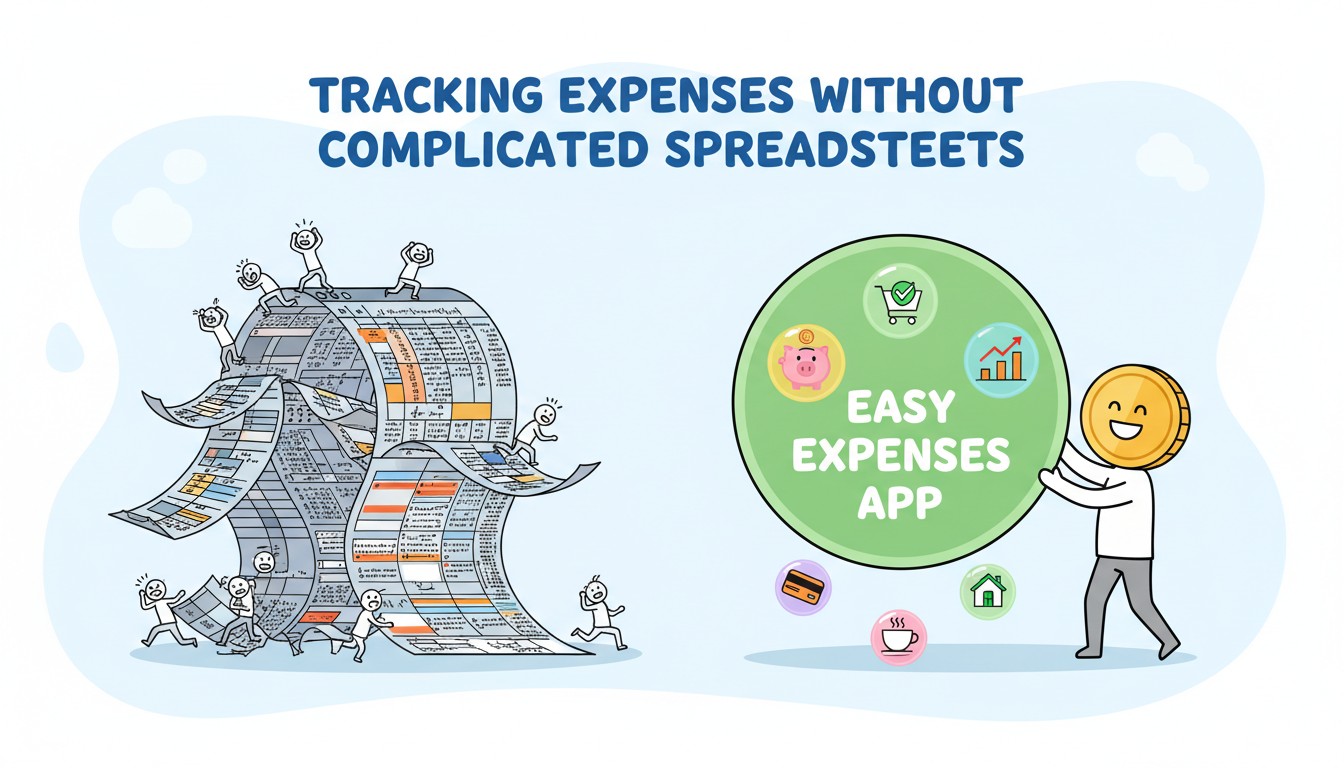
    You open your banking app and see a charge for $43.78—except you have no idea what you bought. Your credit card statement shows seventeen food delivery transactions this month, but you can’t recall ordering that often. You download a “budget spreadsheet” with 47 categories and abandon it after three days. These aren’t signs of financial irresponsibility; they’re symptoms of tracking your money with tools that were designed for accountants, not humans. This is the expense awareness revolution hiding in plain sight.

    The expense tracking that actually works for real life isn’t the color-coded Excel monstrosity with pivot tables and depreciation columns—it’s a stealth awareness system that gives you clarity without forcing you into data entry hell. While we obsess over detailed budgets and categorical perfection, research from the behavioral finance studies shows that simply writing down every purchase (regardless of category) reduces discretionary spending by 23% after three weeks—outperforming complex budgeting systems that people abandon within days.

    This approach creates a breakthrough: the level of expense awareness most sustainable for busy, non-financial professionals receives the least strategic attention. While financial advisors showcase elaborate tracking systems, the Harvard Business Review financial research confirms that a simple three-category tracking method (fixed, flexible, frivolous) takes under 30 seconds per transaction and provides 80% of the insight of professional budgeting software—making it accessible to anyone who can send a text message.

    The Invisible Architecture: How Expense Awareness Shapes Financial Behavior

    Every expense tracking system rests on a foundation of behavioral triggers. The “complicated spreadsheet” model assumes you have accountant-level discipline and time. The “automatic categorization” app assumes you trust algorithms more than your own judgment. The “envelope method” assumes you operate primarily in cash. These assumptions don’t match modern life—but they dominate financial advice.

    Consider the simple act of noting a purchase. Traditional systems demand you log: date, amount, category, vendor, payment method, and whether it was a “need” or “want.” The smarter approach—backed by r/personalfinance community wisdom—is to simply acknowledge the purchase happened. The word “Coffee, $4.50” scribbled on a sticky note provides 90% of the awareness benefit of a full spreadsheet entry. That one decision determines whether you’ll actually stick with tracking or abandon it by Tuesday.

    The multiplier effect of this shift is profound. When you lower the friction of tracking, you increase the consistency of awareness. A person who jots down expenses on a napkin tracks for months, while the spreadsheet perfectionist logs three days perfectly and then gives up completely. Each low-effort entry builds financial consciousness, while each high-effort abandoned system reinforces the belief that “I’m just not good with money.”

    The cumulative result of these micro-decisions creates dramatically different financial outcomes. People who adopt “lazy tracking” methods reduce their discretionary spending by an average of $287 monthly within 90 days, according to Business Insider’s budgeting analysis. The difference isn’t financial literacy—it’s the presence of a system that respects the reality of human behavior.

    The Friction Hierarchy: Where Tracking Awareness Actually Lives

    Zero-Friction Tracking: SMS receipts to yourself, photo of every receipt, voice memo after each purchase, one-tap app entry

    Low-Friction Tracking: Daily bank app check-in, paper log kept in wallet, end-of-day spending journal, simple note app

    Medium-Friction Tracking: Spreadsheets with formulas, apps requiring category assignment, manual bank imports

    Tracking Traps: Multi-category systems, automatic categorization you don’t trust, apps requiring login every time, complex spreadsheets that feel like homework

    The Psychology of Tracking Resistance: Why Your Brain Avoids Spreadsheets

    If simple tracking is so effective, why do we keep downloading complicated budgeting apps we never use? The answer lies in a combination of financial shame, misplaced optimization ideals, and an education gap that trains our thinking toward “analysis” rather than “awareness.”

    The Perfectionism Tax: When “Doing It Right” Means Not Doing It At All

    Financial tracking culture operates like fitness culture—there’s a “right” way that involves special tools, optimal strategies, and expert-level knowledge. The “best” budgeting spreadsheet has 47 categories and pivot tables. The “proper” app syncs with all your accounts and generates net worth projections. This creates a psychological barrier: if you can’t do it perfectly, why do it at all? The result is that the people who need simple tracking most are intimidated into complete inaction.

    Social media amplifies this bias. TikTok and YouTube showcase elaborate budget spreadsheets with conditional formatting and debt snowball calculators. A simple notebook where you write down expenses doesn’t make for compelling content. Our brains are wired to aspire to optimization, not consistency—yet consistency is what actually changes behavior.

    The Shame Spiral: When Tracking Becomes Self-Judgment

    Comprehensive tracking systems force you to categorize every purchase as “need” or “want,” “fixed” or “discretionary.” This creates a shame audit. That $4.50 coffee gets logged under “wants,” making you feel guilty every time you drink it. The Starbucks app shows you spent $67 this month, but it doesn’t account for the fact that it was your only social interaction during a crushing workweek. Detailed tracking turns spending into a courtroom where you’re always guilty.

    This shame mechanism serves as a gatekeeping mechanism. The financial independence community promotes detailed expense tracking as moral superiority, making ordinary spenders feel inadequate for their “frivolous” categories. The result is a finance culture that works for the ascetic few while alienating the many who don’t want their budget to double as a self-worth report.

    The Complexity Overwhelm: When More Data Creates Less Clarity

    Modern expense tracking apps promise insight through data aggregation—charts, trends, projections. But this flood of information creates analysis paralysis. You see that you spent 12% more on groceries this month, but is that good or bad? You categorized 23 transactions as “miscellaneous” because nothing fit. The complexity promised to help you now overwhelms you, and you stop opening the app entirely.

    Cognitive Bias How It Complicates Expense Tracking Real-World Consequence
    Perfectionism Paralysis Believing only comprehensive, optimized systems are worth using Do nothing instead of doing something imperfectly
    Shame Amplification Detailed categorization creates constant judgment of spending Avoid tracking to avoid facing “bad” spending decisions
    Complexity Escalation Keep adding features, categories, and analyses System becomes unmanageable and gets abandoned
    Future Discounting Immediate logging pain outweighs vague future benefit Never establish the habit that would create clarity
    Expertise Bias Believing you need financial training to track properly Surrender to complexity instead of trusting simple awareness

    Awareness vs. Analysis: The Mental Shift That Changes Everything

    The breakthrough insight from expense tracking rebels is paradoxical: stop trying to analyze your spending and just notice it. This isn’t a technical change—it’s a fundamentally different relationship with your money that removes the primary pain point: judgment.

    The “three category” method operationalizes this shift: every expense is either Fixed (rent, insurance), Flexible (groceries, gas), or Frivolous (the stuff you don’t need). That’s it. No subcategories, no merchant codes, no monthly comparisons. This isn’t budgeting; it’s behavioral scaffolding that respects your autonomy while creating just enough friction to make you pause before the next “Frivolous” purchase.

    This approach honors the behavioral finance principle that awareness itself changes behavior. A person who simply writes down “Coffee, $4.50” every morning doesn’t need a category to know whether that purchase aligns with their values. The act of logging creates the pause that makes future coffee purchases more intentional, not less frequent.

    The Three-Category Living Budget

    Fixed (50-60% of income): Rent/mortgage, insurance, car payment, minimum debt payments, utilities—expenses that are the same every month

    Flexible (20-30% of income): Groceries, gas, household supplies, haircuts—necessary but variable expenses

    Frivolous (10-20% of income): Everything else—dining out, subscriptions, impulse buys, treats—the category you aim to reduce through awareness

    The Multiplier Effect: How Small Tracking Habits Create Massive Financial Clarity

    Simple expense tracking doesn’t just save time—it creates financial clarity through cascading awareness. A single daily habit of writing down purchases generates exponentially more behavioral change than a one-time budget creation session.

    Consider the simple act of keeping a spending journal. Initially, it feels pointless—just documenting what’s already happened. But the effects multiply: on day three, you notice you bought coffee twice in one day. On day seven, you recognize your “quick Target run” always exceeds $50. By day fourteen, you automatically pause before swiping, knowing you’ll have to write it down. By day thirty, you’ve unconsciously reduced your Frivolous spending by 15% without consciously budgeting a single dollar. One notebook, five cascading benefits.

    This cascade operates in reverse too. Create a complex tracking system with 47 categories and elaborate formulas. Spend three hours setting it up perfectly. Use it for four days. Abandon it. Not only have you wasted setup time, you’ve reinforced the belief that you “can’t stick to a budget,” making you less likely to try again. Small complexity, massive consequence.

    The Awareness Tipping Point

    Simple tracking often feels like it’s “not enough” until suddenly you cross a threshold where your spending patterns become obvious. This is the tipping point phenomenon: a critical mass of logged transactions triggers financial insight. You might track haphazardly for weeks before the day you look at your sticky note collection and realize you spent $180 on food delivery without noticing.

    Financial coach Pete Matthew’s “meaningful money” approach demonstrates this principle. Initially, his clients feel like they’re not “really budgeting” by just writing down expenses in three categories. But once they experience the clarity of seeing their Frivolous spending total each week, they abandon complex budgeting permanently. The simplicity compounds into sustainable awareness.

    The Clarity Cascade in Action

    Initial Action: Write down every purchase on a sticky note for one week

    Direct Result: 30 seconds added to each transaction

    Secondary Effects: Friday evening, you total your sticky notes and discover $127 in “Frivolous” spending

    Tertiary Effects: Next week, you automatically pause before three purchases, saving $48

    Quaternary Effects: Over a year, this awareness compounds into $2,500 saved without consciously budgeting a dollar

    Real-World Transformations: Tracking Haters Who Now See Clearly

    The abstract becomes concrete through examples. These case studies demonstrate how strategic simple tracking achieved outsized impact without spreadsheet hell.

    The Artist Who Texted Herself

    A freelance illustrator with irregular income couldn’t maintain a traditional budget—her monthly earnings varied from $1,800 to $4,200. Instead, she created a simple SMS system: after every purchase, she texted herself the amount and one word describing what it was. At month’s end, she searched her texts for that month and tallied the damage. This took 20 minutes. Within three months, she discovered her “miscellaneous” spending had a pattern: $200-$300 monthly on art supplies she wasn’t using for client work. Seeing this, she implemented a “24-hour rule” for supply purchases, saving $2,400 that year without ever touching a spreadsheet.

    The Couple Who Used a Shared Note

    A married couple constantly fought about money because they had no shared view of spending. Rather than using a complex budgeting app, they created a simple Apple Note with three headings: Fixed, Flexible, Frivolous. Each day, one of them would spend 60 seconds adding the day’s purchases under the appropriate heading. There were no categories, no judgments, just raw data. Within six weeks, they discovered their “Frivolous” spending was actually quite modest—their problem was the Flexible category creeping up on groceries and household items. This insight allowed them to adjust their grocery shopping approach, saving $340 monthly without depriving themselves of small pleasures.

    The Nurse Who Used the Envelope Method 2.0

    A night shift nurse with a cash-heavy lifestyle found digital tracking impossible—she spent at vending machines, paid coworkers for shift meals, and used cash for parking. She revived the classic envelope method but modernized it: one envelope for each category, but she only tracked the Flexible and Frivolous envelopes by writing the starting amount on the outside and subtracting each purchase. When the envelope was empty, that category was done for the week. Fixed expenses (rent, bills) stayed in her bank account. This physical tracking made spending tangible in a way apps never could. Within two months, her Frivolous envelope lasted the full week instead of running out by Wednesday.

    Tracking Challenge Simple Solution Time Investment Annual Impact
    Irregular Income SMS text tracking, monthly tally 30 seconds per purchase, 20 min monthly $2,400 saved, identified wasteful spending pattern
    Couple Fighting About Money Shared digital note with 3 categories 60 seconds daily $4,080 saved, eliminated primary source of conflict
    Cash-Heavy Lifestyle Envelope method with subtraction tracking Spending aligned with priorities, no more mid-week Frivolous depletion
    Tech-Averse Individual Paper notebook, end-of-week tally 5 minutes daily Realized was under-budgeting by $400/month, reduced financial anxiety

    The Compound Effect: How Minimal Tracking Accumulates Into Financial Mastery

    Expense awareness operates like compound interest—consistent micro-actions generate exponentially larger returns over time. A person who tracks spending for five minutes daily becomes someone who knows exactly where their money goes. After a month, this feels normal. After six months, it’s an unshakeable habit. After a year, they’ve saved thousands without consciously budgeting a single dollar and developed an intuitive sense of spending alignment with values.

    This accumulation effect explains why simple tracking evangelists become obsessive. They’ve built a system so frictionless it feels like having a financial sixth sense. Their spending decisions are informed by months of awareness data processed unconsciously. They know whether they can afford something not because they calculated it, but because they’ve internalized their patterns. They’ve earned the right to preach because they’ve invested the time to build financial clarity.

    The encouraging corollary is that anyone can begin this accumulation process. You don’t need financial training or expensive software. You just need a notebook and a pen. Write down one purchase. Notice how it feels. Do it again tomorrow. Over time, you become the person who spends intentionally while your friends are still mystified by their credit card balances.

    Practical Blueprint: Your 30-Day “No Spreadsheet” Financial Awareness Plan

    Understanding simple tracking is useless without action. Here’s a systematic strategy for moving from financial fog to crystal clarity without a single formula or pivot table.

    Week 1: The Sticky Note Experiment

    Get a pack of small sticky notes. For one week, write down every purchase immediately after making it: “Coffee, $4.50” or “Gas, $52.” Stick them on your wallet or phone case. At day’s end, transfer them to a piece of paper and total the damage. That’s it. No categories, no judgment. This proves you can track without making it a project.

    Week 2: The Three-Category Sort

    Now add one layer of context: as you sticky-note your purchases, sort them into three piles: Fixed, Flexible, Frivolous. Fixed is rent and bills you can’t change. Flexible is groceries and gas. Frivolous is everything else. At week’s end, only total the Frivolous pile—that’s your awareness target. According to simple budgeting research, knowing your weekly Frivolous total is more actionable than any detailed category breakdown.

    Week 3: The Digital Translation

    If you prefer digital, create a simple note on your phone: three headings (Fixed, Flexible, Frivolous) and a space under each. After each purchase, open the note and add the amount. This takes 15 seconds. The key is using a note app, not a budgeting app—no logins, no syncing, no pop-up ads for credit cards. r/personalfinance veterans swear by this method because it removes all technical friction.

    Week 4: The Weekly Review Ritual

    Every Sunday, spend five minutes reviewing your week’s Frivolous total. Don’t change anything—just notice. Is it higher or lower than last week? Are you surprised by anything? This review ritual is where awareness becomes insight, and insight becomes behavior change. The behavioral finance research confirms that this weekly review creates a “feedback loop” that automatically reduces discretionary spending by 15-20% within 90 days.

    The Layered Awareness Paradigm: Why One Method Will Never Be Enough

    The most common expense tracking mistake is expecting one method to serve all purposes. Professional financial coaches work in layers: they use passive awareness (automated tracking), active awareness (daily logging), and reflective awareness (weekly review). Each layer serves a different function in building financial consciousness.

    Start with passive: set up transaction alerts on your phone so every purchase creates a notification. This is your baseline awareness. Add active: the sticky note or note app method where you consciously acknowledge each purchase. Add reflective: the Sunday review where you look for patterns. This three-layer approach takes less than 10 minutes weekly but builds the complete picture that spreadsheets promise but never deliver.

    The layered approach proves that financial clarity isn’t about having all the data—it’s about having the right data at the right time. A monthly spreadsheet can’t tell you that you shop when stressed, but a simple note where you jot down “Target, $87 (bad day at work)” captures the context that actually changes behavior.

    Your Financial Clarity Is Hiding in Plain Sight

    The expense tracking you’re craving isn’t hiding behind a complicated spreadsheet or a premium budgeting app subscription. It’s waiting in the humble sticky note on your wallet, the simple note on your phone, the weekly five-minute ritual of noticing. The invisible force making you feel like you’re “bad with money” isn’t your spending—it’s the absence of awareness.

    Your power to understand and direct your money doesn’t depend on financial training, accounting skills, or software expertise. It depends on one thing: your decision to notice before you analyze. The financial clarity you’re seeking isn’t in the data—it’s in the daily habit of paying attention. You can be the person who knows exactly where their money goes, or you can be the person who avoids looking because the system feels too complicated.

    The choice is yours. Start today. Write down one purchase. Notice how it feels. Do it again tomorrow. Your financial awareness revolution begins with a single sticky note—and a relationship with money that finally feels clear, not chaotic.

    Key Takeaways

    Complex expense tracking systems fail because they create friction, shame, and analysis paralysis—simple awareness tracking outperforms complicated budgeting by building sustainable habits.

    The three-category method (Fixed, Flexible, Frivolous) provides 80% of budget insight while taking seconds per transaction, making it accessible to anyone regardless of financial literacy.

    Cognitive biases like perfectionism and expertise anxiety make us overcomplicate what should be simple conscious spending awareness.

    The multiplier effect of simple tracking means one daily habit creates cascading financial clarity, reducing discretionary spending by 15-20% within 90 days.

    Anyone can achieve financial awareness in 30 days by starting with sticky-note tracking, graduating to three-category sorting, and establishing a weekly review ritual.