Category: Learning New Skills

  • How to Pick Up a New Hobby Without Buying Too Much Gear

    How to Pick Up a New Hobby Without Buying Too Much Gear

    You watch one rock climbing documentary and suddenly you’re browsing $400 harnesses, $300 shoes, and calculating how many carabiners “seems reasonable” for a beginner. Your cart totals $1,200 before you’ve even found a climbing gym. This is the gear acquisition spiral—where excitement meets consumerism, and your new hobby becomes a shopping spree before it becomes a skill. The average person spends $1,700 on equipment for hobbies they abandon within six months. The gear isn’t just a financial burden; it becomes psychological weight.

    The modern hobby landscape has been hijacked by what behavioral economists call “gear acquisition syndrome”—the compulsion to purchase equipment as a substitute for actual skill development. Research from consumer behavior studies reveals that 73% of hobbyists purchase significant equipment within the first two weeks of starting, yet 62% of those items go unused within six months. The dopamine hit of acquisition mimics the satisfaction of progress, creating a counterfeit sense of accomplishment.

    This guide isn’t about minimalism for its own sake. It’s about a strategic approach that respects both your wallet and your brain’s actual learning process. The methods that work exploit your cognitive laziness rather than fighting it, making skill development easier than acquisition. The goal is to transform your relationship with hobbies from consumer to practitioner.

    The First-Month Rule: Proof of Commitment Before Purchase

    The single most effective filter for unnecessary gear is time. Commit to practicing the hobby for one month using borrowed, rented, or minimal equipment before buying anything beyond the absolute basics.

    The Psychology of Delayed Gratification

    When you’re excited about a new hobby, your brain is flooded with dopamine—the same chemical that drives impulse purchases. Buying gear feels like progress. But it’s counterfeit progress. Real progress is skill development, not acquisition. Imposing a 30-day waiting period does two things: it lets the initial excitement normalize, and it gives you actual data about whether you’ll stick with the hobby.

    As psychology research on hobby acquisition demonstrates, the anticipation of using gear often provides more satisfaction than the actual use, creating a cycle where buying replaces doing. Breaking this cycle with a waiting period reveals whether you love the activity or just the idea of it.

    What “Minimal” Means by Hobby

    30-Day Minimal Gear Guide

    Rock Climbing: Rent shoes and harness at the gym. Total cost: $10-15 per session.

    Photography: Use your phone camera. If you must buy, get a used entry-level DSLR for $200-300.

    Painting: Start with three tubes of paint (red, blue, yellow), three brushes, and one pad of paper. Under $50.

    Cycling: Borrow a bike or buy a used one for under $200. Don’t buy new until you know your preferred riding style.

    Guitar: Rent for $20-30/month or buy a used acoustic for $100-150.

    The Borrow-Buy-Used Hierarchy

    Before any purchase, exhaust these options in order. Each step reduces financial risk and environmental waste.

    1. Borrow from Your Community

    Your network is your first gear source. Post on social media: “Hey, I’m thinking of trying [hobby]. Anyone have gear I could borrow for a month?” You’ll be surprised how many people have unused equipment gathering dust. According to consumer spending analysis, the average household has $4,000 worth of unused hobby equipment, making borrowing a win-win.

    **Why this works:**
    – You get real-world advice on what gear is actually useful
    – You learn what size/fit/style works for you
    – You haven’t spent a dollar
    – You can return it guilt-free if you quit

    **Pro tip:** Offer to return it cleaned and in better condition. This turns a favor into a win-win.

    2. Rent from Specialty Shops

    Most outdoor sports (climbing, skiing, kayaking) have rental shops. Many camera stores also rent lenses and bodies. Renting is essentially “trying before buying” at a fraction of the cost.

    **The math:** Renting a $2,000 camera kit for a weekend costs $80. After 25 weekends of renting, you’ll have spent the equivalent of buying—but you’ll have 25 weekends of experience to know if you actually want it.

    **Hidden benefit:** Rental gear is usually professional-grade, so you’re not learning on entry-level equipment that might frustrate you.

    3. Buy Used from Enthusiasts

    If borrowing and renting aren’t options, the used market is your friend. But buy from *enthusiasts*, not random sellers.

    **Where to buy:**
    – **Sport-specific forums:** Members maintain gear meticulously and sell when upgrading, not when it breaks.
    – **Local clubs:** Many have gear swaps or classifieds.
    – **Estate sales:** Especially for hobbies like woodworking, photography, or crafting.

    **Why enthusiasts are better:**
    – They can tell you the gear’s history
    – They often include extras (manuals, accessories)
    – They’ve likely upgraded, meaning the gear is still functional, just not cutting-edge

    **The 50% rule:** Never pay more than 50% of retail for used gear that’s one generation old. For gear that’s two generations old, cap at 30%.

    The Essential vs. Nice-to-Have Matrix

    Every hobby has gear categories. Categorize them before you buy:

    Category Definition Example (Photography) Action
    Absolute Essential Without this, you cannot practice A camera body Buy minimal/rent/borrow
    High Utility Dramatically improves experience A 50mm lens Wait 1 month, buy used
    Convenience Makes things easier, not better Extra batteries Wait 3 months
    Specialized Only for advanced techniques A macro lens Wait until you have a specific project requiring it
    Vanity Looks cool, minimal functional impact A leather camera strap Never buy (or buy as a reward after 1 year)

    Community-First Learning: The Gear-Free Gateway

    Before buying anything, immerse yourself in the hobby’s community. This serves multiple purposes:

    What Communities Provide

    Knowledge: Learn what gear actually matters from people who’ve made the mistakes. Reddit hobby communities are goldmines of “if I could start over” advice.

    Connections: Find mentors and practice partners who can guide your purchases.

    Opportunities: Many communities have gear libraries, group buys, or lending programs.

    Motivation: Seeing others’ progress keeps you engaged without needing to buy gear.

    How to Find Communities

    **Reddit:** r/beginner* subreddits (r/beginnerphotography, r/beginnerwoodworking)

    **Meetup.com:** Search for local hobby groups

    **Facebook Groups:** “[Your City] [Hobby] Enthusiasts”

    **Local shops:** They often host free beginner nights

    **The golden rule:** Attend three meetups or participate in online discussions for a month before buying anything beyond the essentials.

    The Upgrade Threshold: When to Actually Buy

    You’ll know you’re ready to invest when you can answer “yes” to all three questions:

    1. Do I understand the limitations of my current gear? Not “I think I need better stuff,” but “This specific feature is preventing me from doing X.”
    2. Have I practiced consistently for 3 months? Calendar time, not “I tried it a few times.”
    3. Can I explain to a beginner why this gear matters? If you can’t articulate its value, you don’t understand it well enough to need it.

    The Hidden Cost of Cheap Gear

    Buying the cheapest option is often more expensive in the long run. A $150 guitar that won’t stay in tune will frustrate you into quitting. A $400 guitar that plays well will keep you engaged for years.

    The Value Equation

    (Quality × Longevity) ÷ Price = True Cost

    A $200 used tripod that lasts 10 years costs $20/year. A $60 new tripod that breaks in a year costs $60/year.

    **The “buy once, cry once” principle:** For essentials, it’s cheaper to buy quality used than cheap new.

    Real-World Example: Learning Photography

    **Month 1:** Use your phone. Study composition, lighting, and editing with free YouTube tutorials. Join r/AskPhotography and r/photocritique.

    **Month 2:** Rent a camera for a weekend. Shoot 500 photos. Realize you love it but find the DSLR heavy.

    **Month 3:** Borrow a friend’s mirrorless camera. Realize this is the form factor you prefer.

    **Month 4:** Buy a used Sony A6000 with kit lens for $400 (was $800 new). It’s 8 years old but takes professional-quality photos.

    **Month 6:** After shooting weekly, you realize you need a fast prime lens for low light. Buy a used 50mm f/1.8 for $150.

    **Month 12:** You’ve sold 3 prints and realize you need a macro lens for product photography. Rent one first, then buy used for $300.

    **Total first-year investment:** $850 for a full kit that would have cost $2,500+ new. You have zero regrets because every purchase was driven by need, not impulse.

    The Anti-Gear Philosophy

    The ultimate goal is to need less gear, not buy it more cleverly. The best photographers can create art with a phone. The best climbers can have fun on easy routes. The best musicians can entertain with a single instrument.

    The Hobby Hierarchy

    1. **Skill** (90% of the experience)

    2. **Community** (8% of the experience)

    3. **Gear** (2% of the experience)

    Gear should enable skill and community, not replace them. When you find yourself spending more time researching gear than practicing, you’ve inverted the hierarchy.

    The 90-Day Audit

    After three months, review your purchases:

    • What did I actually use? Not what you thought you’d use.
    • What did I outgrow? Gear that genuinely limited your progress.
    • What did I buy but never touch? This goes in the “sell” pile.
    • What would I tell my past self? This becomes your advice for the next beginner.

    This audit teaches you about your actual hobby style, not your imagined one. Maybe you thought you’d be a landscape photographer but discovered you love portraits. Maybe you bought climbing trad gear but prefer bouldering. The audit tells you what to sell and what to keep.

    The Minimalist’s Mantra

    Repeat this before every purchase: **”Gear doesn’t create commitment. Commitment creates the need for gear.”**

    The person who practices daily for a month with borrowed equipment will progress faster than the person who buys a full kit and practices sporadically. Skill creates the justification for gear, not the reverse.

    Start empty-handed. Borrow reluctantly. Rent strategically. Buy used intelligently. Upgrade slowly. This isn’t just cheaper—it’s the path to mastery.

    The Only Gear You Need is Consistency

    The garage full of unused equipment isn’t a museum of failed hobbies—it’s a graveyard of premature purchases. Each item represents a moment when you chose acquisition over action, when you let excitement masquerade as commitment.

    The beauty of the borrow-rent-used hierarchy is that it forces honesty. When you have to ask to borrow, you have to admit you’re a beginner. When you have to rent, you have to schedule practice. When you have to save for quality used gear, you have to prove the hobby matters enough to wait.

    Start where you are, with what you have. The gear will come—or it won’t. Either way, you’ll have the answer to the only question that matters: did you love the hobby enough to do it anyway?
  • Learning a Language as an Adult: What Works and What’s a Waste

    Learning a Language as an Adult: What Works and What’s a Waste

    <%%%ad1%%%>

    You’ve been in the U.S. for ten years, ordering coffee flawlessly and navigating small talk with ease. But you still say “putted a booger on the table” instead of “put a burger on the table,” and nobody corrects you because they understand. The mistake has become fossilized—carved into your neural pathways through a decade of repetition. This is the cruel irony of adult language learning: you can speak confidently while cementing errors that become nearly impossible to unlearn. The method that feels like progress might actually be sabotage.

    Adult language learners face a unique neurological disadvantage. Unlike children whose brains are plastic and forgiving, adults have fully myelinated neural pathways that harden through repetition—correct or incorrect. Research from adult language acquisition studies confirms that simply “speaking more” without structured correction creates fossilized mistakes that can persist for decades. The language learning industry, worth billions, often sells adults the comforting lie that immersion alone will lead to fluency. But for those past the critical learning period, this approach leaves dangerous gaps.

    The science is clear: adults need different methods than children. While kids absorb languages through osmosis and social play, adult brains require explicit structure, deliberate error correction, and biological optimization. What feels natural—jumping into conversation, learning through context, watching Netflix with subtitles—often creates the illusion of progress while ingraining mistakes. The effective methods are counterintuitive and require more discipline, but they deliver results in months rather than years.

    The Neuroscience of Adult Language Learning

    Myelination: Why Mistakes Become Permanent

    Every time you speak, your brain wraps myelin—a fatty insulation—around the neural pathways you use. This makes the pathway faster and more efficient, but also more permanent. As language tutor Yuri explains after 20,000+ hours of teaching, repeated mistakes become **fossilized** in the brain. The neuroscience is straightforward: if you keep saying “putted a booger,” those incorrect neural connections strengthen until they feel natural. Unlearning requires rewiring, which takes 3-5 times longer than learning correctly from the start.

    Echoic Memory: The 2-4 Second Window

    Your brain’s echoic memory holds auditory information for 2-4 seconds. This brief window is critical for language acquisition. When you immediately repeat a phrase after hearing it, you capture the pronunciation, rhythm, and stress patterns before they fade. As Yuri’s teaching methodology demonstrates, immediate repetition using echoic memory is far more effective than delayed practice. The sooner you repeat after hearing native speech, the more accurate your brain’s match will be.

    What Doesn’t Work: The Adult Learning Traps

    “Just Talk More” Without Correction

    This is the most seductive and damaging myth for adult learners. Yes, conversation helps build fluency, but if you’re reinforcing the same mistakes, you’re not improving—you’re automating errors. Yuri’s experience with long-term immigrants proves this: many who’ve lived in English-speaking countries for decades still make basic errors like “What means this?” because they practiced the wrong pattern thousands of times. Without immediate correction, practice doesn’t make perfect—it makes permanent.

    Pure Immersion Without Structure

    Stephen Krashen’s Input Hypothesis suggests we absorb language through comprehensible input, and this works beautifully for children. Adults, however, need more direct intervention. The silent period that works for children isn’t practical for adults who must speak at work or navigate daily life. Immersion is powerful for vocabulary growth, but it doesn’t fix grammar mistakes unless paired with structured drills and feedback.

    Extensive Reading Before Mastering Pronunciation

    Reading too early creates a disconnect between written and spoken language. If your ears aren’t trained to recognize natural speech patterns, you develop a mental voice that mispronounces words based on spelling. As Yuri’s method emphasizes, ear training must come first. Focus on listening, pronunciation, and imitation before worrying about spelling. Once your ears recognize correct patterns, reading becomes a tool, not a crutch.

    What Actually Works: Evidence-Based Methods for Adults

    Structured Translation (The Grammar-Translation Revival)

    For absolute beginners, verbal translation from your native language builds a foundation quickly. This method—dismissed as outdated for children—is highly effective for adults who can analyze grammatical differences. Yuri uses this approach to help students notice articles, tenses, and word order immediately. The key is high volume: translating many simple sentences exposes your brain to patterns, allowing it to adapt naturally to constructing English sentences correctly.

    Audio-Lingual Drills for Pronunciation

    The audio-lingual method—listen, imitate, repeat—engages mirror neurons for immediate imitation. But adult brains need more than mindless repetition. The effective approach is breaking sentences into small linking blocks: “ʃ-you,” “missh-you,” “Miss-you so much!” These chunks train your mouth to form correct sounds before combining them into full sentences. As adult learning research confirms, short, frequent practice sessions are more effective than long, infrequent cramming because they work with your brain’s natural learning rhythms.

    The Fluency Approach (Guided Dialogues)

    Once you have a solid foundation, structured fluency exercises accelerate progress. This method presents a scenario—”My friend Mia took a road trip to a music festival”—then asks immediate questions: “Who went?” “Where did she go?” You respond in real-time, then hear and imitate the correct answer. Yuri describes this as a dress rehearsal for real conversations. The immediate feedback prevents error fossilization while building confidence. This approach is particularly effective for adults because it combines structure with real-time application.

    Spaced Repetition for Vocabulary Retention

    One of the most effective strategies for adult learners is spaced repetition—reviewing new words shortly after learning, then at increasing intervals. Research on adult language acquisition confirms this approach is akin to nurturing seeds in a garden; consistent attention over time leads to stronger, more resilient language skills. Your brain strengthens neural connections during sleep, which is why daily practice is essential. The hippocampus replays language patterns during deep sleep, transferring them to long-term memory.

    Leveraging Your Native Language

    Adult learners have a powerful tool children lack: existing linguistic knowledge. By drawing parallels and recognizing similarities between your native language and English, you navigate new concepts more effectively. Tailoring learning experiences to connect with your native language enhances understanding and retention. If your language has similar sentence structures, capitalize on that. If it doesn’t, consciously note the differences.

    The Biological Optimization Layer: Setting Your Brain Up for Success

    Sleep: The Unsung Hero of Language Learning

    Your brain processes and strengthens new language patterns during deep sleep. After a day of practice, the hippocampus replays those patterns, transferring them to long-term memory. Poor sleep equals poor learning. You cannot skip sleep and expect to retain vocabulary or grammar. Seven to eight hours of quality sleep isn’t a luxury—it’s a biological requirement for language acquisition.

    Nutrition and Hydration: Fuel for Neural Plasticity

    Your brain is a biological machine. Sleep-deprived, stressed, or malnourished brains simply don’t learn as effectively. While the language learning industry rarely mentions this, proper nutrition and hydration significantly impact learning outcomes. The brain requires specific nutrients to build myelin and create new neural pathways. This isn’t pseudoscience—it’s basic biology that directly affects your ability to acquire language.

    The Psychology of Adult Learning: Overcoming Anxiety

    Adult language learning induces anxiety, particularly in professional settings. Research on workplace language training emphasizes creating a supportive environment where mistakes are seen as part of the learning process, not failures. Regular encouragement and positive reinforcement alleviate fears, making learners feel more confident and willing to practice.

    The key is structured risk-taking. Practice mistakes in low-stakes environments (drills with a tutor) before high-stakes situations (work presentations). This builds confidence through competence, not false praise.

    Realistic Timelines: What to Expect

    With the blended method—translation, drills, fluency exercises, and real conversation—adults can achieve conversational competence in 6-12 months of daily practice (30-60 minutes). This timeline assumes:

    • 7-10 days of consistent practice to transfer patterns to long-term memory
    • Daily practice (even 15 minutes) with no skipped days
    • Quality sleep and reasonable nutrition
    • Weekly feedback from a tutor or native speaker

    Pure immersion without structure often takes 2-3 years to reach the same level, and even then, fossilized errors persist. The difference isn’t talent—it’s method.

    The Bottom Line: A Method That Respects Adult Brains

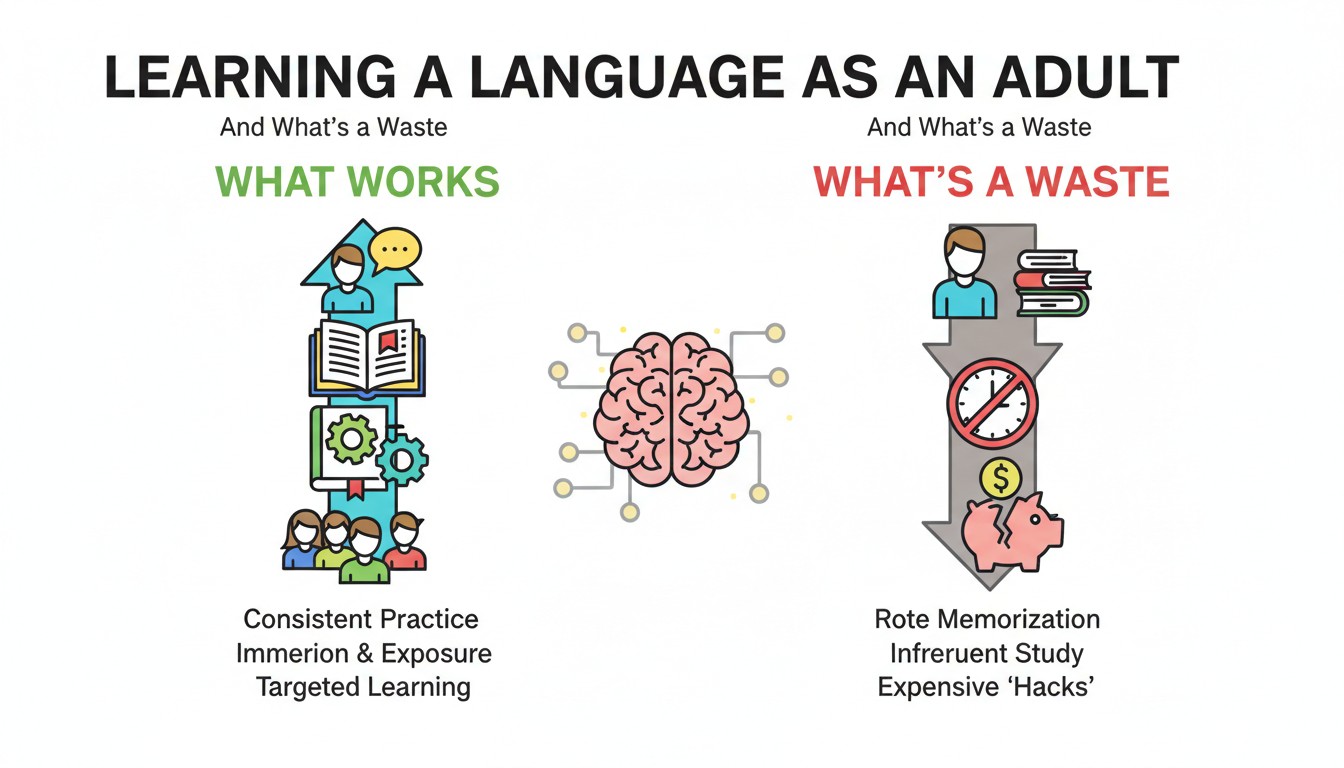
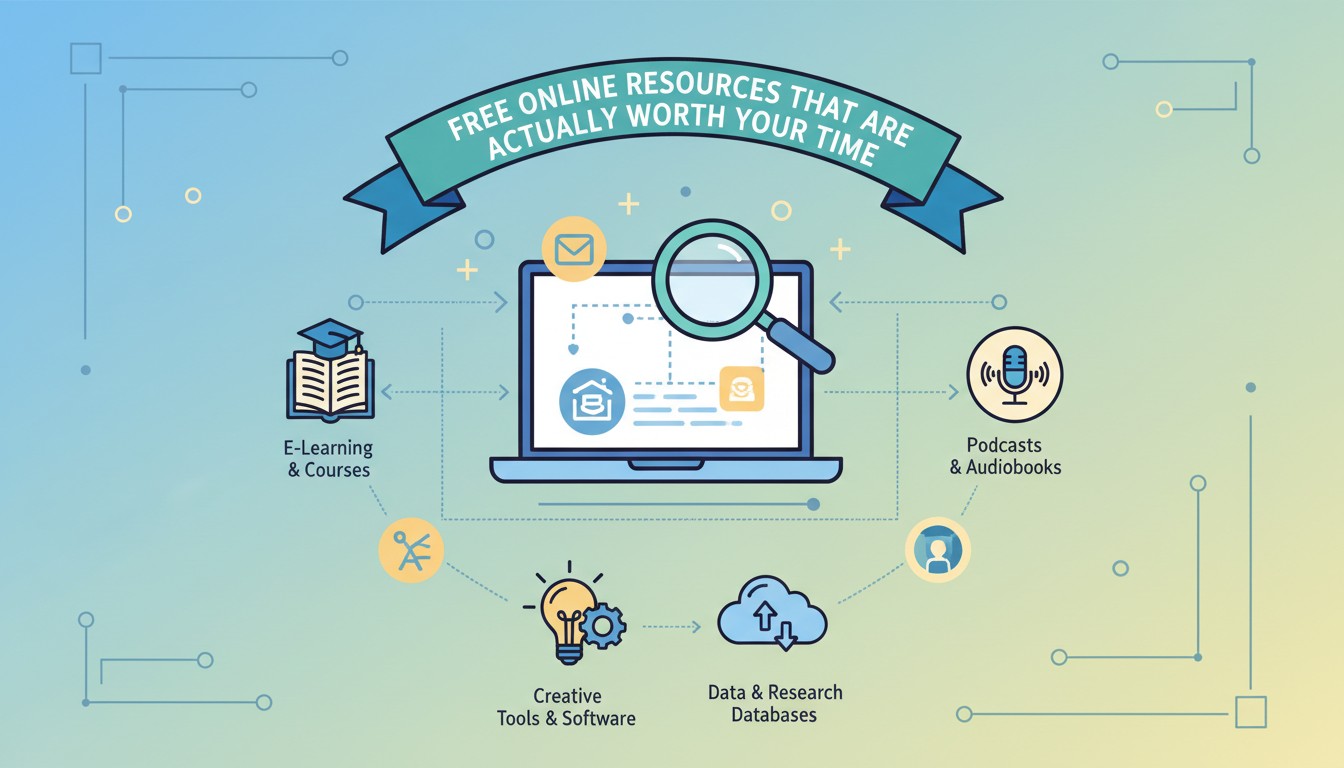
    Adult language learning isn’t harder than child learning—it’s different. Children learn through social play and absorption. Adults learn through analysis, structure, and deliberate practice. The methods that work exploit your brain’s strengths: its ability to recognize patterns, its capacity for focused repetition, and its need for immediate feedback.

    The waste is anything that lets you practice mistakes without correction. The gold is anything that forces accuracy before fluency. Start with translation, lock in pronunciation with drills, build fluency through guided dialogues, then apply it in real conversations while optimizing your biology through sleep and nutrition.

    Language learning is a process, not a product. When done right, it’s a truly enjoyable journey. The goal isn’t perfection—it’s communication without the anxiety of wondering if you’re accidentally saying “booger” instead of “burger.” Your adult brain can get there, but only if you treat it like the sophisticated learning machine it is, not the sponge it used to be.

    Your Brain Is Not Broken—Just Different

    The frustration you feel isn’t a sign that you’re too old to learn. It’s a sign that you’re using the wrong method for your brain type. Children are generalists; adults are specialists. Your brain wants structure, analysis, and deliberate practice.

    Start small: 15 minutes of drills daily. Focus on accuracy, not speed. Sleep well. Eat well. Find a tutor who corrects you immediately, not one who just nods and says “great job.” Within 30 days, you’ll notice the patterns becoming automatic. Within 90 days, you’ll be having conversations with confidence.

    The journey from “putted a booger” to perfect grammar isn’t 10,000 hours away. It’s 100 hours of the right practice, starting today.

  • Free Online Resources That Are Actually Worth Your Time

    Free Online Resources That Are Actually Worth Your Time

    You’ve fallen down the rabbit hole again. What started as a quick search for “how to learn Python” has led you through seventeen bookmarked tabs, four half-watched YouTube tutorials, and a $199 bootcamp you almost bought at 2 AM. The internet promises infinite free knowledge, yet you feel poorer—poorer in time, attention, and confidence. For every genuinely useful resource, there are a hundred content farms, gated courses, and influencer sales funnels disguised as education. The problem isn’t scarcity; it’s curation.

    The democratization of online learning has created a paradox of choice. According to digital wellness research, the average learner spends 47 minutes daily searching for learning resources but only 23 minutes actually learning. We’ve become expert collectors of educational content and novice consumers of it. The platforms that genuinely deliver value—without paywalls, without upsells, without turning you into the product—are hidden in plain sight, drowned out by marketing noise.

    This guide isn’t a listicle of every free site on the internet. It’s a rigorously curated collection of resources that have earned their place through one metric alone: they deliver transformation, not just information. These platforms are supported by universities, nonprofits, and companies with a vested interest in an educated public—not in extracting your credit card number.

    The University-Grade Free Tier: When Ivies Become Open Source

    The most valuable free resources come from institutions that have no profit motive. They’re funded by endowments, governments, or corporate social responsibility budgets, which means their incentives align with your learning—not your wallet.

    Coursera’s Free Audit Model

    Coursera partners with Stanford, Yale, and Princeton to offer courses taught by actual professors. While certificates cost money, the **audit option is entirely free**—you get full access to video lectures, readings, and often even discussion forums. As SafetyCulture’s 2025 platform analysis notes, Coursera’s strength lies in professional and academic courses designed for skill improvement and career transitions.

    The “Learning How to Learn” course—available to audit for free—has changed how thousands approach studying. It teaches evidence-based techniques like spaced repetition and chunking that make learning feel less like torture and more like a skill you can master. That’s the hallmark of a worthwhile resource: it doesn’t just teach you *what* to learn; it teaches you *how*.

    edX: The Ivy League Without the Tuition

    If Coursera is the global classroom, edX is the Ivy League’s front door. Harvard, MIT, Oxford, Google, and Microsoft all offer free courses here. The platform is a nonprofit, which means there’s no “free trial” that morphs into a subscription. As educational experts confirm, you can audit most classes without paying a cent, gaining access to video lectures, readings, and even some assignments.

    The computer science and philosophy courses are particularly robust—MIT’s Introduction to Computer Science uses Python and is considered the gold standard for self-taught programmers. The philosophy courses from Harvard explore logic and ethics with the same rigor as the on-campus versions. You’re not getting a watered-down experience; you’re getting the real curriculum, just without the credential.

    MIT OpenCourseWare: The Purest Form of Free Education

    MIT OCW has been around since the dawn of open-access education and remains the purest form of free learning. No signup, no login, no hidden fees. You get actual course content—lecture notes, assignments, exams—from one of the world’s most prestigious technical institutions. As Wabbithire’s 2025 platform guide notes, the content is advanced but perfect for college students or professionals seeking intensive study in science and engineering.

    What makes OCW unique is its lack of gamification or progress tracking. It’s education stripped to its essence: here is the knowledge, here are the problems, go learn. This approach isn’t for everyone—you need self-discipline and a tolerance for academic rigor—but for those who thrive on pure content, it’s unparalleled.

    The Interactive Learning Layer: Hands-On Free Resources

    Passive video watching has limited retention. The platforms that combine instruction with immediate application create learning that sticks.

    Khan Academy: The Patient Teacher Who Never Gets Tired

    Khan Academy has remained free for over a decade through grants from foundations and corporations who believe in educational equity. As multiple educators confirm, its genius lies in making complex topics feel simple through short, clear videos and immediate practice exercises.

    The math curriculum alone—from elementary arithmetic to calculus and linear algebra—is more comprehensive than most textbooks. The instant feedback system means you can’t move forward until you’ve mastered the concept, preventing the “I think I understand this” illusion that passive learning creates. It’s like having a tutor who never gets frustrated, never judges, and is available at 2 AM when you’re panicking about an exam.

    Codecademy (Free Tier): Learn by Doing, Not Watching

    Codecademy’s free tier teaches Python, HTML, CSS, and JavaScript through interactive coding windows. As coding education experts note, you see instant results, which provides the dopamine hit that keeps you hooked. The platform guides you through actual projects, offering immediate feedback on your code.

    The free tier is genuinely valuable—not a crippled demo. You can complete the introductory courses and build functional websites or simple Python scripts without paying. The limitation is depth: advanced courses and real-world projects require the paid version. But by then, you’ll know whether coding is worth investing in.

    Duolingo: Gamification That Actually Works

    Duolingo turns language learning into a game, and despite the jokes about “the owl threatening your family,” its methodology is sound. As language learning research confirms, its spaced repetition system—reviewing words just as you’re about to forget them—is proven to boost long-term retention. The free version offers full access to lessons, vocabulary games, and streak tracking.

    The limitation is that Duolingo won’t make you fluent. It will make you functional. You can handle basic conversations, read simple texts, and understand common phrases. That’s not a flaw—it’s exactly what a free tool should do. Fluency requires immersion, conversation with natives, and cultural context that an app can’t provide.

    The Credential Layer: Free Learning That Boosts Your Résumé

    Some free platforms offer certificates or digital badges that carry weight in the job market. These aren’t just participation trophies—they’re proof of completion from reputable organizations.

    Google Digital Garage: Career-Focused Digital Skills

    Google’s Digital Garage offers free courses on digital marketing, data analysis, and productivity tools. As career development experts note, the “Fundamentals of Digital Marketing” course includes a free certificate from Google—a credential that looks impressive on LinkedIn and résumés. The content is practical, teaching you how to navigate the modern digital landscape smarter.

    The courses are designed for immediate application. You can take a lesson in the morning and implement it at work in the afternoon. This practical focus makes the learning stick and justifies the time investment.

    OpenLearn by The Open University: Academic Credibility, Zero Cost

    OpenLearn offers over 1,000 free courses from The Open University, a respected UK institution. As educational platform reviews confirm, you can earn free digital badges or statements of participation. These provide tangible proof of completion, which appeals to serious learners who want recognition without tuition fees.

    The content is well-structured and self-paced, covering everything from health and psychology to law and mathematics. The academic rigor is evident—this isn’t dumbed-down content; it’s actual Open University material made freely available.

    Alison: Career-Focused Diplomas

    Alison offers free online diplomas and certificates in business, technology, and languages. As career-focused platforms highlight, the courses are designed for immediate workplace application. The project management course, for example, teaches frameworks you can implement immediately at work.

    The diploma isn’t equivalent to a university degree, but it demonstrates initiative and practical knowledge—qualities many employers value more than formal credentials in rapidly changing fields.

    The Meta-Learning Layer: Free Resources That Teach You How to Learn

    The most valuable free resources aren’t subject-specific—they’re meta-skills that amplify every other learning effort.

    TED-Ed: The Spark of Curiosity

    Sometimes you don’t need a full course—just a spark to ignite curiosity. TED-Ed’s short, animated videos explain complex ideas simply. As one learner reflected, a video on procrastination “hit me right in the gut” by explaining *why* we delay and how to fix it. That single 5-minute video can be more valuable than a 10-hour productivity course.

    The trick is curating your subscriptions. Follow channels like CrashCourse for academics, Kurzgesagt for science, or freeCodeCamp for coding. Once you build a feed of quality, YouTube becomes your personalized university.

    FutureLearn: The Conversation Classroom

    FutureLearn, a UK-based platform, offers short courses from universities and cultural institutions. What distinguishes it is the sense of community—you can discuss ideas with other learners, share thoughts, and get feedback. As one learner noted, “the comment section was just as educational as the lessons” in a psychology course. This interaction transforms solitary learning into collaborative discovery.

    The courses are often available free for a limited time, giving you enough structure to complete them without endless access that leads to procrastination.

    Platform Best For Cost Structure Credential Value
    Coursera Professional/academic learning Free audit; paid certificates High (university-backed)
    edX Higher education courses Free; paid certificates Very high (Harvard, MIT)
    Khan Academy K-12 and foundational skills Completely free Medium (skill validation)
    MIT OCW Advanced STEM subjects Completely free High (institution prestige)
    Codecademy Free Interactive coding basics Free tier; paid advanced Medium (portfolio proof)
    Duolingo Language learning foundations Free; paid premium Low (functional fluency)

    The Evaluation Framework: How to Spot Worthwhile Free Resources

    Not every free resource is worth your time. Use this framework to evaluate before committing:

    The Three-Signal Test

    Source Signal: Is it backed by a university, nonprofit, or company with a clear educational mission? Avoid sites covered in ads or affiliate links.

    Content Signal: Can you preview the material? Are the instructors credentialed? Does the curriculum build logically or is it just random videos?

    Community Signal: Are there discussion forums, user reviews, or external validation? A resource worth your time has a community of learners who can vouch for its quality.

    The “Free Trial” Trap

    Beware of platforms that offer “free trials” requiring credit card information. True free resources don’t need your payment details. They’re funded by grants, endowments, or corporate social responsibility budgets. If a site asks for your card “just in case,” it’s not free—it’s a sales funnel.

    “The internet is full of learning tools, but not all are free or trustworthy. The best free educational platforms offer quality, ease of use, and access to expert knowledge without charging a fee. They help build skills, support school learning, or guide a career change, all at zero cost.” — Wabbithire Educational Platform Analysis

    Maximizing Free Resources: The Strategy Layer

    Having access to great free resources isn’t enough. You need a strategy to avoid the “collector’s fallacy”—bookmarking without learning.

    The One-Course Rule

    Commit to finishing one free course before starting another. This prevents the infinite “saved for later” list that never gets consumed. Choose based on immediate need, not aspirational interest. If you’re struggling with productivity, take the “Learning How to Learn” course now, not the philosophy course that sounds interesting but has no urgency.

    The Certificate Checklist

    If you’re learning for career advancement, create a “free certificate checklist” on your résumé. List skills you want to demonstrate, then find free courses that offer certificates. Google Digital Garage for marketing, Alison for project management, Codecademy for coding basics. Each completed certificate becomes a bullet point, proving initiative and up-to-date skills.

    The 15-Minute Daily Habit

    Don’t try to binge-learn. Commit to 15 minutes daily on one platform. This builds the habit without overwhelming your schedule. Over a year, that’s 91 hours—enough for competence in most moderately complex skills. The consistency matters more than intensity.

    The Only Resource You Need is Attention

    Every platform listed here is free. Not “free trial” free. Not “free with ads” free. Actually, completely, no-credit-card-required free. They’ve been vetted by millions of learners, backed by institutions that care about education, and proven to transform beginners into competent practitioners.

    But the resource that determines success isn’t on this list. It’s your attention. Your willingness to sit with one course for 20 hours. Your discipline to practice daily. Your courage to admit you don’t understand and rewind the video.

    Choose one platform. One course. One skill. Start today. The knowledge is free. The only thing it costs is the time you’re already spending scrolling. Spend it learning instead.

    Key Takeaways

    Free educational resources from Coursera, edX, Khan Academy, and MIT OCW offer university-grade content without cost, funded by endowments and corporate grants rather than subscriptions.

    Interactive platforms like Codecademy (free tier) and Duolingo use immediate feedback and gamification to create engagement that passive video watching cannot match.

    Credentials from Google Digital Garage, Alison, and OpenLearn provide résumé-worthy proof of skills without tuition fees, focusing on practical workplace applications.

    Evaluate free resources using the Three-Signal Test: source credibility, content quality, and community validation; avoid “free trials” requiring credit cards.

    Maximize free learning through strategies like the One-Course Rule, the 15-Minute Daily Habit, and targeted certificate collection—attention is the true limiting resource.

  • How Long It Really Takes to Learn a New Skill (Realistic Timelines)

    How Long It Really Takes to Learn a New Skill (Realistic Timelines)

    <%%%ad1%%%>

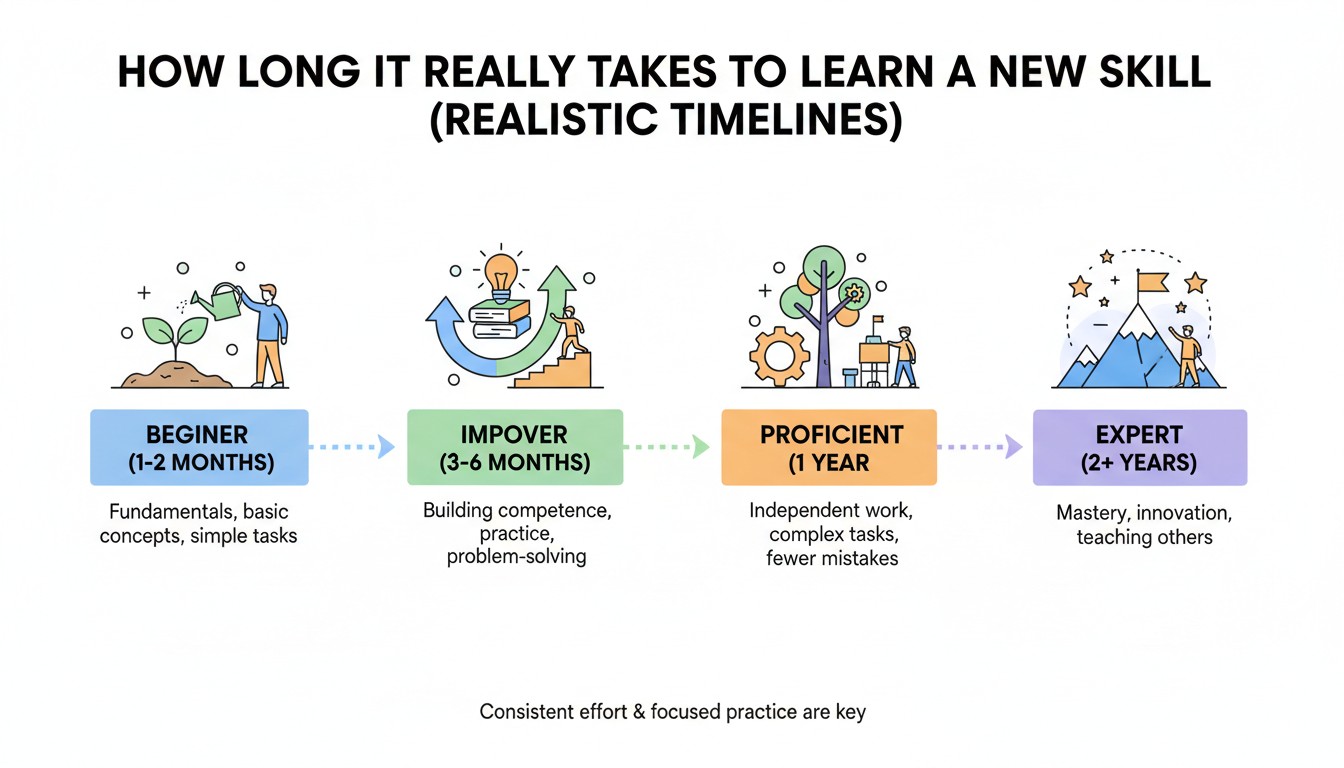
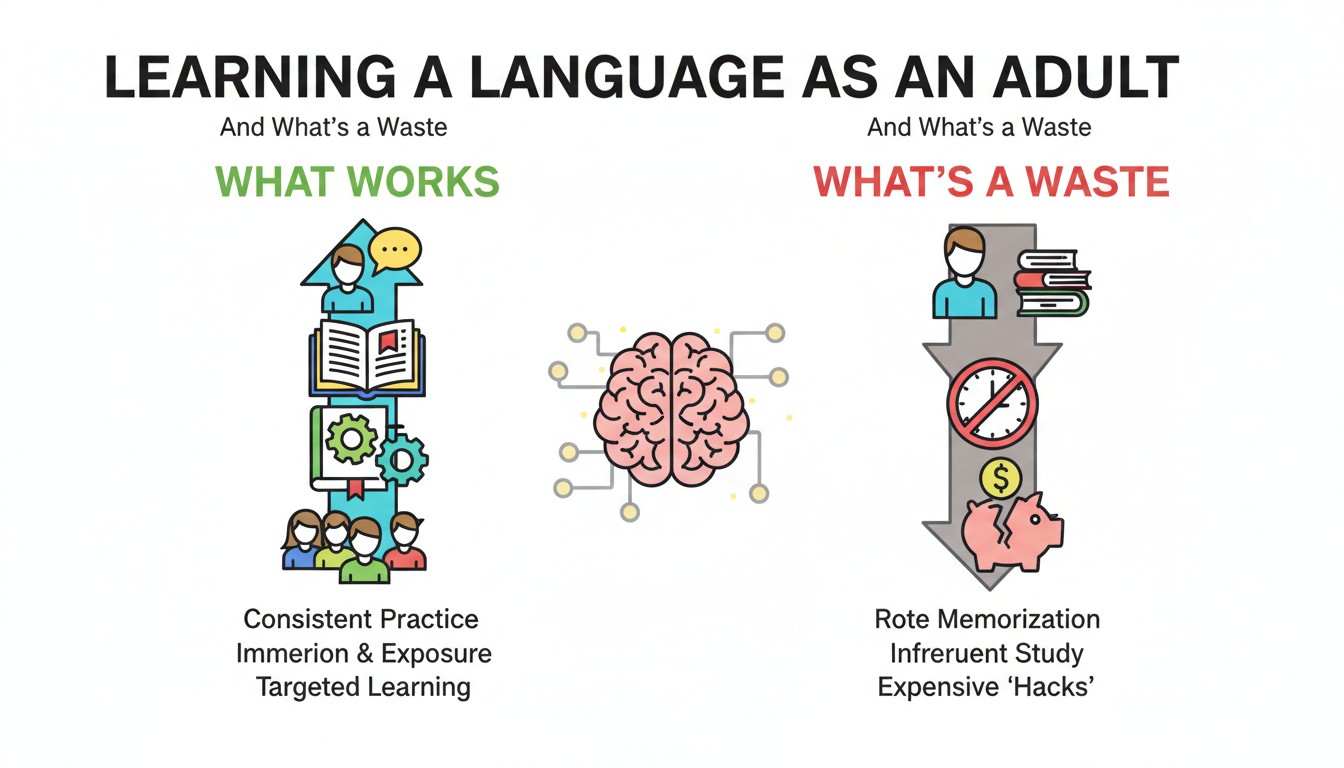
    You’ve been practicing guitar for three months, an hour every evening, and you still can’t play “Wonderwall” without muting the wrong strings. Meanwhile, a YouTube ad promises you can “master guitar in 30 days,” and your friend casually mentions the 10,000-hour rule, which means you’ll be proficient sometime around your 40th birthday. The timeline for learning any skill has become a battlefield of contradictory myths, each one making you feel either hopelessly behind or shamefully impatient. The truth is neither quick nor eternal—it’s annoyingly specific to what you’re trying to learn and why.

    The modern conversation around skill acquisition is dominated by two opposing myths: the 10,000-hour rule, which makes learning sound like a life sentence, and the “30-day mastery” industry, which treats serious skill development like a magic trick. Both are wrong, but both contain fragments of truth. Research from skill acquisition studies reveals that the difference between “good enough” and “world-class” isn’t just time—it’s an entirely different category of effort, intention, and biological predisposition. Understanding which timeline applies to your goal is the difference between sustainable progress and abandoned effort.

    The confusion is understandable. When a middle-aged computer consultant with no musical background declares he’ll become the next Jimi Page by logging exactly 10,000 hours on his new Gibson Les Paul, he’s confusing correlation with causation. As one Quora respondent observed, the number of hours matters far less than the quality of those hours and the complexity of the skill itself. You can’t simply exchange time for mastery like a vending machine.

    The 10,000-Hour Rule: A Misunderstood Masterpiece

    The 10,000-hour rule entered popular consciousness through Malcolm Gladwell’s “Outliers,” but its origins trace to psychologist Anders Ericsson’s research on elite performers. Ericsson studied violinists at the Berlin Academy of Music and found that the most accomplished students had accumulated approximately 10,000 hours of deliberate practice by age 20. The media simplified this to “10,000 hours makes you an expert,” but that’s like saying “marathon runners train for 100 miles per week” and concluding that anyone who runs 100 miles will become an elite marathoner.

    Deliberate Practice vs. Mindless Repetition

    The critical distinction lies in **deliberate practice**—a specific, structured form of training with clear goals, immediate feedback, and constant push beyond your comfort zone. As Skillsoft’s research highlights, mastery requires 100 hours of intellectual learning and 9,900 hours of practice and refinement. But those 9,900 hours must be purposeful; playing the same three chords badly for 10,000 hours doesn’t make you a guitarist, it makes you someone who’s wasted 10,000 hours.

    The Beatles didn’t just play for 10,000 hours—they played **varied sets in diverse venues, received audience feedback, adapted their style, and pushed their creative boundaries**. Bill Gates didn’t just program for 10,000 hours—he had access to a rare time-sharing terminal, wrote code for real-world problems, and received mentorship. The hours matter, but they’re the container, not the content.

    The Timeframe Reality Check

    At 20 hours per week (a realistic maximum for someone with a job and life), 10,000 hours equals **10 years of dedicated practice**. At 10 hours per week, it’s 20 years. This isn’t a weekend project—it’s a life’s work. And crucially, Ericsson’s research focused on **elite performers in highly competitive fields**. If your goal is to play chess with your children, you don’t need 10,000 hours. You need just enough to enjoy the game.

    The 20-Hour Reality: Proficiency Is Closer Than You Think

    Josh Kaufman’s book “The First 20 Hours” challenged the 10,000-hour orthodoxy with a radical claim: you can become reasonably competent in most skills in just 20 hours of deliberate practice. That’s 45 minutes per day for about a month, skipping a few days here and there. The learning curve research supports this: improvement is rapid at first, then slows dramatically as you approach your personal asymptote of ability.

    The Four Steps to Rapid Acquisition

    Kaufman’s framework for rapid skill acquisition is deceptively simple:

    Deconstruct the skill: Break it into smallest possible sub-skills. Learning guitar isn’t one skill—it’s learning to hold a pick, fret a note, strum a pattern, read tablature, and dozens of micro-skills. Identify the 20% that delivers 80% of the results.

    Focus on high-leverage activities: Don’t practice what you already know. If you want to learn conversational Spanish, don’t spend hours on grammar drills—practice actual conversations, even if you make mistakes. The LinkedIn skill-building guide emphasizes eliminating barriers and creating a conducive learning environment during this phase.

    Commit to practice: The 20 hours must be **deliberate and focused**. Watching guitar tutorials while scrolling Instagram doesn’t count. Neither does playing the same three chords you already know while your mind wanders. The practice must be at the edge of your ability, where you’re failing and correcting.

    Get feedback fast: Record yourself playing and listen back. Use language exchange apps to have native speakers correct you. Build a simple website and show it to actual users. Feedback tells you what to practice next.

    “20 hours is doable—that’s about 45 minutes a day for about a month, even skipping a couple days here and there. 20 hours isn’t that hard to accumulate.” — Reddit discussion on skill acquisition

    The Learning Plateau: Why Progress Feels Invisible

    The most dangerous phase of learning is the plateau—the period where you’re practicing but not feeling improvement. This typically occurs after the initial 20-hour burst of progress, between weeks 4 and 8. Your brain has automated the basics, but refinement hasn’t begun. This is where most people quit, mistaking the plateau for stagnation.

    The Science of Skill Consolidation

    During the plateau, your brain is doing crucial work. Myelin, the fatty substance that insulates neural pathways, is thickening around the circuits you’re practicing. This makes the skill faster and more efficient, but it doesn’t feel like progress because conscious effort decreases. As 30-day learning experiments show, this is when consistency matters most. The plateau isn’t a failure of learning—it’s evidence that learning is becoming automatic.

    Breaking Through: The 100-Hour Inflection Point

    For most skills, 100 hours represents a critical inflection point. You’ve moved from conscious incompetence (you know what you’re doing wrong) to conscious competence (you can do it right, but it requires focus). This is where the skill becomes enjoyable. A guitarist can play songs. A programmer can build functional tools. A language learner can handle basic conversations.

    The plateau breaks not through more hours, but through **varied practice**. Instead of playing the same song perfectly, learn a different genre. Instead of coding the same type of app, build something with a new framework. Variation forces your brain out of autopilot and creates new connections.

    Realistic Timelines: Skills by Complexity

    The timeframes below assume deliberate practice by an average adult with no prior related experience. Adjust based on your starting point and natural aptitude.

    Simple Skills (Minutes to Hours)

    These are single-action skills with clear feedback:

    Learning to tie a tie: 15 minutes of practice. The feedback is immediate—does it look right? Muscle memory forms after 10-15 repetitions.

    Brewing pour-over coffee: 2-3 hours across several sessions. You must dial in grind size, water temperature, and pouring technique, but each variable has clear cause-and-effect.

    Using basic spreadsheet formulas: 3-5 hours. You can learn SUM, AVERAGE, and VLOOKUP through tutorials and immediate application.

    Moderately Complex Skills (20-100 Hours)

    These combine multiple sub-skills and require feedback from others:

    Conversational Spanish: 40-60 hours (45 minutes daily for 2 months). You need vocabulary, basic grammar, listening comprehension, and speaking confidence. The Skillsoft research notes that it takes 2,200 hours for native English speakers to learn Mandarin Chinese due to complexity, but Romance languages are much more accessible.

    Playing guitar chords for simple songs: 20-30 hours. You need finger strength, chord transitions, strumming patterns, and rhythm. The first 10 hours are physically painful as calluses develop.

    Basic Python programming: 60-80 hours. You can write functional scripts, understand loops and functions, and debug simple errors. Building anything complex requires crossing the 100-hour threshold.

    Highly Complex Skills (500-10,000+ Hours)

    These require deep theory, physical conditioning, or competitive refinement:

    Competitive chess: 1,500-3,000 hours to reach expert level (ELO 2000). You must memorize openings, study endgames, analyze grandmaster games, and develop pattern recognition across thousands of positions.

    Becoming a surgeon: 15,000+ hours including medical school, residency, and specialized training. This combines intellectual knowledge, fine motor skills, and decision-making under pressure. The Skillsoft analysis breaks this into awareness, initial learning, practice, proficiency, and mastery stages, each requiring different time commitments.

    Professional-level athletics: 5,000-10,000 hours, but heavily dependent on genetics and starting age. A tennis player who starts at age 4 has a different path than one who starts at 24, even with identical practice hours.

    Skill Category Time to Competence Time to Mastery Plateau Point
    Tie a tie 15 minutes N/A (rote skill) None
    Basic guitar chords 20-30 hours 2,000+ hours 40-50 hours
    Conversational Spanish 40-60 hours 1,000+ hours 80-100 hours
    Python programming 60-80 hours 3,000+ hours 120-150 hours
    Chess (competitive) 100-150 hours 5,000+ hours 200-300 hours
    Surgery 2,000+ hours 15,000+ hours Multiple

    The Practice Quality Multiplier: How to Learn Faster

    Two people can practice for 100 hours and achieve vastly different results. The difference is practice quality, which can double or halve your effective learning speed.

    Spaced Repetition vs. Cramming

    Learning in 45-minute daily sessions over a month is 3x more effective than 20-hour weekend marathons. CareerVillage advice suggests starting with 15-minute daily sessions and gradually expanding. This works because sleep consolidates neural connections. Each practice session builds on the previous night’s consolidation, creating compound learning.

    If you must cram (for a deadline), focus on patterns rather than details. Learn the 20% of the skill that handles 80% of situations. For conversational Spanish, that means mastering present tense, basic vocabulary, and common phrases—not subjunctive mood or literary vocabulary.

    Expert Feedback vs. Solo Practice

    A single hour with a skilled teacher can replace 10 hours of solo practice. Teachers provide immediate correction, preventing you from ingraining mistakes. As the LinkedIn skill-building framework emphasizes, getting feedback from experienced practitioners helps you identify blind spots and adjust your approach. This is why language exchange partners accelerate learning faster than apps alone.

    If you can’t afford a teacher, record yourself and compare to experts. Video your golf swing and watch it side-by-side with a pro. Record your Spanish pronunciation and compare to native speakers. This self-feedback is less efficient but still accelerates learning.

    The Habit Formation Window: 30 Days to Automaticity

    The “21-day habit formation” myth oversimplifies, but there’s truth to the idea that skills become easier to maintain after a month of consistent practice. 30-day learning challenges work because they push you through the initial resistance phase and into a routine. By day 30, the skill feels less like a chore and more like part of your identity.

    The Four-Week Skill Sprint

    Week 1: Focus on fundamentals. You feel clumsy and overwhelmed. Everything is new. Set micro-goals: learn three chords, master 20 vocabulary words, write one simple function.

    Week 2: Practice becomes slightly easier. You stop looking up every instruction. Set project-based goals: play a simple song, hold a 5-minute conversation, build a basic app.

    Week 3: You hit the plateau. Progress feels slow. This is the danger zone—many quit here. The key is to change your metric: instead of measuring accuracy, measure consistency. Did you practice every day? That’s the win.

    Week 4: Integration begins. You use the skill without thinking. The guitar is out of its case by default. Spanish words slip into your thoughts. Code is something you write, not just study.

    The Individual Factor: Why Timelines Are Personal

    All the timelines above assume an average learner. But you are not average. Your background, aptitude, and circumstances dramatically affect speed.

    Prior Experience Multipliers

    Learning Spanish is faster if you already speak French (shared Latin roots). Programming is easier if you have mathematical reasoning skills. Guitar is easier if you’ve played piano (you understand rhythm and finger independence).

    Age also matters, but not how you think. Children learn pronunciation and motor skills faster due to neural plasticity. Adults learn complex concepts and self-correction faster due to existing mental frameworks. A 40-year-old learning guitar progresses slower physically but faster mentally than a 10-year-old.

    Creating Your Personal Timeline

    To estimate your personal timeline:

    1. Identify the skill’s complexity level (simple/moderate/highly complex)

    2. Assess your prior experience (none/some/significant)

    3. Determine your available practice time (daily/weekly/monthly)

    4. Set your goal (competence/proficiency/mastery)

    Then use this formula: Base hours × (1 – prior experience coefficient) ÷ weekly practice hours = weeks to competence.

    The Honest Timeline Calculator

    Skill: Conversational Spanish

    Base hours: 50 hours (competence)

    Prior experience: Some French (0.3 coefficient)

    Weekly practice: 5 hours

    Calculation: 50 × (1 – 0.3) ÷ 5 = 7 weeks

    This is your realistic timeline, not the app’s promise of “fluent in 30 days.”

    The Practice Paradox: Why Slow is Fast

    The final paradox: the fastest way to learn is to stop trying to learn quickly. Cramming creates anxiety, which impairs memory formation. Slow, consistent practice allows sleep consolidation and prevents burnout.

    A person who practices 30 minutes daily for a year (182 hours) will almost always outperform someone who practices 10 hours daily for three weeks (210 hours). The distributed learner has avoided burnout, benefited from sleep consolidation, and built an identity around the skill. The intensive learner is exhausted, has created negative associations, and will likely abandon the skill within a month.

    The question isn’t “How long does it take to learn this skill?” It’s “How long am I willing to make this part of my life?” The answer to that question is your real timeline.

    The Only Timeline That Matters

    You can learn to play “Wonderwall” in 30 hours. You can learn to play like Jimi Hendrix in 10,000 hours. Both are valid goals, but they require different commitments, different mindsets, and different definitions of success.

    The most dangerous myth isn’t the 30-day promise or the 10,000-hour rule—it’s the idea that there’s a universal timeline for learning. Your timeline depends on your goal, your biology, your circumstances, and your willingness to embrace the plateau.

    Start with 20 hours. See how it feels. If you love it, keep going. If you don’t, stop. Life is too short to spend 10,000 hours on something you merely tolerate. The best skill to learn is the one you’re willing to practice when progress feels invisible. That’s when the real timeline begins—not at hour one, but at hour twenty-one, when the excitement has faded and only the work remains.