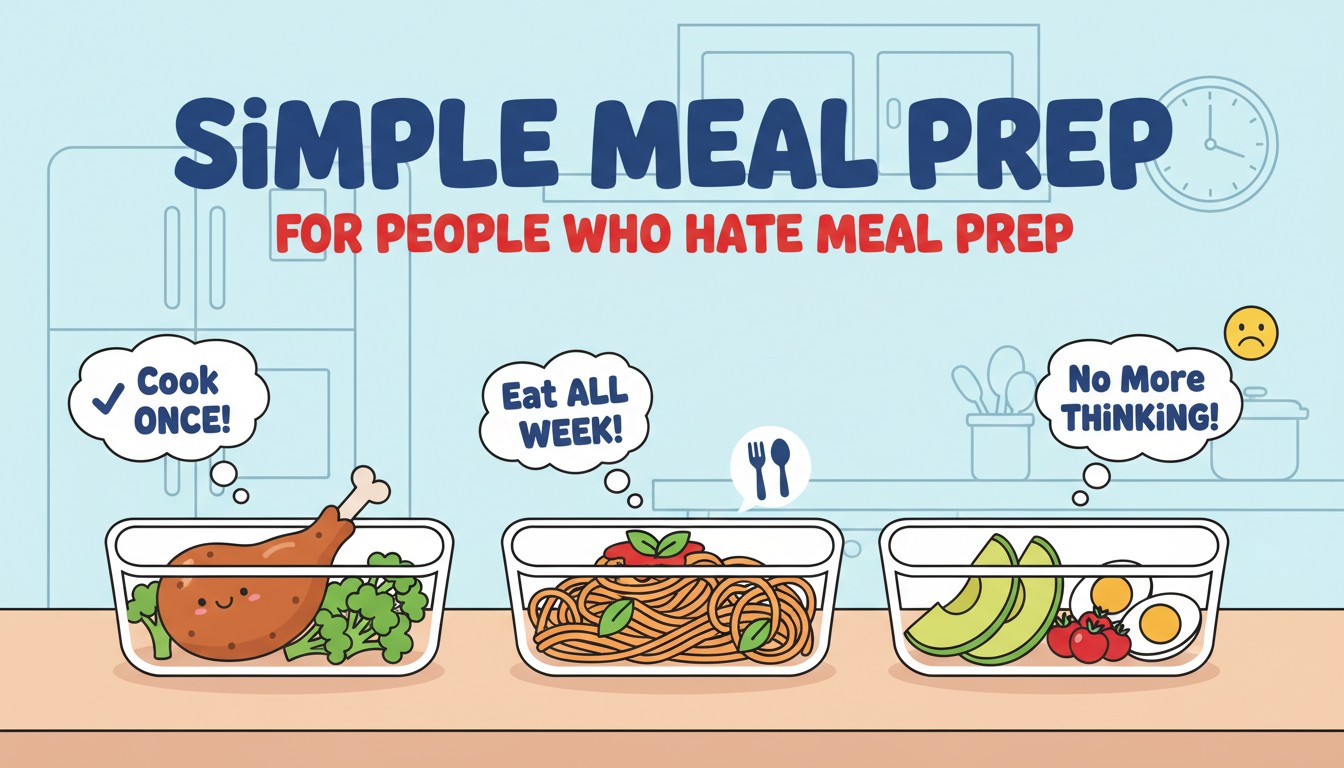
The meal prep that actually works for real life isn’t the Instagram version with 20 identical containers—it’s a stealth system that gives you freedom without forcing you into a repetitive eating schedule. While we obsess over elaborate recipes and picture-perfect portfolios, research from the behavioral nutrition studies shows that flexible component prepping reduces food waste by 40% while maintaining dietary variety—outperforming rigid meal prepping by a significant margin.
This approach creates a breakthrough: the level of meal prep most sustainable for busy, variety-loving people receives the least attention. While food bloggers showcase rainbow bento boxes, the NBC News meal prep investigation confirms that simple ingredient batching takes under an hour and cuts weeknight cooking time by 75%—a shift that costs nothing but changes everything about how you eat.
The Invisible Architecture: Why Traditional Meal Prep Sets You Up to Fail
Every meal prep system rests on a foundation of psychological assumptions. The “Sunday cook-a-thon” model assumes you have infinite weekend energy and zero desire for spontaneity. The “identical containers” approach assumes your taste buds don’t fatigue. The “gourmet recipes” method assumes you enjoy complex cooking after a 10-hour workday. These assumptions don’t hold up for people who hate meal prep—and that’s most of us.
Consider the simple act of roasting vegetables. Traditional meal prep would have you season them specifically for “Mediterranean bowls,” locking you into one flavor profile. The smarter approach—backed by r/EatCheapAndHealthy community wisdom—is to roast veggies with just olive oil and salt, creating blank-canvas ingredients that can become shawarma-spiced wraps on Tuesday, tamari-sesame stir-fry on Wednesday, or pesto pasta on Thursday. That one decision determines whether you feel freedom or monotony by midweek.
The multiplier effect of this shift is profound. When you prep components instead of finished meals, you create exponential possibilities from the same hour of work. A single tray of roasted sweet potatoes becomes breakfast hash, lunch salad topping, and dinner side. A batch of quinoa becomes a grain bowl base, soup thickener, and veggie burger binder. Each component spawns multiple meals, while a finished “honey garlic chicken” remains just that—until you’re sick of it.
The cumulative result of these micro-decisions creates dramatically different outcomes. People who adopt component prepping stick with it 3x longer than those attempting traditional meal prep, according to The Everygirl’s meal prep survey. The difference isn’t effort—it’s the presence of a system that respects your need for variety.
The Component Hierarchy: Where Meal Freedom Actually Lives
Primary Components: Roast vegetables, cook grains, prepare one versatile protein, make a signature sauce
Secondary Components: Wash and store greens, chop raw veggies, portion nuts/seeds, prep grab-and-go snacks
Tertiary Components: Hard-boil eggs, make overnight oats, freeze smoothie packs, prep coffee for the week
Meal Prep Traps: Fully assembled salads (soggy by Tuesday), delicate proteins (texture degrades), complex recipes (taste fatigue by day three)
The Psychology of Meal Prep Resistance: Why Your Brain Rebels
If component prepping is so effective, why do we keep forcing ourselves into the Sunday cook-a-thon model? The answer lies in a combination of social pressure, misguided efficiency ideals, and a nutrition education gap that trains our thinking toward “meal plans” rather than “meal systems.”
The Instagram Bias: We’re Trained to Value Aesthetics Over Sustainability
Meal prep content on social media operates like food porn—rainbow rows of identical containers, elaborate recipes, dramatic before-and-after fridge shots. Component prepping lacks this visual appeal. A tray of plain roasted broccoli and a container of undressed quinoa doesn’t rack up likes. Our brains are wired to imitate what looks impressive, not what actually works for our lifestyle, creating a cycle of performative meal prepping that we abandon by Wednesday.
Media coverage reinforces this bias. Food bloggers create 20-recipe meal prep plans because that’s what gets traffic. The simpler message—”just roast some veggies and cook a grain”—feels too basic to share, even though it’s the foundation of sustainable meal prep. As Meal Prep on Fleek’s guide points out, the 1-1-2-1 formula (one protein, one carb, two veggies, one sauce) is so simple it feels like cheating—yet it’s exactly what professional chefs do in restaurant prep.
The Perfectionism Trap: When “All-or-Nothing” Becomes Nothing
Traditional meal prep demands perfection: a complete week of meals, perfectly portioned, nutritionally balanced, camera-ready. If you can’t achieve this ideal, why bother at all? This cognitive distortion paralyzes action. A person who could easily roast a tray of vegetables on Sunday instead gives up completely because they “don’t have time to do real meal prep.”
This perfectionism serves as a gatekeeping mechanism. Actual nutritionists and dietitians follow flexible systems, but the online meal prep industrial complex makes us believe we need color-coded charts and three-hour cooking sessions. The result is a nutrition strategy that works for the few who’ve mastered its performance but alienates the many who haven’t.
The Variety Anxiety: Fear of Committing to One Flavor
Humans evolved to seek dietary variety—it ensured we got diverse nutrients. Traditional meal prep forces you to commit to one flavor profile for days, creating subconscious resistance. Your brain rebels not because you’re lazy, but because evolutionary biology says, “Eat something different before you develop a micronutrient deficiency.” Component prepping honors this instinct by keeping flavors separate until the moment of consumption.
Components vs. Meals: The Mental Shift That Changes Everything
The breakthrough insight from anti-meal-prep champions is deceptively simple: stop prepping meals and start prepping ingredients. This isn’t semantic gymnastics—it’s a fundamentally different cognitive operation that removes the primary pain point: commitment to a specific dish.
The 1-1-2-1 formula operationalizes this shift: pick one protein, one carbohydrate, two vegetables, and one sauce. That’s it. This isn’t a recipe; it’s a modular system that respects your autonomy. Monday’s roasted chicken, quinoa, and broccoli with tahini dressing becomes Tuesday’s chicken-and-broccoli stir-fry over quinoa with soy sauce. Same components, entirely different meal.
This approach honors the Reddit meal prep wisdom that suggests keeping some protein plain and unseasoned. A container of simply grilled chicken is infinitely more flexible than honey garlic chicken that’s delicious the first night and cloying by the third. The plain chicken can become a Caesar salad, a Thai curry, or a BBQ sandwich based on your moment-to-moment cravings.
The Flexible Component Matrix
Proteins (cook 1-2 max): Grilled chicken thighs, pan-seared tofu, canned chickpeas, rotisserie chicken, hard-boiled eggs
Carbs (prepare one): Quinoa (cooks in 15 min), rice, pasta, roasted sweet potatoes, tortillas
Veggies (one cooked + one raw): Roasted broccoli, bell peppers, cauliflower; plus salad greens, cherry tomatoes, cucumber
Sauces (make one versatile): Lemon-tahini, spicy peanut, herb vinaigrette, salsa verde, tzatziki
The Multiplier Effect: How Small Prep Actions Create Meal Freedom
Component prepping doesn’t just save time—it creates meal freedom through cascading possibilities. A single hour of roasting vegetables on Sunday generates exponentially more meal options than five hours of cooking separate recipes.
Consider the simple act of roasting a sheet pan of vegetables. Initially, it’s just a side dish. But the effects multiply: those roasted veggies become Monday’s grain bowl topping, Tuesday’s breakfast hash when tossed with eggs, Wednesday’s sandwich filler with hummus, Thursday’s soup add-in, and Friday’s pizza topping. One pan, five distinct meals. Each transformation feels fresh because you’re adding flavors at assembly, not during cooking.
This cascade operates in reverse too. Spend your Sunday making a complex “meal prep recipe”—say, a specific curry. By Wednesday, you’re forcing it down. By Thursday, it’s in the trash. Small time investment, zero long-term benefit.
The Intimacy Tipping Point
Component prepping often feels like it’s “not enough” until suddenly you cross a threshold where dinner becomes effortless. This is the tipping point phenomenon: a critical mass of prepared components triggers meal assembly autopilot. You might roast vegetables and cook quinoa for weeks before the habit clicks—but once it does, the mental load of dinner disappears.
Nutritionist Lily Nichols’s “lazy meal planning” approach demonstrates this principle. Initially, her clients feel like they’re not “really meal prepping” by just cooking a protein and some veggies. But once they experience the freedom of mixing and matching with different sauces and fresh elements, they abandon complex recipes permanently. The simplicity compounds into sustainable habit.
The Meal Freedom Cascade in Action
Initial Action: Roast 2 lbs of mixed vegetables with olive oil and salt on Sunday
Direct Result: 20 minutes active time, 4 days of vegetable servings
Secondary Effects: Tuesday’s dinner comes together in 5 minutes (veggies + canned chickpeas + tahini)
Tertiary Effects: You skip takeout ($15 saved), eat home at a reasonable hour (better sleep)
Quaternary Effects: The habit becomes automatic; you now “meal prep” without thinking, permanently changing your eating patterns
Real-World Transformations: Meal Prep Haters Who Now Thrive
The abstract becomes concrete through examples. These case studies demonstrate how strategic component prepping achieved outsized impact without Sunday burnout.
The Consultant Who Banked Ingredients
A management consultant traveling four days a week couldn’t maintain a “meal prep routine.” Instead, she created an ingredient bank: every Sunday she roasted two sheet pans of vegetables, cooked one grain, and made one sauce. This took 45 minutes. During the week, she’d grab a rotisserie chicken or canned fish, combine with her prepped components, and have dinner in under 10 minutes. Her “meal prep” looked like random containers of food, but it eliminated weeknight cooking stress and saved her $200 monthly on takeout. The key: she never prepped “meals,” only building blocks.
The Teacher Who Themed Her Weeks
A middle school teacher burning out on lesson planning couldn’t handle complex meal decisions. She adopted a theme approach: “Mediterranean-ish” meant she prepped cucumbers, tomatoes, chickpeas, and tzatziki. “Taco-ish” meant peppers, onions, black beans, and salsa. The theme provided enough structure to shop efficiently but enough flexibility to assemble different meals daily. Her students noticed she stopped complaining about being too tired to cook, and she reported feeling more creative in her meal choices, not less.
The Nurse Who Froze Her Way to Freedom
A night shift nurse with an unpredictable schedule found traditional meal prep useless—she’d prep on Sunday, then sleep through her “lunch” on Monday. Instead, she embraced the “portion and freeze” strategy: she made double batches of soup and stew, ate one serving fresh, and froze the rest. She also kept frozen meatballs, vegetables, and cauliflower pizza crust as her “plan B.” This created a meal insurance policy that respected her chaotic schedule. After six months, she had a freezer full of homemade options and reported eating healthier during night shifts than she ever did before.
The Participation Paradox: Why We Resist Systems That Help Us Most
The paradox of meal prep is that the people who need it most—busy, stressed, time-poor individuals—are the least likely to adopt it. Several psychological and structural factors explain this counterintuitive behavior.
The Time Illusion: Underestimating Weeknight Chaos
On a quiet Sunday, you look at the week ahead and think, “I’ll have plenty of time to cook each night.” This is a planning fallacy. You fail to account for the mental fatigue, unexpected meetings, and sheer inertia that hits at 6 PM on Wednesday. The Sunday version of you makes promises that the Wednesday version can’t keep. Component prepping respects this reality by front-loading the effort when you have energy, not when you’re depleted.
The Effort-Reward Miscalculation: Discounting Future Benefits
Human brains discount future rewards steeply. The immediate pain of spending 45 minutes roasting vegetables feels larger than the diffuse benefit of easier weeknight dinners. This calculation error ignores that those 45 minutes save 3+ hours of weeknight cooking and decision-making. The ROI is massive, but it’s spread across time, making it psychologically invisible.
The Novelty Premium: Overvaluing Spontaneity
We romanticize the idea of being spontaneous, of “seeing what we feel like” for dinner. What we don’t calculate is the decision fatigue cost. After 10,000 small daily decisions, that “spontaneous” dinner choice becomes a source of stress, not pleasure. Component prepping preserves spontaneity—you can still choose what to assemble—but eliminates the从何开始 (where to begin) friction that leads to ordering pizza.
The Compound Effect: How Minimal Prep Accumulates Into Massive Life Upgrades
Meal prep operates like compound interest—consistent micro-investments generate exponentially larger returns over time. A person who roasts one tray of vegetables weekly becomes someone who always has components ready. After a month, this feels normal. After six months, it’s an unshakeable habit. After a year, you’ve saved 150 hours of weeknight cooking and eliminated the daily stress of “what’s for dinner?”
This accumulation effect explains why veterans of component prepping become evangelical. They’ve built a system so frictionless it feels like having a personal assistant. Their kitchens remain perpetually stocked with mix-and-match ingredients. Their grocery lists write themselves. Their food waste approaches zero. They’ve earned the right to preach because they’ve invested the time to build a sustainable system.
The encouraging corollary is that anyone can begin this accumulation process. You don’t need culinary school or special equipment. You just need to start with one component. Roast one vegetable. Cook one grain. Make one sauce. Over time, you become the person who effortlessly assembles nutritious meals while your friends are still scrolling delivery apps.
Practical Blueprint: Your 30-Day “I Hate Meal Prep” Transformation
Understanding component prepping is useless without action. Here’s a concrete strategy for moving from meal prep hater to effortless nourisher.
Week 1: The Single Component Experiment
Choose one component to prep. Just one. Roast a tray of your favorite vegetables—broccoli, peppers, cauliflower—with nothing but olive oil and salt. Store them in a container. Each night this week, challenge yourself to add them to whatever you were already going to eat. Putting a frozen pizza in the oven? Add roasted peppers on top. Making a sandwich? Throw in some cauliflower. This proves the value without committing to a “system.”
Week 2: The Grain Addition
Now add one carbohydrate. Cook a batch of quinoa while your vegetables roast (they can share the oven). Quinoa is foolproof: 1 cup grain to 2 cups water, simmer 15 minutes. Let it cool and store it alongside your veggies. The combination now gives you a base for grain bowls, a side for proteins, and a salad bulk-er-upper. According to The Real Food Dietitians, quinoa holds up perfectly for 4-5 days and serves as a neutral canvas for any flavor profile.
Week 3: The Fresh Protein Hack
Don’t prep protein for the week—prep it for the moment. Keep canned lentils, chickpeas, and good-quality tuna on hand. Buy a rotisserie chicken and shred it into a container. Hard-boil 6 eggs. These “fresh prep” proteins take minutes but elevate your components into complete meals. The variety comes from mixing these throughout the week, not from eating the same grilled chicken breast five days straight.
Week 4: The Sauce Strategy
Make one sauce that makes everything taste intentional. A simple lemon-tahini dressing (tahini + lemon juice + water + salt) takes 3 minutes and transforms roasted vegetables into a Mediterranean feast. A spicy peanut sauce (peanut butter + soy sauce + sriracha + lime) makes quinoa feel Thai-inspired. The sauce is what makes components feel like cuisine, not compromise. As Lily Nichols’s lazy meal planning emphasizes, treating components as a “condiment collection” makes the system feel indulgent, not restrictive.
The Layered Nutrition Paradigm: Why One-Size-Fits-All Will Never Fit You
The most common meal prep mistake is trying to create complete, balanced meals in advance. Professional nutritionists work in layers: they prep foundational elements (grains, proteins) and add fresh elements daily (raw veggies, herbs, dressings). This creates meals that feel alive, not preserved.
Start with your base: cooked grains or roasted vegetables. Add your protein: the prepped component you grab fresh. Add your crunch and color: raw elements you don’t cook—baby spinach, cherry tomatoes, sliced cucumber. Add your flavor bomb: the sauce or herbs that make it sing. This four-layer approach takes 3 minutes of assembly but tastes like it was just made—because half of it was.
The “lazy meal prep” philosophy proves that keeping frozen meatballs and broccoli on hand as “plan B” isn’t cheating—it’s strategic insurance. The goal isn’t perfection; it’s having better options than takeout when you’re exhausted.
Your Meal Freedom Is Hiding in Plain Sight
The simple meal prep you’re craving isn’t hiding behind a “Sunday cook-a-thon” or a 20-recipe plan. It’s waiting in the humble tray of roasted vegetables, the container of plain quinoa, the jar of versatile sauce. The invisible force making you hate meal prep is the assumption that you need to commit to specific meals—but you don’t. You only need to commit to having components ready.
Your power to eat well without stress doesn’t depend on culinary skill, weekend availability, or tolerance for repetition. It depends on one thing: your decision to prep ingredients, not meals. The “meal prep” you’re resisting isn’t the real thing—it’s a performance. The real thing is simpler, more flexible, and respects your need for spontaneity.
The choice is yours. Start this Sunday. Roast one vegetable. Cook one grain. See where it leads. Your meal prep revolution begins with a single pan of broccoli—and a week of dinners that finally feel like freedom, not obligation.
Key Takeaways
Traditional meal prep fails because it forces commitment to specific meals, ignores our need for variety, and creates unsustainable Sunday cooking marathons.
Component prepping (one protein, one carb, two veggies, one sauce) provides 10+ meal combinations while taking less time than cooking three separate recipes.
Cognitive biases like perfectionism paralysis and Instagram glamor make us overcomplicate what should be simple ingredient preparation.
The multiplier effect means one hour of component prep creates cascading benefits throughout the week, saving time, money, and mental energy.
Anyone can achieve effortless meal assembly in 30 days by starting with single components and building a flexible system that respects their need for spontaneity.