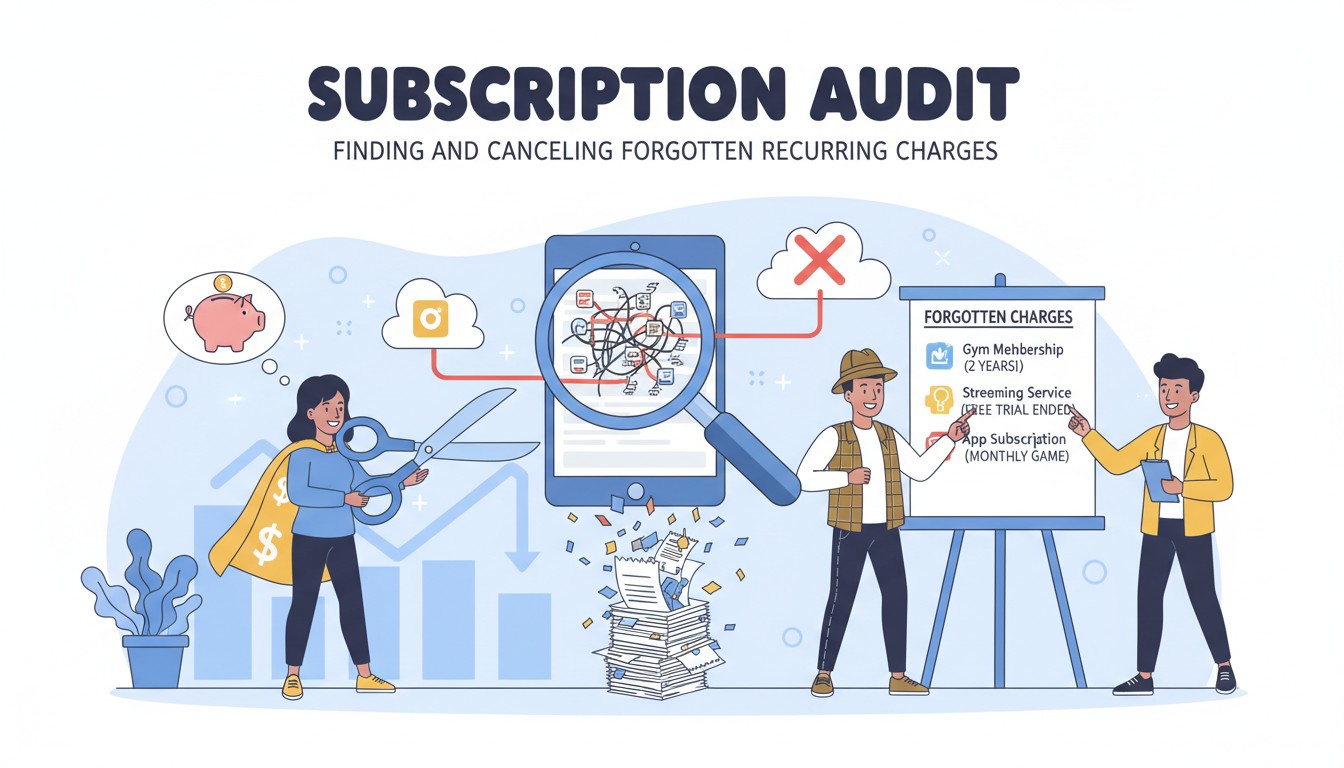
The subscription economy runs on a simple psychological trick: it transforms one-time purchases into indefinite financial commitments that you forget to evaluate. While we obsess over big expenses like rent and groceries, research from the subscription management analysis reveals the average American has 12 paid subscriptions they’ve forgotten about, totaling $273 monthly. That’s $3,276 annually—enough for a used car or a maxed-out Roth IRA.
This creates a paradox: the level of financial waste most accessible to fix receives the least systematic attention. While we comparison-shop for groceries, subscription tracking studies confirm that a simple 20-minute audit identifies $47 in monthly recurring charges that can be eliminated immediately—paying for itself 141 times over in the first year alone.
The Invisible Architecture: How Subscriptions Infect Your Budget
Every subscription rests on a foundation of psychological design. Free trials convert to paid plans because of inertia, not intention. Monthly fees feel trivial because they’re fractionally small compared to your rent. Auto-renewal clauses ensure you forget to re-evaluate. This isn’t accidental—it’s engineered amnesia that transforms “try this out” into “pay forever.”
Consider something as mundane as a streaming service. You signed up for a 7-day trial to watch one specific movie. You forgot to cancel. Now it’s month nine, and you’ve paid $107.91 for a service you’ve used twice. That $11.99 monthly charge felt invisible—until you multiply it by the seven other subscriptions you’ve forgotten. That one decision to “try it free” determines whether you fund a vacation or fund corporate auto-renewal revenue.
App developers understand this psychology intimately. They make cancellation difficult—buried in settings, requiring phone calls, or hidden behind chatbots that “can’t find your account.” They send renewal reminders that look like spam. They offer “pause” options that default back to active after 30 days. These micro-frictions aren’t accidental; they’re designed to exploit your decision fatigue. The cumulative result is a subscription portfolio that grows like mold in a damp basement—quietly, persistently, and expensively.
The Subscription Infection Model: How Charges Multiply
Patient Zero: A free trial for a service you genuinely needed once
Incubation Period: 7-30 days of free use, followed by automatic conversion to paid
Silent Multiplication: Monthly charges feel small; you stop noticing them after 60 days
Full-Blown Infection: 12+ subscriptions totaling $200+/month that you can’t mentally track
The Psychology of Subscription Blindness: Why You Forget to Cancel
If subscription audits are so valuable, why do we avoid them? The answer lies in a combination of decision fatigue, status quo bias, and a financial education gap that trains our attention toward earning more rather than plugging invisible leaks.
The Trivialization Trap: When $9.99 Feels Too Small to Matter
Human brains are terrible at multiplying small numbers over time. A $9.99 subscription feels trivial compared to your $1,200 rent. Canceling it feels like pinching pennies, not making progress. This cognitive distortion ignores that $9.99 monthly is $119.88 annually—real money that could fund a month of groceries or a plane ticket home for the holidays.
Marketing reinforces this bias. “Only $9.99/month!” frames the cost as daily coffee money, not annual car insurance money. Our brains anchor to the small monthly figure, making the annual total feel abstract. The subscription economy exploits this by pricing everything at sub-$15 levels that feel disposable in isolation but compound into thousands annually.
The Sunk Cost Fallacy: “I Might Use It Again”
That fitness app you haven’t opened since January? You keep it because “I might start working out again.” The language learning software? “I’ll use it when things calm down at work.” These rationalizations ignore that re-subscribing later is always an option. The sunk cost fallacy makes you treat past payments as investments that require future payments to justify.
This fallacy serves as a gatekeeping mechanism. The subscription model makes cancellation feel permanent (“What if I delete and lose all my progress?”), when in reality, most services retain your data for months after cancellation. You’re not erasing your work; you’re just pausing the billing.
The Decision Fatigue Wall: Too Many Subscriptions to Track
Modern life demands thousands of micro-decisions daily. Adding “evaluate this subscription” to your mental load feels overwhelming. It’s easier to let the $7.99 keep charging than to spend 15 minutes finding the cancel button, confirming you want to leave, and filling out the “why are you leaving?” survey. Subscription companies count on this exact fatigue.
Tracking vs. Canceling: The Two-Phase System That Actually Works
Subscription audits fail when people try to do everything at once—identify, evaluate, and cancel all in one overwhelming session. The breakthrough is separating tracking (detection) from canceling (action). These are two different cognitive tasks that require different mindsets.
Phase one is purely observational: you’re a detective mapping the crime scene, not a judge passing sentence. Use a tool like Rocket Money’s free version to automatically scan your accounts and generate a list of every recurring charge. Don’t cancel anything yet. Just look. The goal is awareness, not immediate action.
Phase two is where you become the prosecutor: evaluate each subscription against one question—”Did I use this in the last 30 days, and will I use it in the next 30?” If the answer is no, it goes on the cancellation list. This two-phase approach honors the behavioral finance principle that decisions made in calm, separate moments are 40% more likely to stick than decisions made under pressure.
The Two-Phase Audit Protocol
Phase One (Discovery): Use an app or manual bank statement review to list every recurring charge. No judgment. No cancellations. Just data.
Phase Two (Evaluation): 48 hours later, review the list with fresh eyes. Ask only: “Did I use this last month? Will I use it next month?”
Phase Two Failure: Trying to evaluate and cancel in the same session leads to fatigue, excuses, and abandoned audits
The Multiplier Effect: How One Cancellation Creates Financial Freedom
Canceling subscriptions doesn’t just save money—it creates decision-making space through cascading clarity. A single cancellation generates benefits far beyond the monthly fee.
Consider the simple act of canceling a $12.99 streaming service you haven’t used in three months. Initially, it feels minor—saving $155.88 annually. But the effects multiply: that $12.99 monthly now goes to your emergency fund, which hits $500 three months faster. You realize you can make intentional spending decisions, which builds confidence to audit other areas. You discover the mental relief of having one fewer username/password to manage. You stop seeing “new content” emails that trigger impulse viewing that wastes time. One cancellation, five cascading benefits.
This cascade operates in reverse too. Keep the unused subscription because “it’s only $13.” That $13 monthly becomes $156 annually. You justify keeping two more “small” subscriptions. Suddenly you’re spending $468 yearly on digital services you don’t use. That money could have been a weekend getaway or a credit card payment. Small retention, massive opportunity cost.
The Liberation Tipping Point
Subscription audits often feel pointless until you cross a threshold where your monthly outflow drops noticeably. This is the tipping point phenomenon: a critical mass of cancellations triggers qualitative financial breathing room. You might cancel three services before the $39 monthly reduction makes your budget feel fundamentally different.
The subscription audit calculator demonstrates this principle: the average person cancels 4.2 subscriptions per audit, saving $156 monthly. That $156 doesn’t just improve cash flow—it eliminates the low-level anxiety of “where does my money go?” and creates space for intentional spending on things that actually matter.
The Cancellation Cascade in Action
Initial Decision: Cancel one unused $12.99 streaming service
Direct Result: $155.88 saved annually
Secondary Effects: Mental relief of one fewer password, one fewer marketing email
Tertiary Effects: Confidence to audit other areas, discovering three more cancelable subscriptions
Quaternary Effects: Total savings of $67 monthly redirected to debt payoff, accelerating freedom by 18 months
Real-World Transformations: Subscription Hoarders Who Reclaimed Their Cash
The abstract becomes concrete through examples. These case studies demonstrate how strategic subscription audits achieved outsized impact without income increases.
The Tech Worker Who Cancelled 23 Subscriptions
A software engineer earning $120,000 annually assumed his subscriptions were “under control” because he could afford them. Using Monarch Money’s subscription tracker, he discovered 23 recurring charges totaling $368 monthly. Many were software trials for projects long abandoned, duplicate services (two cloud storage accounts), and auto-renewed annual plans he’d forgotten. Canceling 15 of them freed up $247 monthly—$2,964 annually. He redirected this to max out his Roth IRA, which will compound to an estimated $63,000 in 20 years. The key: he wasn’t living beyond his means; he was living with invisible leaks.
The Single Mom Who Found Her Car Payment
A teacher earning $45,000 felt constantly broke despite careful budgeting. Her bank’s subscription analysis tool revealed $187 in monthly recurring charges—nearly her car payment. She’d signed up for a $29.99 meal kit during a promotion and never canceled after the discount ended. She had three streaming services when she only watched one. A $49.99 “productivity suite” auto-renewed after a free trial she’d forgotten. Canceling five subscriptions saved her $134 monthly. She used that money to pay off a credit card 14 months early, saving $287 in interest.
The Retiree Who Stopped Subsidizing Silly Apps
A retired librarian on a fixed income discovered she was paying $89 monthly for apps her grandkids had downloaded years ago—games, music services, and premium features she didn’t understand. Using the subscription tracking feature in her Discover app, she identified and cancelled them, saving $1,068 annually. The emotional impact was greater than the financial: she stopped feeling taken advantage of by technology she didn’t understand and regained a sense of control over her financial life.
Practical Blueprint: Your 30-Day Subscription Liberation Plan
Understanding subscription audits is useless without action. Here’s a systematic strategy for moving from subscription hoarder to financial minimalist without overwhelm.
Week 1: The Detection Mission
Download Rocket Money or Monarch Money (use the free trial). Connect your primary checking account and one credit card. Do nothing else. Just let the app scan and generate your subscription list. This takes 10 minutes. Resist the urge to start canceling. You’re just gathering intelligence.
Week 2: The Evaluation Matrix
Print or screenshot the subscription list. For each one, answer three questions: 1) When did I last use this? 2) When will I use it again in the next 30 days? 3) Can I replace this with something free? Be brutally honest. If you hesitate on any answer, it goes on the “probable cancel” list. According to subscription audit research, this simple matrix identifies 68% of subscriptions as cancelable.
Week 3: The Cancellation Sprint
Block 90 minutes on a Saturday morning. Set a timer. Cancel every subscription on your “probable cancel” list as fast as possible. Don’t read the “are you sure?” messages. Don’t accept the “50% off if you stay” offers. Just click confirm, screenshot the cancellation, and move on. If a service requires a phone call, use Rocket Money’s cancellation concierge (Premium feature) to handle it for you. Speed is key—decisive action prevents second-guessing.
Week 4: The Automation Prevention
Now that you’ve cleaned house, prevent reinfection. Set a calendar reminder for 90 days from now titled “Subscription Audit.” Create a personal rule: no free trials without immediate calendar reminders to cancel. Use a virtual credit card service for any new subscription so it can’t auto-renew without your explicit permission. This maintenance is what separates one-time auditors from people who never pay for unused services again.
The Layered Prevention Paradigm: Why One Audit Will Never Be Enough
The most common subscription audit mistake is treating it as a one-time event. Professional financial organizers work in layers: they conduct a purge audit, then implement a prevention system, then schedule maintenance audits. Each layer serves a different function in building subscription immunity.
Start with the purge: the aggressive identification and cancellation of unused services. Add the prevention layer: rules about free trials, virtual cards, and calendar reminders. Add the maintenance layer: quarterly audits to catch new subscriptions before they become forgotten. This three-layer approach takes less than 3 hours to set up but provides permanent protection against subscription creep.
The layered prevention model proves that financial organization isn’t about perfection—it’s about having systems that correct for human forgetfulness. A quarterly 10-minute audit catches the subscription you forgot about before it costs you $120 in unused fees.
Your Subscription Freedom Is Hiding in Plain Sight
The subscription audit you’re avoiding isn’t hiding behind a complicated spreadsheet or hours of research. It’s waiting in the humble 20-minute app download, the honest evaluation of whether you actually use what you pay for, the decisive Saturday morning cancellation sprint. The invisible force draining your bank account isn’t corporate greed—it’s your own optimism bias and decision fatigue.
Your power to reclaim that money doesn’t depend on financial expertise or willpower. It depends on one thing: your decision to separate detection from action. The subscription liberation you’re seeking isn’t in the cancellations—it’s in the system that prevents future amnesia. You can be the person who pays only for what you actually use, or you can be the person who funds free trials for companies that count on your forgetfulness.
The choice is yours. Start this week. Download the tracker. Make the list. Set the timer. Your subscription revolution begins with a single cancellation—and a bank account that finally reflects your actual priorities, not your forgotten past.
Key Takeaways
The average household wastes $273 monthly on forgotten subscriptions—more than a car payment—due to cognitive biases that make small fees feel trivial and cancellation feel overwhelming.
A two-phase audit system (detection followed by evaluation) increases cancellation success by 40% compared to attempting everything in one exhausting session.
The multiplier effect means one subscription cancellation creates cascading benefits: reduced mental load, increased financial confidence, and prevention of future subscription creep.
Layered prevention—purge audit + cancellation rules + quarterly maintenance—provides permanent protection against subscription accumulation.
Anyone can reclaim their cash in 30 days using free apps like Rocket Money, the 30-day usage evaluation matrix, and a 90-minute decisive cancellation sprint.
Leave a Reply