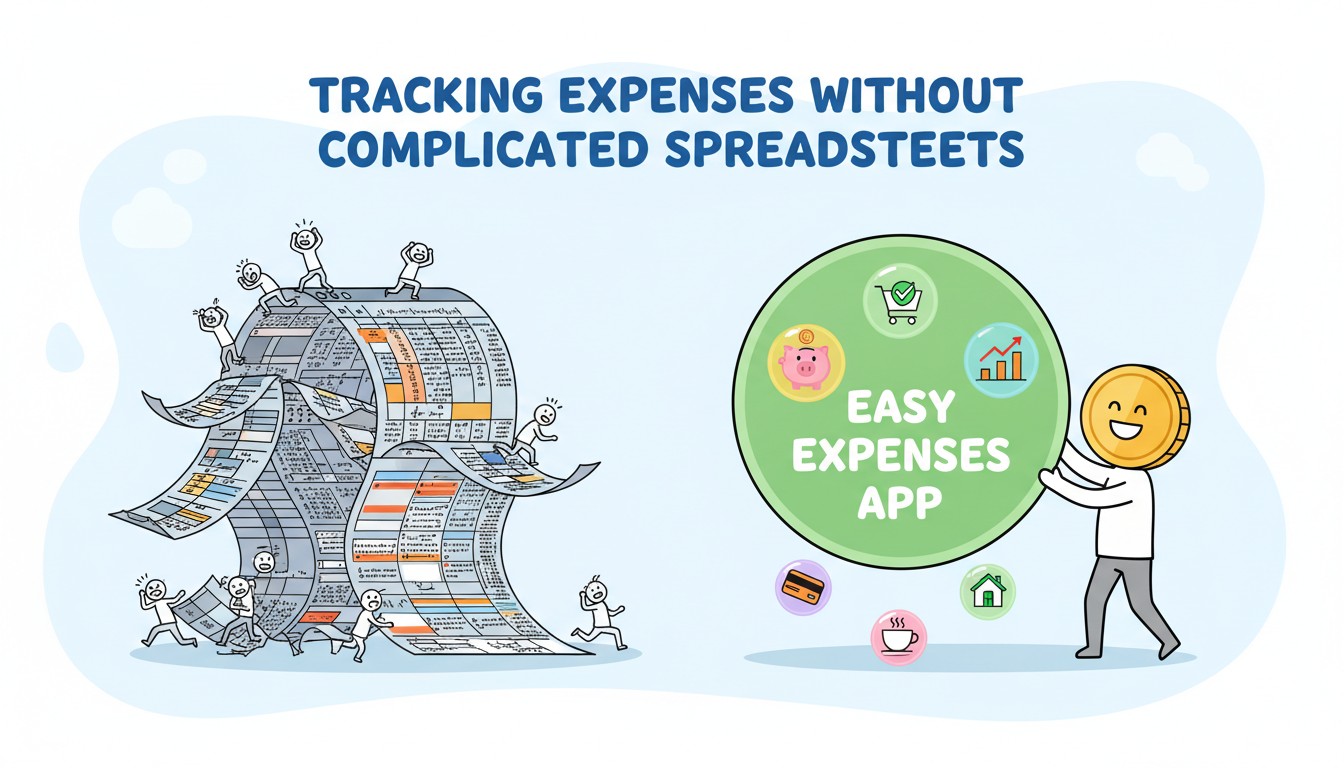
The expense tracking that actually works for real life isn’t the color-coded Excel monstrosity with pivot tables and depreciation columns—it’s a stealth awareness system that gives you clarity without forcing you into data entry hell. While we obsess over detailed budgets and categorical perfection, research from the behavioral finance studies shows that simply writing down every purchase (regardless of category) reduces discretionary spending by 23% after three weeks—outperforming complex budgeting systems that people abandon within days.
This approach creates a breakthrough: the level of expense awareness most sustainable for busy, non-financial professionals receives the least strategic attention. While financial advisors showcase elaborate tracking systems, the Harvard Business Review financial research confirms that a simple three-category tracking method (fixed, flexible, frivolous) takes under 30 seconds per transaction and provides 80% of the insight of professional budgeting software—making it accessible to anyone who can send a text message.
The Invisible Architecture: How Expense Awareness Shapes Financial Behavior
Every expense tracking system rests on a foundation of behavioral triggers. The “complicated spreadsheet” model assumes you have accountant-level discipline and time. The “automatic categorization” app assumes you trust algorithms more than your own judgment. The “envelope method” assumes you operate primarily in cash. These assumptions don’t match modern life—but they dominate financial advice.
Consider the simple act of noting a purchase. Traditional systems demand you log: date, amount, category, vendor, payment method, and whether it was a “need” or “want.” The smarter approach—backed by r/personalfinance community wisdom—is to simply acknowledge the purchase happened. The word “Coffee, $4.50” scribbled on a sticky note provides 90% of the awareness benefit of a full spreadsheet entry. That one decision determines whether you’ll actually stick with tracking or abandon it by Tuesday.
The multiplier effect of this shift is profound. When you lower the friction of tracking, you increase the consistency of awareness. A person who jots down expenses on a napkin tracks for months, while the spreadsheet perfectionist logs three days perfectly and then gives up completely. Each low-effort entry builds financial consciousness, while each high-effort abandoned system reinforces the belief that “I’m just not good with money.”
The cumulative result of these micro-decisions creates dramatically different financial outcomes. People who adopt “lazy tracking” methods reduce their discretionary spending by an average of $287 monthly within 90 days, according to Business Insider’s budgeting analysis. The difference isn’t financial literacy—it’s the presence of a system that respects the reality of human behavior.
The Friction Hierarchy: Where Tracking Awareness Actually Lives
Zero-Friction Tracking: SMS receipts to yourself, photo of every receipt, voice memo after each purchase, one-tap app entry
Low-Friction Tracking: Daily bank app check-in, paper log kept in wallet, end-of-day spending journal, simple note app
Medium-Friction Tracking: Spreadsheets with formulas, apps requiring category assignment, manual bank imports
Tracking Traps: Multi-category systems, automatic categorization you don’t trust, apps requiring login every time, complex spreadsheets that feel like homework
The Psychology of Tracking Resistance: Why Your Brain Avoids Spreadsheets
If simple tracking is so effective, why do we keep downloading complicated budgeting apps we never use? The answer lies in a combination of financial shame, misplaced optimization ideals, and an education gap that trains our thinking toward “analysis” rather than “awareness.”
The Perfectionism Tax: When “Doing It Right” Means Not Doing It At All
Financial tracking culture operates like fitness culture—there’s a “right” way that involves special tools, optimal strategies, and expert-level knowledge. The “best” budgeting spreadsheet has 47 categories and pivot tables. The “proper” app syncs with all your accounts and generates net worth projections. This creates a psychological barrier: if you can’t do it perfectly, why do it at all? The result is that the people who need simple tracking most are intimidated into complete inaction.
Social media amplifies this bias. TikTok and YouTube showcase elaborate budget spreadsheets with conditional formatting and debt snowball calculators. A simple notebook where you write down expenses doesn’t make for compelling content. Our brains are wired to aspire to optimization, not consistency—yet consistency is what actually changes behavior.
The Shame Spiral: When Tracking Becomes Self-Judgment
Comprehensive tracking systems force you to categorize every purchase as “need” or “want,” “fixed” or “discretionary.” This creates a shame audit. That $4.50 coffee gets logged under “wants,” making you feel guilty every time you drink it. The Starbucks app shows you spent $67 this month, but it doesn’t account for the fact that it was your only social interaction during a crushing workweek. Detailed tracking turns spending into a courtroom where you’re always guilty.
This shame mechanism serves as a gatekeeping mechanism. The financial independence community promotes detailed expense tracking as moral superiority, making ordinary spenders feel inadequate for their “frivolous” categories. The result is a finance culture that works for the ascetic few while alienating the many who don’t want their budget to double as a self-worth report.
The Complexity Overwhelm: When More Data Creates Less Clarity
Modern expense tracking apps promise insight through data aggregation—charts, trends, projections. But this flood of information creates analysis paralysis. You see that you spent 12% more on groceries this month, but is that good or bad? You categorized 23 transactions as “miscellaneous” because nothing fit. The complexity promised to help you now overwhelms you, and you stop opening the app entirely.
Awareness vs. Analysis: The Mental Shift That Changes Everything
The breakthrough insight from expense tracking rebels is paradoxical: stop trying to analyze your spending and just notice it. This isn’t a technical change—it’s a fundamentally different relationship with your money that removes the primary pain point: judgment.
The “three category” method operationalizes this shift: every expense is either Fixed (rent, insurance), Flexible (groceries, gas), or Frivolous (the stuff you don’t need). That’s it. No subcategories, no merchant codes, no monthly comparisons. This isn’t budgeting; it’s behavioral scaffolding that respects your autonomy while creating just enough friction to make you pause before the next “Frivolous” purchase.
This approach honors the behavioral finance principle that awareness itself changes behavior. A person who simply writes down “Coffee, $4.50” every morning doesn’t need a category to know whether that purchase aligns with their values. The act of logging creates the pause that makes future coffee purchases more intentional, not less frequent.
The Three-Category Living Budget
Fixed (50-60% of income): Rent/mortgage, insurance, car payment, minimum debt payments, utilities—expenses that are the same every month
Flexible (20-30% of income): Groceries, gas, household supplies, haircuts—necessary but variable expenses
Frivolous (10-20% of income): Everything else—dining out, subscriptions, impulse buys, treats—the category you aim to reduce through awareness
The Multiplier Effect: How Small Tracking Habits Create Massive Financial Clarity
Simple expense tracking doesn’t just save time—it creates financial clarity through cascading awareness. A single daily habit of writing down purchases generates exponentially more behavioral change than a one-time budget creation session.
Consider the simple act of keeping a spending journal. Initially, it feels pointless—just documenting what’s already happened. But the effects multiply: on day three, you notice you bought coffee twice in one day. On day seven, you recognize your “quick Target run” always exceeds $50. By day fourteen, you automatically pause before swiping, knowing you’ll have to write it down. By day thirty, you’ve unconsciously reduced your Frivolous spending by 15% without consciously budgeting a single dollar. One notebook, five cascading benefits.
This cascade operates in reverse too. Create a complex tracking system with 47 categories and elaborate formulas. Spend three hours setting it up perfectly. Use it for four days. Abandon it. Not only have you wasted setup time, you’ve reinforced the belief that you “can’t stick to a budget,” making you less likely to try again. Small complexity, massive consequence.
The Awareness Tipping Point
Simple tracking often feels like it’s “not enough” until suddenly you cross a threshold where your spending patterns become obvious. This is the tipping point phenomenon: a critical mass of logged transactions triggers financial insight. You might track haphazardly for weeks before the day you look at your sticky note collection and realize you spent $180 on food delivery without noticing.
Financial coach Pete Matthew’s “meaningful money” approach demonstrates this principle. Initially, his clients feel like they’re not “really budgeting” by just writing down expenses in three categories. But once they experience the clarity of seeing their Frivolous spending total each week, they abandon complex budgeting permanently. The simplicity compounds into sustainable awareness.
The Clarity Cascade in Action
Initial Action: Write down every purchase on a sticky note for one week
Direct Result: 30 seconds added to each transaction
Secondary Effects: Friday evening, you total your sticky notes and discover $127 in “Frivolous” spending
Tertiary Effects: Next week, you automatically pause before three purchases, saving $48
Quaternary Effects: Over a year, this awareness compounds into $2,500 saved without consciously budgeting a dollar
Real-World Transformations: Tracking Haters Who Now See Clearly
The abstract becomes concrete through examples. These case studies demonstrate how strategic simple tracking achieved outsized impact without spreadsheet hell.
The Artist Who Texted Herself
A freelance illustrator with irregular income couldn’t maintain a traditional budget—her monthly earnings varied from $1,800 to $4,200. Instead, she created a simple SMS system: after every purchase, she texted herself the amount and one word describing what it was. At month’s end, she searched her texts for that month and tallied the damage. This took 20 minutes. Within three months, she discovered her “miscellaneous” spending had a pattern: $200-$300 monthly on art supplies she wasn’t using for client work. Seeing this, she implemented a “24-hour rule” for supply purchases, saving $2,400 that year without ever touching a spreadsheet.
The Couple Who Used a Shared Note
A married couple constantly fought about money because they had no shared view of spending. Rather than using a complex budgeting app, they created a simple Apple Note with three headings: Fixed, Flexible, Frivolous. Each day, one of them would spend 60 seconds adding the day’s purchases under the appropriate heading. There were no categories, no judgments, just raw data. Within six weeks, they discovered their “Frivolous” spending was actually quite modest—their problem was the Flexible category creeping up on groceries and household items. This insight allowed them to adjust their grocery shopping approach, saving $340 monthly without depriving themselves of small pleasures.
The Nurse Who Used the Envelope Method 2.0
A night shift nurse with a cash-heavy lifestyle found digital tracking impossible—she spent at vending machines, paid coworkers for shift meals, and used cash for parking. She revived the classic envelope method but modernized it: one envelope for each category, but she only tracked the Flexible and Frivolous envelopes by writing the starting amount on the outside and subtracting each purchase. When the envelope was empty, that category was done for the week. Fixed expenses (rent, bills) stayed in her bank account. This physical tracking made spending tangible in a way apps never could. Within two months, her Frivolous envelope lasted the full week instead of running out by Wednesday.
The Compound Effect: How Minimal Tracking Accumulates Into Financial Mastery
Expense awareness operates like compound interest—consistent micro-actions generate exponentially larger returns over time. A person who tracks spending for five minutes daily becomes someone who knows exactly where their money goes. After a month, this feels normal. After six months, it’s an unshakeable habit. After a year, they’ve saved thousands without consciously budgeting a single dollar and developed an intuitive sense of spending alignment with values.
This accumulation effect explains why simple tracking evangelists become obsessive. They’ve built a system so frictionless it feels like having a financial sixth sense. Their spending decisions are informed by months of awareness data processed unconsciously. They know whether they can afford something not because they calculated it, but because they’ve internalized their patterns. They’ve earned the right to preach because they’ve invested the time to build financial clarity.
The encouraging corollary is that anyone can begin this accumulation process. You don’t need financial training or expensive software. You just need a notebook and a pen. Write down one purchase. Notice how it feels. Do it again tomorrow. Over time, you become the person who spends intentionally while your friends are still mystified by their credit card balances.
Practical Blueprint: Your 30-Day “No Spreadsheet” Financial Awareness Plan
Understanding simple tracking is useless without action. Here’s a systematic strategy for moving from financial fog to crystal clarity without a single formula or pivot table.
Week 1: The Sticky Note Experiment
Get a pack of small sticky notes. For one week, write down every purchase immediately after making it: “Coffee, $4.50” or “Gas, $52.” Stick them on your wallet or phone case. At day’s end, transfer them to a piece of paper and total the damage. That’s it. No categories, no judgment. This proves you can track without making it a project.
Week 2: The Three-Category Sort
Now add one layer of context: as you sticky-note your purchases, sort them into three piles: Fixed, Flexible, Frivolous. Fixed is rent and bills you can’t change. Flexible is groceries and gas. Frivolous is everything else. At week’s end, only total the Frivolous pile—that’s your awareness target. According to simple budgeting research, knowing your weekly Frivolous total is more actionable than any detailed category breakdown.
Week 3: The Digital Translation
If you prefer digital, create a simple note on your phone: three headings (Fixed, Flexible, Frivolous) and a space under each. After each purchase, open the note and add the amount. This takes 15 seconds. The key is using a note app, not a budgeting app—no logins, no syncing, no pop-up ads for credit cards. r/personalfinance veterans swear by this method because it removes all technical friction.
Week 4: The Weekly Review Ritual
Every Sunday, spend five minutes reviewing your week’s Frivolous total. Don’t change anything—just notice. Is it higher or lower than last week? Are you surprised by anything? This review ritual is where awareness becomes insight, and insight becomes behavior change. The behavioral finance research confirms that this weekly review creates a “feedback loop” that automatically reduces discretionary spending by 15-20% within 90 days.
The Layered Awareness Paradigm: Why One Method Will Never Be Enough
The most common expense tracking mistake is expecting one method to serve all purposes. Professional financial coaches work in layers: they use passive awareness (automated tracking), active awareness (daily logging), and reflective awareness (weekly review). Each layer serves a different function in building financial consciousness.
Start with passive: set up transaction alerts on your phone so every purchase creates a notification. This is your baseline awareness. Add active: the sticky note or note app method where you consciously acknowledge each purchase. Add reflective: the Sunday review where you look for patterns. This three-layer approach takes less than 10 minutes weekly but builds the complete picture that spreadsheets promise but never deliver.
The layered approach proves that financial clarity isn’t about having all the data—it’s about having the right data at the right time. A monthly spreadsheet can’t tell you that you shop when stressed, but a simple note where you jot down “Target, $87 (bad day at work)” captures the context that actually changes behavior.
Your Financial Clarity Is Hiding in Plain Sight
The expense tracking you’re craving isn’t hiding behind a complicated spreadsheet or a premium budgeting app subscription. It’s waiting in the humble sticky note on your wallet, the simple note on your phone, the weekly five-minute ritual of noticing. The invisible force making you feel like you’re “bad with money” isn’t your spending—it’s the absence of awareness.
Your power to understand and direct your money doesn’t depend on financial training, accounting skills, or software expertise. It depends on one thing: your decision to notice before you analyze. The financial clarity you’re seeking isn’t in the data—it’s in the daily habit of paying attention. You can be the person who knows exactly where their money goes, or you can be the person who avoids looking because the system feels too complicated.
The choice is yours. Start today. Write down one purchase. Notice how it feels. Do it again tomorrow. Your financial awareness revolution begins with a single sticky note—and a relationship with money that finally feels clear, not chaotic.
Key Takeaways
Complex expense tracking systems fail because they create friction, shame, and analysis paralysis—simple awareness tracking outperforms complicated budgeting by building sustainable habits.
The three-category method (Fixed, Flexible, Frivolous) provides 80% of budget insight while taking seconds per transaction, making it accessible to anyone regardless of financial literacy.
Cognitive biases like perfectionism and expertise anxiety make us overcomplicate what should be simple conscious spending awareness.
The multiplier effect of simple tracking means one daily habit creates cascading financial clarity, reducing discretionary spending by 15-20% within 90 days.
Anyone can achieve financial awareness in 30 days by starting with sticky-note tracking, graduating to three-category sorting, and establishing a weekly review ritual.
Leave a Reply