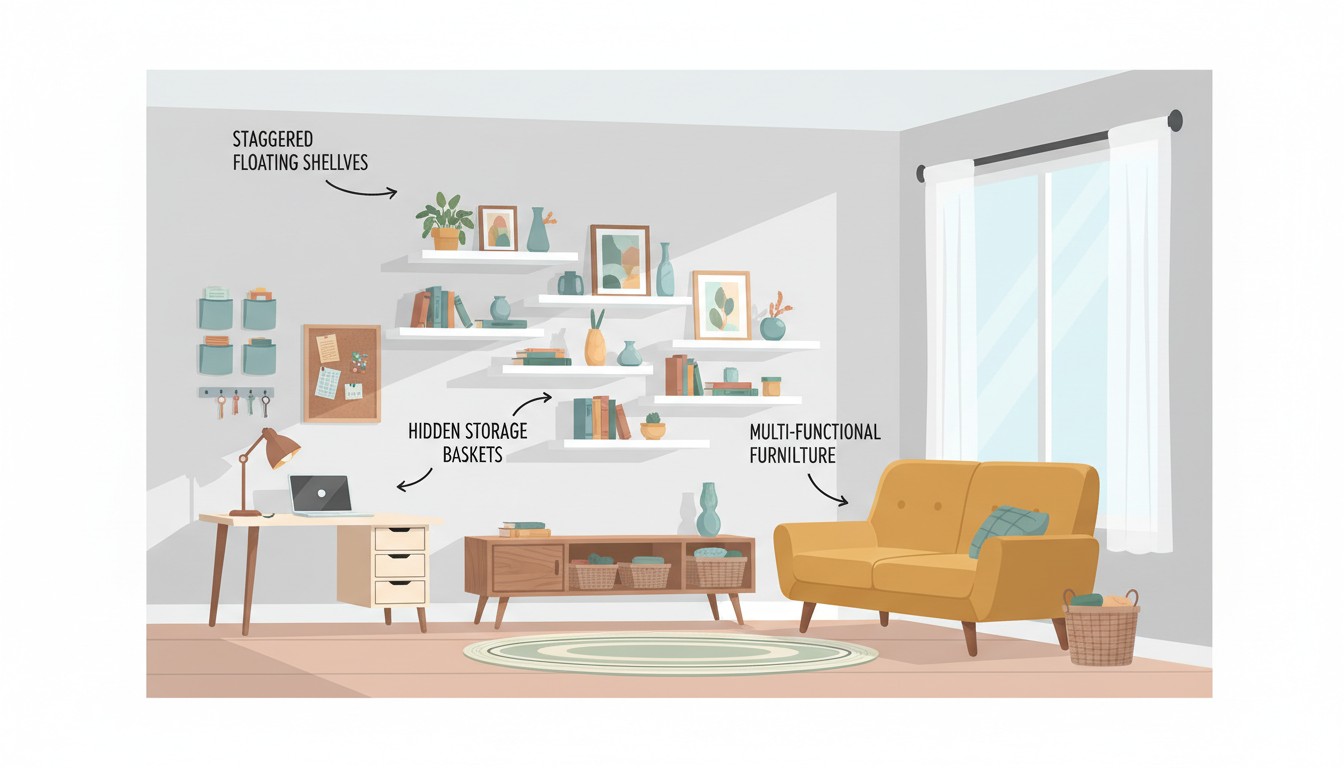
The small-space organization industrial complex has convinced us that more storage equals better living. But the result is often a home that feels like a logistics center—bins, baskets, and labels everywhere, creating visual noise that paradoxically makes spaces feel smaller and more chaotic. Research from Apartment Therapy’s small space guide reveals that visual clutter increases perceived stress by 40% in compact environments, yet most storage solutions add more visual elements rather than subtracting them.
The breakthrough insight: aesthetic organization is actually more functional. When storage looks intentional—like decor rather than utility—you’re more likely to maintain it. When everything has a designated, beautiful place, you stop accumulating clutter. The pegboard that displays your copper pots becomes art. The ladder that holds throw blankets becomes architecture. The tissue box that stores plastic bags becomes invisible.
This comprehensive guide maps the principles of invisible storage, room-by-room aesthetic solutions, and the critical “one in, one out” rule that professional organizers use to prevent the storage unit aesthetic.
The Core Principles: Storage That Disappears
Before diving into specific solutions, understand the architectural philosophy that separates organized from oppressive. Professional organizers from House Beautiful’s organizing feature emphasize that “you don’t need more bins, you need less stuff”—the foundation of aesthetic storage is brutal curation.
Principle 1: Vertical = Visual Architecture
Standard advice says “use vertical space.” Aesthetic storage says “vertical space IS your architecture.” A ladder leaning against the wall isn’t a storage hack—it’s a design element that happens to hold throw blankets . A pegboard painted sage green with copper hooks doesn’t read as organization—it reads as a curated gallery wall that holds your plants, cookbooks, and coffee mugs .
The key is treating vertical storage as intentional display rather than desperate utility. Wall-mounted shelves should have a 60/40 rule: 60% functional items, 40% decorative objects. This visual breathing room prevents the “warehouse” effect.
Principle 2: Transparency Is Terrifying (and Liberating)
Round baskets look Instagram-worthy, but professional organizer Danica Carson warns they “reduce storage efficiency” because they only touch at one point . Worse, they hide contents, leading to “out of sight, out of mind” accumulation. The aesthetic solution: straight-edged, clear containers that line up perfectly and let you see what you own .
When you can see everything, you realize you have three half-used lotions and five orphan gloves. Visibility is the first step toward the radical decluttering that makes small spaces feel spacious.
Principle 3: Furniture Must Have Secret Identities
Every piece of furniture in a small space must perform at least two jobs. An ottoman with a hidden compartment stores throw blankets and serves as extra seating . A Murphy bed folds away to create a home office . A nightstand with drawers designed for shoes frees closet space while looking like standard furniture .
The aesthetic trick: the secondary function should be invisible. The shoe storage nightstand shouldn’t have a label that says “shoes”—it should just be a beautiful nightstand that happens to hold your footwear.
Room-by-Room Aesthetic Organization
The Entryway: First Impression, First Function
The entryway sets the tone for your entire home. Traditional advice says “add a console table with baskets.” Aesthetic advice says “create a mini mudroom that looks like a design choice.” Use a narrow bench with built-in divided cubbies underneath for shoes . Above, Add compartments with matching bins (not mismatched baskets) for keys, mail, and dog leashes. The key is coordination: same color bins, same style hooks, everything feels intentional.
For apartments without an entryway, wall-mounted organizers create the illusion of one. A slim floating shelf for keys and mail, plus hooks for coats, transforms a blank wall into a drop zone that looks curated, not cluttered . Paint the wall a deep accent color behind it so the functional items pop as intentional design elements.
The Kitchen: Where Function Becomes Sculpture
Kitchen storage fails when it prioritizes hiding over displaying. The magnetic organizer on your refrigerator’s side isn’t just storage—it’s a vertical sculpture that holds salt and pepper shakers, paper towels, and spices . Choose copper canisters, glass jars with uniform labels, and wooden utensils that create a monochromatic palette.
The pegboard revolution: a wall-mounted pegboard painted to match your kitchen walls holds pots, pans, and utensils. It looks like intentional industrial design, not desperate storage . The trick is spacing—don’t cram every hook with items. Leave 40% empty to create visual breathing room.
For awkward corners, install shallow shelves alongside the refrigerator to store paper bags, homework folders, and tablets. Add an outlet on the shelf for charging devices, and use the back of the door for chore charts . When closed, it’s invisible. When open, it’s a command center.
The Bathroom: Minimalism as Luxury
Small bathrooms become storage nightmares because we hide clutter instead of eliminating it. The aesthetic solution starts with brutal editing: “extra lotions, hair products, and small samples rarely get used” . Keep only what you love and use daily.
For what remains, use a hair dryer holder that fits over the cabinet door—cords stay tidy, and the tool is accessible but invisible . Install a magnetic strip inside the medicine cabinet door for bobby pins and tweezers. Use clear, straight-edged bins under the sink so you can see supplies without rummaging .
The over-the-toilet area is prime vertical real estate. A narrow shelving unit with matching baskets stores towels and toiletries while looking like intentional design . Choose baskets in a single color family (all natural wicker or all white) to avoid visual chaos.
The Bedroom: Where Storage Becomes Sanctuary
The bed is your largest storage opportunity. A frame with built-in drawers eliminates the need for a dresser, freeing floor space . For existing beds, use shallow bins for shoes and out-of-season clothes—choose bins with lids that slide smoothly and match your bedding color.
Nightstand clutter is the enemy of serenity. Replace a standard nightstand with a small dresser—three drawers for pajamas, reading materials, and personal items eliminate surface clutter . If space is extremely tight, a wall-mounted shelf with a built-in drawer provides storage without floor footprint.
Closet optimization requires the 60/40 rule again: 60% of hanging space for clothes, 40% for visual breathing room. Use slim, matching hangers in a single color. Add a tiered rack for shoes that also holds sweaters or handbags—multipurpose storage that looks intentional .
The “One In, One Out” Rule: The Only Organizing System That Matters
Professional organizers agree: no storage system works without the one-in, one-out rule. For every new item you bring into your small space, one item must leave . This isn’t about minimalism—it’s about maintaining the visual clarity that makes aesthetic storage possible.
The rule applies to everything: new shoes mean old shoes get donated. New kitchen gadget means an old one gets rehomed. This prevents the gradual accumulation that turns beautiful organized systems into cluttered storage units.
The 20/80 Wardrobe Reality Check
Professional organizer Danica Carson reveals the brutal truth: “we typically wear 20 percent of our clothing 80 percent of the time” . Instead of buying more storage for clothes you never wear, edit down to the 20% you love and find a few supporting pieces. The freed space becomes breathing room, not storage.
Decorative Disguises: Storage That Looks Like Art
The ultimate aesthetic storage hack is making storage disappear into decor. These solutions hide function so completely that guests don’t recognize them as organization.
The Bicycle Gallery
Instead of hiding your bike in a closet, mount it on the wall with a decorative bracket. The bike becomes a sculptural element. Add a small shelf below for your helmet and lock—suddenly it’s a curated vignette, not clutter .
The Ladder Library
An old wooden ladder leaning against the wall becomes a bookshelf for magazines and throws. Paint it the same color as your walls to make it recede visually. The rungs become display ledges for plants and small objects .
The Curtain Concealment
Install a tension rod with a decorative curtain under your kitchen sink or in an open closet. The curtain hides cleaning supplies or clothing while adding texture and color to the room .
What to Avoid: The Storage Unit Aesthetic
Even well-intentioned organization can create a storage unit vibe if you commit these design sins:
🚫 Clear Plastic Bins Everywhere: They scream “I gave up.” Use opaque, matching containers
🚫 Mismatched Baskets: Different colors, shapes, and materials create chaos. Choose a family
🚫 Label Everything: A wall of labels is visual noise. Use clear containers instead
🚫 Over-the-Door Shoe Racks: Functional but ugly. Use a slim shoe cabinet instead
🚫 Too Many Systems: Pegboards + shelves + baskets = storage unit. Pick one visual system
The 30-Day Storage Transformation
Transforming your small space from storage unit to sanctuary doesn’t happen overnight. Here’s the 30-day sprint:
The 30-Day Storage Sprint
Days 1-7 (Purge): Remove 50% of your belongings using the 20/80 rule. If you haven’t used it in 6 months, it goes.
Days 8-14 (Plan): Choose ONE storage system per room (pegboard, floating shelves, or cabinets). Measure twice.
Days 15-21 (Install): Install storage. Buy matching containers in ONE color family.
Days 22-30 (Refine): Edit the final 10%. Remove anything that doesn’t fit your new aesthetic system.
Storage as Self-Expression: The Ultimate Luxury
In a small space, every storage decision is a design decision. That tension rod you install in a cabinet to hold trash bags—is it chrome to match your faucet, or black to match your hardware? The adhesive hooks on the back of a cabinet door—are they copper to add warmth, or white to disappear?
These micro-decisions accumulate into an atmosphere. When storage is chosen with the same eye as decor, your home feels intentional, not accidental. It feels like you, not a storage unit.
The ultimate small-space luxury isn’t more square footage—it’s the confidence that everything you own has a beautiful, designated place. That confidence radiates from the pegboard that displays your copper pots, the ladder that holds your throw blankets, the nightstand that stores your pajamas without revealing a single visual clue of its function.
Your Storage Is Your Story
Every storage choice you make in a small space tells a story about what you value. A wall of clear plastic bins says “I value utility over beauty.” A pegboard painted sage green with copper hooks says “I believe function should be beautiful.”
Small spaces don’t have the luxury of hiding mess. They force you to curate, to choose, to display only what you love. This isn’t a limitation—it’s an invitation to live more intentionally.
Choose storage that disappears into your decor, not storage that dominates it. Choose visibility over hidden clutter. Choose fewer, more beautiful things over more, uglier bins. Your small space will feel like a gallery, not a warehouse. And you’ll breathe easier for it.
Leave a Reply