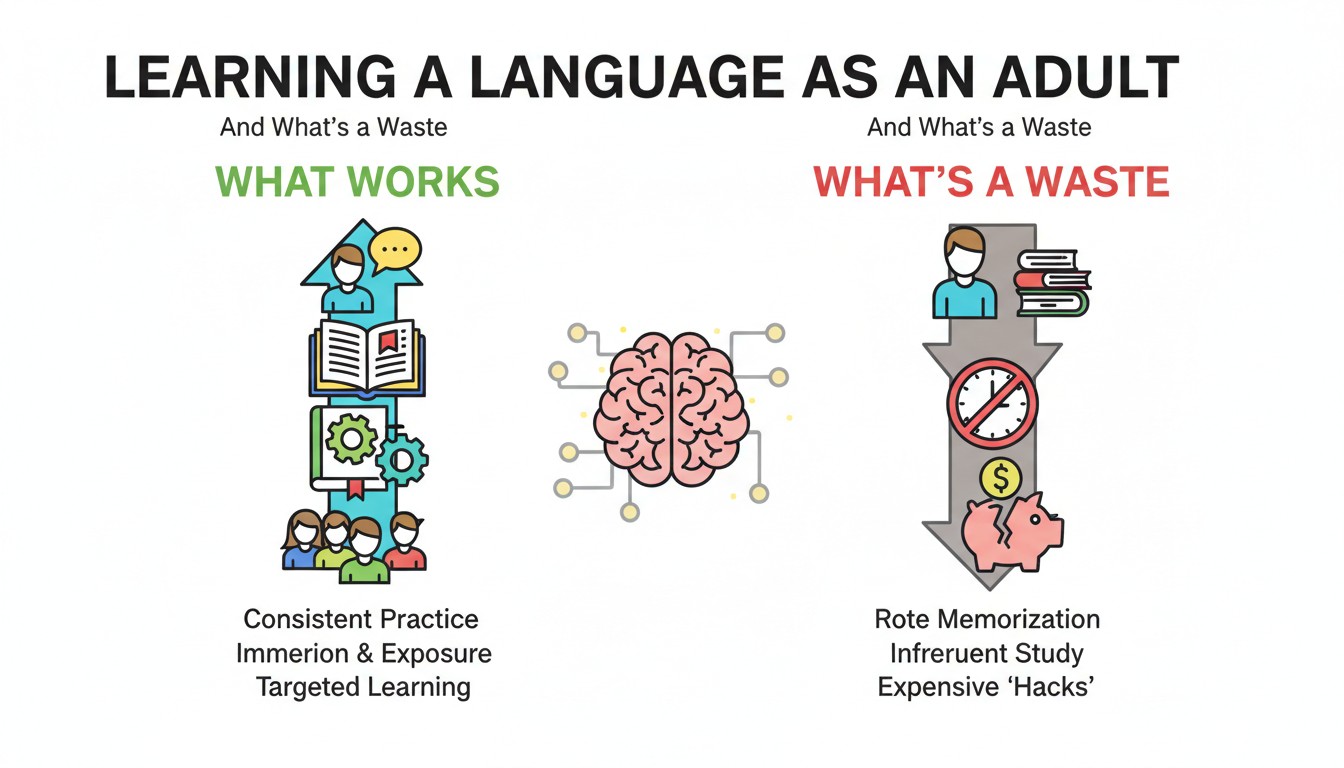
Adult language learners face a unique neurological disadvantage. Unlike children whose brains are plastic and forgiving, adults have fully myelinated neural pathways that harden through repetition—correct or incorrect. Research from adult language acquisition studies confirms that simply “speaking more” without structured correction creates fossilized mistakes that can persist for decades. The language learning industry, worth billions, often sells adults the comforting lie that immersion alone will lead to fluency. But for those past the critical learning period, this approach leaves dangerous gaps.
The science is clear: adults need different methods than children. While kids absorb languages through osmosis and social play, adult brains require explicit structure, deliberate error correction, and biological optimization. What feels natural—jumping into conversation, learning through context, watching Netflix with subtitles—often creates the illusion of progress while ingraining mistakes. The effective methods are counterintuitive and require more discipline, but they deliver results in months rather than years.
The Neuroscience of Adult Language Learning
Myelination: Why Mistakes Become Permanent
Every time you speak, your brain wraps myelin—a fatty insulation—around the neural pathways you use. This makes the pathway faster and more efficient, but also more permanent. As language tutor Yuri explains after 20,000+ hours of teaching, repeated mistakes become **fossilized** in the brain. The neuroscience is straightforward: if you keep saying “putted a booger,” those incorrect neural connections strengthen until they feel natural. Unlearning requires rewiring, which takes 3-5 times longer than learning correctly from the start.
Echoic Memory: The 2-4 Second Window
Your brain’s echoic memory holds auditory information for 2-4 seconds. This brief window is critical for language acquisition. When you immediately repeat a phrase after hearing it, you capture the pronunciation, rhythm, and stress patterns before they fade. As Yuri’s teaching methodology demonstrates, immediate repetition using echoic memory is far more effective than delayed practice. The sooner you repeat after hearing native speech, the more accurate your brain’s match will be.
What Doesn’t Work: The Adult Learning Traps
“Just Talk More” Without Correction
This is the most seductive and damaging myth for adult learners. Yes, conversation helps build fluency, but if you’re reinforcing the same mistakes, you’re not improving—you’re automating errors. Yuri’s experience with long-term immigrants proves this: many who’ve lived in English-speaking countries for decades still make basic errors like “What means this?” because they practiced the wrong pattern thousands of times. Without immediate correction, practice doesn’t make perfect—it makes permanent.
Pure Immersion Without Structure
Stephen Krashen’s Input Hypothesis suggests we absorb language through comprehensible input, and this works beautifully for children. Adults, however, need more direct intervention. The silent period that works for children isn’t practical for adults who must speak at work or navigate daily life. Immersion is powerful for vocabulary growth, but it doesn’t fix grammar mistakes unless paired with structured drills and feedback.
Extensive Reading Before Mastering Pronunciation
Reading too early creates a disconnect between written and spoken language. If your ears aren’t trained to recognize natural speech patterns, you develop a mental voice that mispronounces words based on spelling. As Yuri’s method emphasizes, ear training must come first. Focus on listening, pronunciation, and imitation before worrying about spelling. Once your ears recognize correct patterns, reading becomes a tool, not a crutch.
What Actually Works: Evidence-Based Methods for Adults
Structured Translation (The Grammar-Translation Revival)
For absolute beginners, verbal translation from your native language builds a foundation quickly. This method—dismissed as outdated for children—is highly effective for adults who can analyze grammatical differences. Yuri uses this approach to help students notice articles, tenses, and word order immediately. The key is high volume: translating many simple sentences exposes your brain to patterns, allowing it to adapt naturally to constructing English sentences correctly.
Audio-Lingual Drills for Pronunciation
The audio-lingual method—listen, imitate, repeat—engages mirror neurons for immediate imitation. But adult brains need more than mindless repetition. The effective approach is breaking sentences into small linking blocks: “ʃ-you,” “missh-you,” “Miss-you so much!” These chunks train your mouth to form correct sounds before combining them into full sentences. As adult learning research confirms, short, frequent practice sessions are more effective than long, infrequent cramming because they work with your brain’s natural learning rhythms.
The Fluency Approach (Guided Dialogues)
Once you have a solid foundation, structured fluency exercises accelerate progress. This method presents a scenario—”My friend Mia took a road trip to a music festival”—then asks immediate questions: “Who went?” “Where did she go?” You respond in real-time, then hear and imitate the correct answer. Yuri describes this as a dress rehearsal for real conversations. The immediate feedback prevents error fossilization while building confidence. This approach is particularly effective for adults because it combines structure with real-time application.
Spaced Repetition for Vocabulary Retention
One of the most effective strategies for adult learners is spaced repetition—reviewing new words shortly after learning, then at increasing intervals. Research on adult language acquisition confirms this approach is akin to nurturing seeds in a garden; consistent attention over time leads to stronger, more resilient language skills. Your brain strengthens neural connections during sleep, which is why daily practice is essential. The hippocampus replays language patterns during deep sleep, transferring them to long-term memory.
Leveraging Your Native Language
Adult learners have a powerful tool children lack: existing linguistic knowledge. By drawing parallels and recognizing similarities between your native language and English, you navigate new concepts more effectively. Tailoring learning experiences to connect with your native language enhances understanding and retention. If your language has similar sentence structures, capitalize on that. If it doesn’t, consciously note the differences.
The Biological Optimization Layer: Setting Your Brain Up for Success
Sleep: The Unsung Hero of Language Learning
Your brain processes and strengthens new language patterns during deep sleep. After a day of practice, the hippocampus replays those patterns, transferring them to long-term memory. Poor sleep equals poor learning. You cannot skip sleep and expect to retain vocabulary or grammar. Seven to eight hours of quality sleep isn’t a luxury—it’s a biological requirement for language acquisition.
Nutrition and Hydration: Fuel for Neural Plasticity
Your brain is a biological machine. Sleep-deprived, stressed, or malnourished brains simply don’t learn as effectively. While the language learning industry rarely mentions this, proper nutrition and hydration significantly impact learning outcomes. The brain requires specific nutrients to build myelin and create new neural pathways. This isn’t pseudoscience—it’s basic biology that directly affects your ability to acquire language.
The Psychology of Adult Learning: Overcoming Anxiety
Adult language learning induces anxiety, particularly in professional settings. Research on workplace language training emphasizes creating a supportive environment where mistakes are seen as part of the learning process, not failures. Regular encouragement and positive reinforcement alleviate fears, making learners feel more confident and willing to practice.
The key is structured risk-taking. Practice mistakes in low-stakes environments (drills with a tutor) before high-stakes situations (work presentations). This builds confidence through competence, not false praise.
Realistic Timelines: What to Expect
With the blended method—translation, drills, fluency exercises, and real conversation—adults can achieve conversational competence in 6-12 months of daily practice (30-60 minutes). This timeline assumes:
- 7-10 days of consistent practice to transfer patterns to long-term memory
- Daily practice (even 15 minutes) with no skipped days
- Quality sleep and reasonable nutrition
- Weekly feedback from a tutor or native speaker
Pure immersion without structure often takes 2-3 years to reach the same level, and even then, fossilized errors persist. The difference isn’t talent—it’s method.
The Bottom Line: A Method That Respects Adult Brains
Adult language learning isn’t harder than child learning—it’s different. Children learn through social play and absorption. Adults learn through analysis, structure, and deliberate practice. The methods that work exploit your brain’s strengths: its ability to recognize patterns, its capacity for focused repetition, and its need for immediate feedback.
The waste is anything that lets you practice mistakes without correction. The gold is anything that forces accuracy before fluency. Start with translation, lock in pronunciation with drills, build fluency through guided dialogues, then apply it in real conversations while optimizing your biology through sleep and nutrition.
Language learning is a process, not a product. When done right, it’s a truly enjoyable journey. The goal isn’t perfection—it’s communication without the anxiety of wondering if you’re accidentally saying “booger” instead of “burger.” Your adult brain can get there, but only if you treat it like the sophisticated learning machine it is, not the sponge it used to be.
Your Brain Is Not Broken—Just Different
The frustration you feel isn’t a sign that you’re too old to learn. It’s a sign that you’re using the wrong method for your brain type. Children are generalists; adults are specialists. Your brain wants structure, analysis, and deliberate practice.
Start small: 15 minutes of drills daily. Focus on accuracy, not speed. Sleep well. Eat well. Find a tutor who corrects you immediately, not one who just nods and says “great job.” Within 30 days, you’ll notice the patterns becoming automatic. Within 90 days, you’ll be having conversations with confidence.
The journey from “putted a booger” to perfect grammar isn’t 10,000 hours away. It’s 100 hours of the right practice, starting today.
Leave a Reply