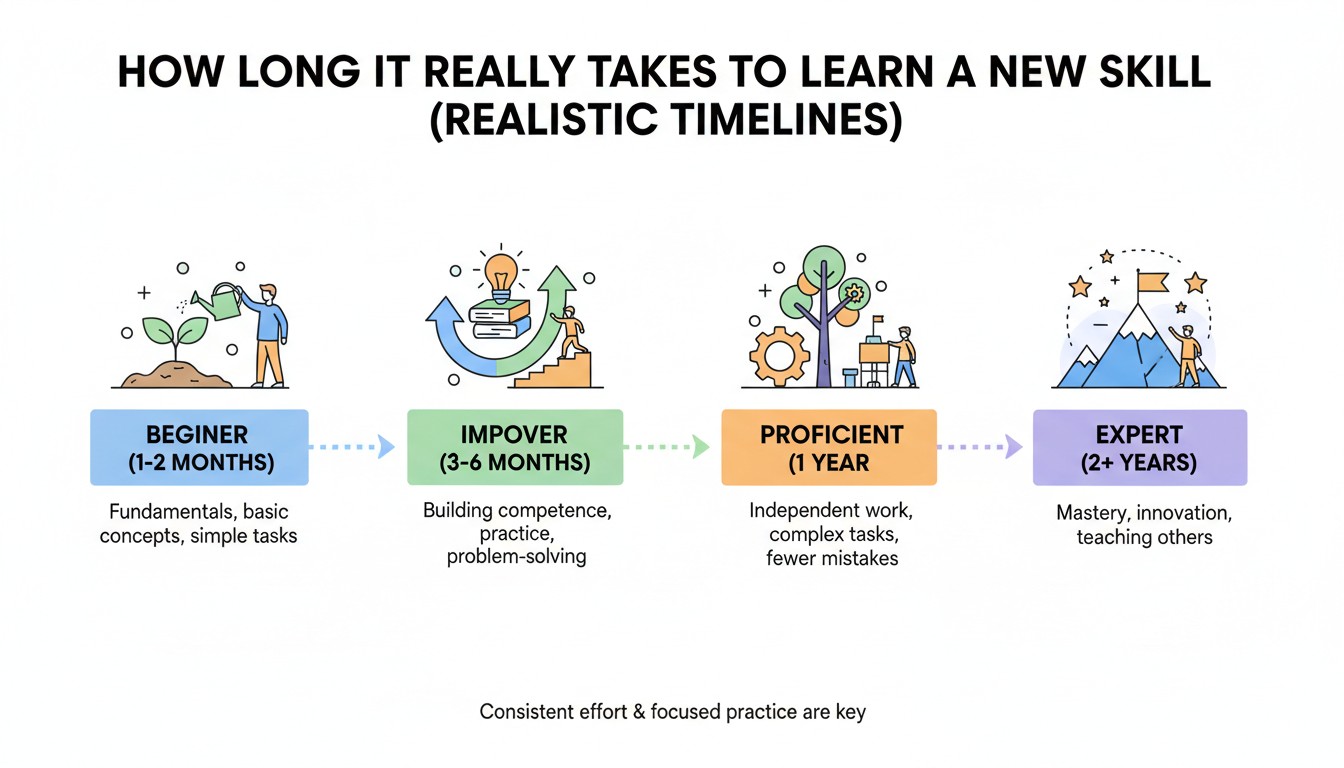
The modern conversation around skill acquisition is dominated by two opposing myths: the 10,000-hour rule, which makes learning sound like a life sentence, and the “30-day mastery” industry, which treats serious skill development like a magic trick. Both are wrong, but both contain fragments of truth. Research from skill acquisition studies reveals that the difference between “good enough” and “world-class” isn’t just time—it’s an entirely different category of effort, intention, and biological predisposition. Understanding which timeline applies to your goal is the difference between sustainable progress and abandoned effort.
The confusion is understandable. When a middle-aged computer consultant with no musical background declares he’ll become the next Jimi Page by logging exactly 10,000 hours on his new Gibson Les Paul, he’s confusing correlation with causation. As one Quora respondent observed, the number of hours matters far less than the quality of those hours and the complexity of the skill itself. You can’t simply exchange time for mastery like a vending machine.
The 10,000-Hour Rule: A Misunderstood Masterpiece
The 10,000-hour rule entered popular consciousness through Malcolm Gladwell’s “Outliers,” but its origins trace to psychologist Anders Ericsson’s research on elite performers. Ericsson studied violinists at the Berlin Academy of Music and found that the most accomplished students had accumulated approximately 10,000 hours of deliberate practice by age 20. The media simplified this to “10,000 hours makes you an expert,” but that’s like saying “marathon runners train for 100 miles per week” and concluding that anyone who runs 100 miles will become an elite marathoner.
Deliberate Practice vs. Mindless Repetition
The critical distinction lies in **deliberate practice**—a specific, structured form of training with clear goals, immediate feedback, and constant push beyond your comfort zone. As Skillsoft’s research highlights, mastery requires 100 hours of intellectual learning and 9,900 hours of practice and refinement. But those 9,900 hours must be purposeful; playing the same three chords badly for 10,000 hours doesn’t make you a guitarist, it makes you someone who’s wasted 10,000 hours.
The Beatles didn’t just play for 10,000 hours—they played **varied sets in diverse venues, received audience feedback, adapted their style, and pushed their creative boundaries**. Bill Gates didn’t just program for 10,000 hours—he had access to a rare time-sharing terminal, wrote code for real-world problems, and received mentorship. The hours matter, but they’re the container, not the content.
The Timeframe Reality Check
At 20 hours per week (a realistic maximum for someone with a job and life), 10,000 hours equals **10 years of dedicated practice**. At 10 hours per week, it’s 20 years. This isn’t a weekend project—it’s a life’s work. And crucially, Ericsson’s research focused on **elite performers in highly competitive fields**. If your goal is to play chess with your children, you don’t need 10,000 hours. You need just enough to enjoy the game.
The 20-Hour Reality: Proficiency Is Closer Than You Think
Josh Kaufman’s book “The First 20 Hours” challenged the 10,000-hour orthodoxy with a radical claim: you can become reasonably competent in most skills in just 20 hours of deliberate practice. That’s 45 minutes per day for about a month, skipping a few days here and there. The learning curve research supports this: improvement is rapid at first, then slows dramatically as you approach your personal asymptote of ability.
The Four Steps to Rapid Acquisition
Kaufman’s framework for rapid skill acquisition is deceptively simple:
Deconstruct the skill: Break it into smallest possible sub-skills. Learning guitar isn’t one skill—it’s learning to hold a pick, fret a note, strum a pattern, read tablature, and dozens of micro-skills. Identify the 20% that delivers 80% of the results.
Focus on high-leverage activities: Don’t practice what you already know. If you want to learn conversational Spanish, don’t spend hours on grammar drills—practice actual conversations, even if you make mistakes. The LinkedIn skill-building guide emphasizes eliminating barriers and creating a conducive learning environment during this phase.
Commit to practice: The 20 hours must be **deliberate and focused**. Watching guitar tutorials while scrolling Instagram doesn’t count. Neither does playing the same three chords you already know while your mind wanders. The practice must be at the edge of your ability, where you’re failing and correcting.
Get feedback fast: Record yourself playing and listen back. Use language exchange apps to have native speakers correct you. Build a simple website and show it to actual users. Feedback tells you what to practice next.
“20 hours is doable—that’s about 45 minutes a day for about a month, even skipping a couple days here and there. 20 hours isn’t that hard to accumulate.” — Reddit discussion on skill acquisition
The Learning Plateau: Why Progress Feels Invisible
The most dangerous phase of learning is the plateau—the period where you’re practicing but not feeling improvement. This typically occurs after the initial 20-hour burst of progress, between weeks 4 and 8. Your brain has automated the basics, but refinement hasn’t begun. This is where most people quit, mistaking the plateau for stagnation.
The Science of Skill Consolidation
During the plateau, your brain is doing crucial work. Myelin, the fatty substance that insulates neural pathways, is thickening around the circuits you’re practicing. This makes the skill faster and more efficient, but it doesn’t feel like progress because conscious effort decreases. As 30-day learning experiments show, this is when consistency matters most. The plateau isn’t a failure of learning—it’s evidence that learning is becoming automatic.
Breaking Through: The 100-Hour Inflection Point
For most skills, 100 hours represents a critical inflection point. You’ve moved from conscious incompetence (you know what you’re doing wrong) to conscious competence (you can do it right, but it requires focus). This is where the skill becomes enjoyable. A guitarist can play songs. A programmer can build functional tools. A language learner can handle basic conversations.
The plateau breaks not through more hours, but through **varied practice**. Instead of playing the same song perfectly, learn a different genre. Instead of coding the same type of app, build something with a new framework. Variation forces your brain out of autopilot and creates new connections.
Realistic Timelines: Skills by Complexity
The timeframes below assume deliberate practice by an average adult with no prior related experience. Adjust based on your starting point and natural aptitude.
Simple Skills (Minutes to Hours)
These are single-action skills with clear feedback:
Learning to tie a tie: 15 minutes of practice. The feedback is immediate—does it look right? Muscle memory forms after 10-15 repetitions.
Brewing pour-over coffee: 2-3 hours across several sessions. You must dial in grind size, water temperature, and pouring technique, but each variable has clear cause-and-effect.
Using basic spreadsheet formulas: 3-5 hours. You can learn SUM, AVERAGE, and VLOOKUP through tutorials and immediate application.
Moderately Complex Skills (20-100 Hours)
These combine multiple sub-skills and require feedback from others:
Conversational Spanish: 40-60 hours (45 minutes daily for 2 months). You need vocabulary, basic grammar, listening comprehension, and speaking confidence. The Skillsoft research notes that it takes 2,200 hours for native English speakers to learn Mandarin Chinese due to complexity, but Romance languages are much more accessible.
Playing guitar chords for simple songs: 20-30 hours. You need finger strength, chord transitions, strumming patterns, and rhythm. The first 10 hours are physically painful as calluses develop.
Basic Python programming: 60-80 hours. You can write functional scripts, understand loops and functions, and debug simple errors. Building anything complex requires crossing the 100-hour threshold.
Highly Complex Skills (500-10,000+ Hours)
These require deep theory, physical conditioning, or competitive refinement:
Competitive chess: 1,500-3,000 hours to reach expert level (ELO 2000). You must memorize openings, study endgames, analyze grandmaster games, and develop pattern recognition across thousands of positions.
Becoming a surgeon: 15,000+ hours including medical school, residency, and specialized training. This combines intellectual knowledge, fine motor skills, and decision-making under pressure. The Skillsoft analysis breaks this into awareness, initial learning, practice, proficiency, and mastery stages, each requiring different time commitments.
Professional-level athletics: 5,000-10,000 hours, but heavily dependent on genetics and starting age. A tennis player who starts at age 4 has a different path than one who starts at 24, even with identical practice hours.
The Practice Quality Multiplier: How to Learn Faster
Two people can practice for 100 hours and achieve vastly different results. The difference is practice quality, which can double or halve your effective learning speed.
Spaced Repetition vs. Cramming
Learning in 45-minute daily sessions over a month is 3x more effective than 20-hour weekend marathons. CareerVillage advice suggests starting with 15-minute daily sessions and gradually expanding. This works because sleep consolidates neural connections. Each practice session builds on the previous night’s consolidation, creating compound learning.
If you must cram (for a deadline), focus on patterns rather than details. Learn the 20% of the skill that handles 80% of situations. For conversational Spanish, that means mastering present tense, basic vocabulary, and common phrases—not subjunctive mood or literary vocabulary.
Expert Feedback vs. Solo Practice
A single hour with a skilled teacher can replace 10 hours of solo practice. Teachers provide immediate correction, preventing you from ingraining mistakes. As the LinkedIn skill-building framework emphasizes, getting feedback from experienced practitioners helps you identify blind spots and adjust your approach. This is why language exchange partners accelerate learning faster than apps alone.
If you can’t afford a teacher, record yourself and compare to experts. Video your golf swing and watch it side-by-side with a pro. Record your Spanish pronunciation and compare to native speakers. This self-feedback is less efficient but still accelerates learning.
The Habit Formation Window: 30 Days to Automaticity
The “21-day habit formation” myth oversimplifies, but there’s truth to the idea that skills become easier to maintain after a month of consistent practice. 30-day learning challenges work because they push you through the initial resistance phase and into a routine. By day 30, the skill feels less like a chore and more like part of your identity.
The Four-Week Skill Sprint
Week 1: Focus on fundamentals. You feel clumsy and overwhelmed. Everything is new. Set micro-goals: learn three chords, master 20 vocabulary words, write one simple function.
Week 2: Practice becomes slightly easier. You stop looking up every instruction. Set project-based goals: play a simple song, hold a 5-minute conversation, build a basic app.
Week 3: You hit the plateau. Progress feels slow. This is the danger zone—many quit here. The key is to change your metric: instead of measuring accuracy, measure consistency. Did you practice every day? That’s the win.
Week 4: Integration begins. You use the skill without thinking. The guitar is out of its case by default. Spanish words slip into your thoughts. Code is something you write, not just study.
The Individual Factor: Why Timelines Are Personal
All the timelines above assume an average learner. But you are not average. Your background, aptitude, and circumstances dramatically affect speed.
Prior Experience Multipliers
Learning Spanish is faster if you already speak French (shared Latin roots). Programming is easier if you have mathematical reasoning skills. Guitar is easier if you’ve played piano (you understand rhythm and finger independence).
Age also matters, but not how you think. Children learn pronunciation and motor skills faster due to neural plasticity. Adults learn complex concepts and self-correction faster due to existing mental frameworks. A 40-year-old learning guitar progresses slower physically but faster mentally than a 10-year-old.
Creating Your Personal Timeline
To estimate your personal timeline:
1. Identify the skill’s complexity level (simple/moderate/highly complex)
2. Assess your prior experience (none/some/significant)
3. Determine your available practice time (daily/weekly/monthly)
4. Set your goal (competence/proficiency/mastery)
Then use this formula: Base hours × (1 – prior experience coefficient) ÷ weekly practice hours = weeks to competence.
The Honest Timeline Calculator
Skill: Conversational Spanish
Base hours: 50 hours (competence)
Prior experience: Some French (0.3 coefficient)
Weekly practice: 5 hours
Calculation: 50 × (1 – 0.3) ÷ 5 = 7 weeks
This is your realistic timeline, not the app’s promise of “fluent in 30 days.”
The Practice Paradox: Why Slow is Fast
The final paradox: the fastest way to learn is to stop trying to learn quickly. Cramming creates anxiety, which impairs memory formation. Slow, consistent practice allows sleep consolidation and prevents burnout.
A person who practices 30 minutes daily for a year (182 hours) will almost always outperform someone who practices 10 hours daily for three weeks (210 hours). The distributed learner has avoided burnout, benefited from sleep consolidation, and built an identity around the skill. The intensive learner is exhausted, has created negative associations, and will likely abandon the skill within a month.
The question isn’t “How long does it take to learn this skill?” It’s “How long am I willing to make this part of my life?” The answer to that question is your real timeline.
The Only Timeline That Matters
You can learn to play “Wonderwall” in 30 hours. You can learn to play like Jimi Hendrix in 10,000 hours. Both are valid goals, but they require different commitments, different mindsets, and different definitions of success.
The most dangerous myth isn’t the 30-day promise or the 10,000-hour rule—it’s the idea that there’s a universal timeline for learning. Your timeline depends on your goal, your biology, your circumstances, and your willingness to embrace the plateau.
Start with 20 hours. See how it feels. If you love it, keep going. If you don’t, stop. Life is too short to spend 10,000 hours on something you merely tolerate. The best skill to learn is the one you’re willing to practice when progress feels invisible. That’s when the real timeline begins—not at hour one, but at hour twenty-one, when the excitement has faded and only the work remains.
Leave a Reply