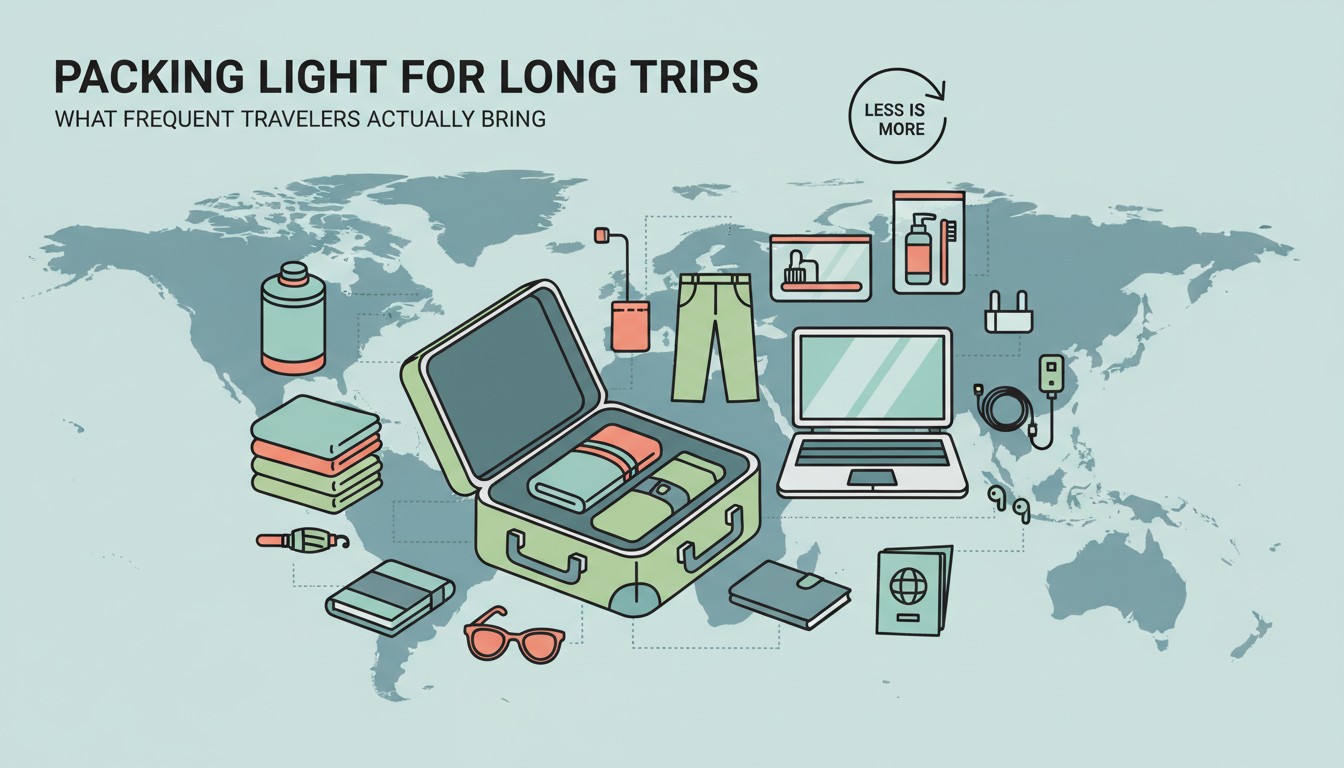
Frequent travelers operate by a different calculus. While occasional tourists pack for every hypothetical scenario, road warriors pack for the certainty of mobility. The difference shows up in muscle memory—one group arrives at the gate breathless, the other arrives with time to spare. Research from seasoned travelers’ forums reveals that the most journeyed among us carry fewer than 20 items of clothing even for trips spanning multiple seasons and months.
The Psychology of the Capsule: Why Less Is Actually More
What drives most people to overpack isn’t necessity but anxiety. We pack for the person we fear we’ll become—the one who needs formal wear at a beach resort, or hiking boots in a city. This “multiple personality packing” creates a psychological burden that begins before you even leave home. Every item you bring is a decision you must make: wear it, store it, or carry it.
The 10-Item Wardrobe: A Professional’s Framework
Professional gear reviewer Jessie from Where’s Jessie B swears by a capsule wardrobe of just 10-12 core items, not including underwear. This isn’t monk-like asceticism; it’s strategic curation. The magic lies in fabric choice: merino wool pieces that resist odor for a week, ADAY’s pill-resistant blends that look fresh after years of wear, and quick-dry synthetics that hand-wash in a hotel sink and dry by morning.
The formula is simple: each top pairs with each bottom. A single pair of Outlier Slim Dungarees—hailed by gear nerds as the only pants you’ll ever need—works with three merino wool t-shirts, one button-down for “fancy” occasions, and a packable jacket. That’s it. That’s seven days or seven months of clothing.
The Capsule Wardrobe Breakdown
3 Tops: Merino wool t-shirts (odor-resistant, quick-dry)
1 Bottom: Versatile travel pants (water-resistant, wrinkle-proof)
1 Layer: Packable down jacket (10 oz, compresses to nothing)
2 Shoes: One pair worn, one packed (versatile sneakers + sandals/flats)
Accessories: Baseball cap, sunglasses, merino wool socks (2 pairs)
The Tech Arsenal: What Never Gets Left Behind
Frequent travelers don’t debate whether to bring tech—they debate which tech eliminates the need for other items. The goal is digital multitasking: one device that does the work of three, one adapter that charges everything.
The Universal Charging Matrix
According to frequent fliers, the single most important tech item is a compact wall adapter with multiple USB-C ports. The Anker 523, weighing mere ounces, can charge a MacBook Pro and two devices simultaneously. Pair it with a 6-inch USB-C cable and you’ve eliminated the rat’s nest of cords that plagues most suitcases.
The AirFly Pro Bluetooth transmitter earns its place by liberating you from wired headphones on planes that still haven’t entered the 21st century. As gear reviewers note, this tiny device means your $300 noise-canceling headphones work with any in-flight entertainment system.
The Single-Purpose Purge
Here’s where minimalists get ruthless. That Kindle? Your phone has a Kindle app. The dedicated camera? Your phone’s camera is probably better. The travel alarm clock? Your phone. The exception: if you’re a professional photographer, the Peak Design Capture clip that secures your DSLR to your backpack strap is non-negotiable—it’s the difference between missing a shot and capturing it.
“I don’t bring anything that only does one job,” says a road warrior with 200 nights a year in hotels. “If it can’t multitask, it can’t come.”
The Toiletries Revolution: Small Bags, Big Impact
The most significant evolution in travel packing isn’t clothing or tech—it’s the realization that toiletries are not precious. You can buy toothpaste anywhere. This mental shift frees up liters of space and pounds of weight.
The Two-Bag System
Savvy travelers separate toiletries into two categories: dry and wet. Dry items—comb, nail clippers, tweezers, safety pins, bamboo toothbrush—go in a hanging toiletry bag. Wet items—liquids, gels, creams—live in a transparent, TSA-ready pouch that can be removed in seconds at security.
The minimalist’s secret weapon is Dr. Bronner’s biodegradable soap. As The Packable Life demonstrates, this single liquid soap functions as body wash, shampoo, laundry detergent, and dish soap. One bottle eliminates four products.
The Travel-Sized Truth
You don’t need a month’s worth of face cream for a month-long trip. Decant everything into containers under 100ml, and bring only enough for two weeks. You’ll replenish on the road—turning a chore into a cultural experience (foreign pharmacies are fascinating). The Cadence capsules, while pricey at $84 for six, have become cult favorites for their magnetic stacking and leak-proof design.
The Unexpected Multipliers: Small Items That Earn Their Keep
Frequent travelers develop an intuition for items that solve multiple problems. These aren’t obvious choices—they’re hard-won lessons from midnight arrivals and missed connections.
The Secret Weapons
A canvas tote bag folds flat but becomes a laundry hamper, grocery carrier, or beach bag. Compression socks—recommended by flight veterans—improve circulation on long flights and double as emergency layers in cold weather. A silk eye mask isn’t just for sleep; it’s a signal to chatty seatmates that you’re unavailable.
Safety pins, mentioned in nearly every frequent traveler forum, have infinite uses: securing a torn hem, replacing a zipper pull, clipping curtains shut in a too-bright hotel room. They’re the definition of small but mighty.
The Digital Nomad’s Reality Check
If you’re working on the road, the laptop is sacred—but everything else is negotiable. A portable laptop stand that weighs ounces prevents neck strain. A compact Bluetooth speaker (JBL Go 3 at 3.5 ounces) transforms hotel rooms into home offices. But the real essential? A VPN subscription that weighs nothing but protects everything.
The Long-Trip Paradox: Why More Time Means Less Stuff
Here’s the counterintuitive truth that breaks most people’s brains: a six-month trip requires the same packing list as a one-week trip. The difference isn’t quantity—it’s strategy. Long-term travelers wash clothes. They buy replacements. They adapt to local climates and customs.
The Rhythm of Replenishment
Professional travelers plan to shop. They’ll buy sunscreen in Thailand, socks in Iceland, a hat in Peru. Each purchase becomes a souvenir with utility. This approach, documented by solo long-haul experts, transforms necessity into cultural immersion.
The 40-liter duffel is the sweet spot—whether it’s Patagonia’s Black Hole, Eagle Creek’s Cargo Hauler, or The North Face’s Base Camp. Any larger and you’ll fill it. Any smaller and you’ll struggle. These bags force discipline while remaining carry-on compliant for 90% of airlines.
The 24-Hour Audit: Before You Zip That Bag
Lay everything out. For each item, ask:
- Have I used this in the last month?
- Can I buy this at my destination for less than $20?
- Does this item serve at least two purposes?
- Am I packing this for a fear-based “what if” scenario?
If you answer “no” to the first three and “yes” to the last, leave it home.
Real-World Packing Lists: From Business to Backpacking
The business traveler living from a carry-on for three weeks packs differently than the hostel hopper, but the principles align. Both prioritize versatility and reject redundancy.
The Corporate Nomad
For the consultant who lives in airports, the uniform is sacred: two merino wool suits (navy and charcoal) that can be mixed with different shirts. Five dress shirts, all wrinkle-resistant. Two pairs of shoes—one worn, one packed. The entire wardrobe fits in a 40-liter roller that never leaves their side.
Tech is minimal: laptop, phone, universal adapter, noise-canceling earbuds. Toiletries are decanted into Cadence capsules. Everything else is disposable or replaceable. This traveler has checked a bag exactly once in five years—when a client required safety equipment.
The Adventure Minimalist
The hiker tackling the Kumano Kodo trail carries what Jill on Journey documented: a 40-liter duffel with one pair of pants, three shirts, two pairs of socks, and a down jacket. Add a titanium mug, spork, and water purifier. Total weight: under 15 pounds.
This traveler washes clothes in streams, sleeps in huts, and buys food locally. They carry no toiletries beyond Dr. Bronner’s soap and a toothbrush. Their luxury item? A smartphone with offline maps and a Kindle app.
The Weight of Freedom
Every item you leave behind is a possibility you create. The space in your bag becomes space in your itinerary. That unburdened shoulder translates to an unburdened mind. Traveling light isn’t a contest in suffering—it’s a strategy for spontaneity.
The frequent travelers who navigate the world with a single bag aren’t minimalists by deprivation. They’re maximalists by experience. They’ve discovered that the less time you spend managing your stuff, the more time you have for the reasons you travel in the first place.
Start where you are. Pack for your next trip, then remove five items. Then remove three more. Feel the lightness. Embrace the flexibility. The world opens up when you’re not weighed down by the fear of being without. Trust yourself to find what you need, when you need it—on the road, in a new city, in the space between destinations. That’s where the real journey happens.
Leave a Reply